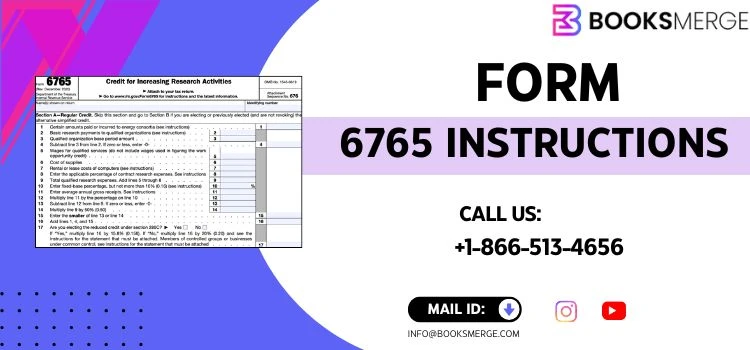

Form 6765 Instructions explain how to calculate and claim the federal Research and Experimentation (R&D) tax credit, outline reporting requirements, and show election options for payroll or reduced credits.
Table of contents
- What is Form 6765? Quick overview
- Why the Form 6765 instructions matter in 2025
- Who must file and who benefits
- Step-by-step Form 6765 instructions (practical walkthrough)
- Top documentation and recordkeeping tips
- Common mistakes to avoid
- How BooksMerge helps you claim R&D credits
- Conclusion and next steps
- FAQ
What is Form 6765? Quick overview
Form 6765, Credit for Increasing Research Activities, lets eligible businesses calculate and claim the federal research and experimentation (R&D) tax credit. The Form 6765 Instructions also allows taxpayers to elect a reduced credit under section 280C and, for qualifying startups and small businesses, to claim a portion of the credit as a payroll tax credit against the employer share of Social Security. These instructions explain who qualifies, how to compute qualified research expenses, and where to report the credit.
Why the Form 6765 instructions matter?
The IRS updated Form 6765 and released revised instructions in 2025. Those changes expand reporting fields and clarify how groups of entities should report qualified research expenses. Section G reporting was set to be phased in, and for tax year 2025 Section G is optional while the IRS continues to gather stakeholder feedback. These updates mean you may need more granular project-level documentation than before.
Short version: the IRS expects clearer information, and preparers should plan to produce it.
Who must file and who benefits
- Partnerships and S corporations: must file Form 6765 to claim the credit on behalf of owners.
- C corporations and sole proprietors: generally claim the credit too, often via Form 6765 or Form 3800 depending on circumstances.
- Startups and qualified small businesses: can elect to apply up to a capped amount of the credit against employer Social Security tax (payroll election).
Benefits: Lower federal tax liability, improved cash flow, and more capital to reinvest in innovation.
Step-by-step Form 6765 instructions
I’ll keep the paragraphs short and the logic tight — like a good lab experiment, but without the goggles.
1. Determine qualified research activities (QRA)
Qualified research generally involves a process of experimentation aimed at technological improvement in the hard sciences or computer science. Cosmetic or routine quality improvements usually do not qualify. Keep tech notes, prototypes, and trial records.
2. Identify qualified research expenses (QREs)
Typical QREs include:
- Wages for employees performing or supporting QRA
- Supplies used in QRA
- A portion of payments to outside contractors who perform qualified research for you
3. Choose a credit computation method
Form 6765 asks you to choose the applicable calculation (regular or alternative) and whether you elect the reduced credit under section 280C. Your tax advisor should test both methods to see which yields the best result.
4. Decide payroll election (if eligible)
Qualified small businesses can elect to apply up to a statutory cap of the credit against the employer portion of Social Security tax, which can be helpful for early-stage companies with little taxable income. The Form 6765 instructions detail eligibility and how to make this election.
5. Complete the form and attach supporting schedules
The modernized Form 6765 asks for more descriptive information and summaries of QREs. Expect to break out activities by business component and to attach clear summaries for auditors. Professional firms analyzed these changes as a material expansion of reporting obligations.
6. Keep an audit-ready trail
Save time later: preserve time-stamped project notes, payroll allocations, supplier invoices, and tech memos. The IRS expects that claims rest on contemporaneous documentation.
Quick Tip: Complete list of IRS forms to help businesses and individuals file taxes accurately and stay compliant with federal requirements.
Top documentation and recordkeeping tips
- Tie technical narratives to numbers: For every project, write a 1–2 paragraph technical summary and link it to the QREs.
- Use timesheets: Track employee time by project; that converts to wages on the form.
- Keep supplier invoices and contracts: Mark which line items are research-related.
- Store backups of prototypes and versions: Even a dated commit message can help.
- Consider a centralized workbook: A single spreadsheet that maps projects to expenses simplifies Form 6765 preparation.
Short, consistent records beat heroic reconstructions during audits.
Common mistakes to avoid
- Overclaiming internal-use software without showing significant technical uncertainty.
- Poor allocation of wages across projects.
- Using generic memos instead of technical summaries.
- Ignoring the updated 2025 instructions and failing to provide the expanded detail the IRS now expects.
How BooksMerge helps you claim R&D credits
At BooksMerge, we blend accounting precision with practical tax strategy. We help you:
- Map projects to eligible QREs.
- Prepare Form 6765 with audit-ready narratives and schedules.
- Decide whether to elect the payroll tax option or the reduced credit.
Call us at +1-866-513-4656 for a free initial review. We also publish easy-to-read insights on small business finance, such as how financial literacy can influence tax planning — check our related post for helpful stats and planning ideas: financial literacy statistics.
We keep advice practical, not mystical. Think of us as your accounting compass when the tax code feels like a maze.
Conclusion
Form 6765 instructions for 2025 tighten the reporting expectations and ask for clearer linkage between activities and expenses. Follow a disciplined documentation system, involve technical staff to craft concise project narratives, and test both calculation methods with your preparer. If you qualify as a small business or startup, evaluate the payroll election — it can deliver welcome relief. For tailored, hands-on help, reach out to BooksMerge at +1-866-513-4656.
FAQ
Q: What is the main purpose of Form 6765?
A: To calculate and claim the federal R&D tax credit, choose elections such as the reduced credit under section 280C or the payroll tax election for qualified small businesses.
Q: Are there special 2025 changes I should know?
A: Yes. The IRS updated the form and instructions in 2025 and phased the rollout of new reporting fields. Section G was optional for tax year 2025 while the IRS collects feedback.
Q: Which expenses typically qualify as QREs?
A: Wages for R&D work, supplies consumed in research, and a portion of payments to third-party contractors can qualify. Documentation must support each claim.
Q: Can a startup use the credit if it has no income tax liability?
A: Qualified small businesses can elect to apply up to a capped amount of the credit against the employer portion of Social Security tax, providing benefit even with low taxable income.
Q: How can BooksMerge help me file Form 6765?
A: We prepare the form, structure documentation, evaluate elections, and assemble audit-ready summaries. Call +1-866-513-4656 for a review.
Read Also: 1099-misc vs 1099-nec


























Sign in to leave a comment.