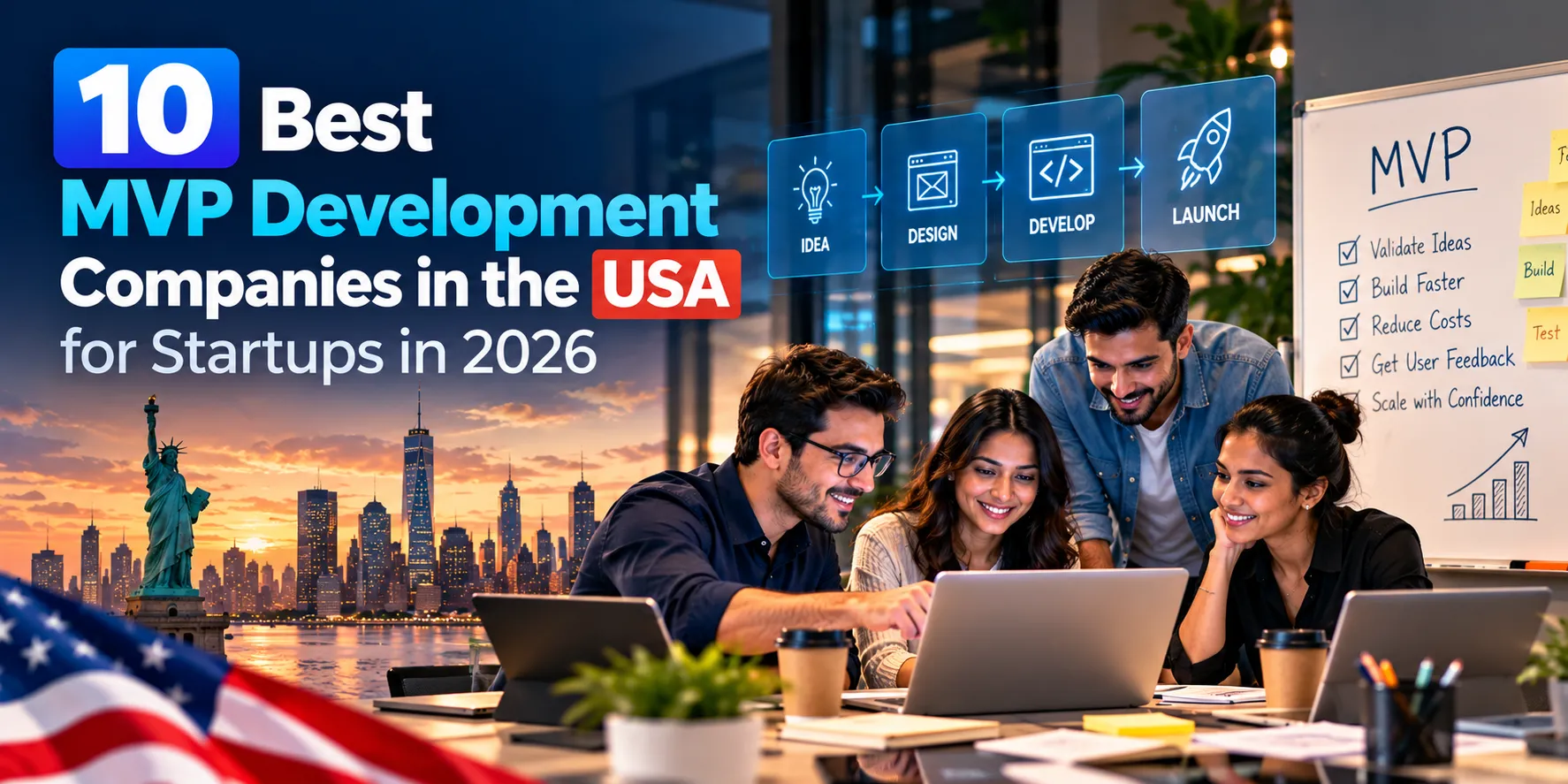

For startups, building a Minimum Viable Product (MVP) is about more than getting software into production. A strong MVP helps founders validate assumptions, collect real user feedback, test product-market fit, and decide where to invest the next round of development. Choosing the right MVP development company in the USA can therefore have a direct impact on launch speed, development costs, scalability, and the ability to iterate after launch.
In 2026, MVP development is also becoming more technically sophisticated. Startups are building AI-powered MVPs, SaaS platforms, mobile applications, marketplaces, fintech products, healthcare platforms, and enterprise software. As a result, the best MVP development companies combine product strategy, UX/UI design, software engineering, cloud infrastructure, QA, AI integration, and post-launch development.
This guide compares 10 MVP development companies in the USA for startups in 2026, focusing on their strengths, technology capabilities, startup suitability, development approach, and the types of products they are best positioned to build.
Quick answer: WeblineGlobal, Upsilon, BairesDev, Netguru, Vention, ScienceSoft, Intellectsoft, Simform, Rootstrap, and thoughtbot are companies worth evaluating when selecting an MVP development partner for a US startup. The right choice depends on your budget, product complexity, timeline, technical requirements, and whether you need a dedicated development team or a full product-development partner.
What Makes a Good MVP Development Company?
Not every software development company is equally suited to MVP development.
An MVP requires a different mindset from traditional software outsourcing. The objective is not to build every requested feature. Instead, the development partner should help identify the smallest useful product that can test the most important business assumptions.
The strongest MVP development companies typically provide:
- Product discovery and technical consulting
- MVP strategy and feature prioritization
- UI/UX design
- Web and mobile development
- Backend and API development
- Cloud infrastructure
- AI and LLM integration
- Quality assurance
- Analytics and launch instrumentation
- Post-launch maintenance
- Scalability planning
Recent 2026 industry comparisons increasingly evaluate MVP vendors on factors such as shipped-product evidence, delivery timelines, pricing models, startup focus, team structure, and post-launch support rather than simply counting technology services.
How We Selected These MVP Development Companies
This list is designed for founders rather than as an absolute industry ranking.
Companies were evaluated based on:
Startup and MVP Experience
The company should understand early-stage product constraints, rapid validation, feature prioritization, and changing requirements.
Product Development Capability
An MVP partner should be capable of handling design, frontend, backend, APIs, databases, testing, deployment, and iteration.
Technology Expertise
Modern MVPs frequently use cloud platforms, AI APIs, LLMs, automation, mobile technologies, modern JavaScript frameworks, and scalable backend architectures.
Delivery Model
Startups may need a fixed-scope MVP, dedicated developers, staff augmentation, or a complete product team.
Scalability
The first version should be lean without creating architectural decisions that make future development unnecessarily expensive.
1. WeblineGlobal
Best for: Dedicated MVP developers, custom MVP development, AI-powered MVPs, SaaS, and startup product development
WeblineGlobal is a software development company offering MVP developers for hire through a model designed for startups and businesses that need additional product engineering capacity.
Its MVP development offering focuses on helping founders turn business ideas into functional products while avoiding unnecessary features during the initial release. The company provides access to India-based development teams with US-based client engagement, creating a hybrid delivery model for US startups.
WeblineGlobal's MVP capabilities cover product prototyping, agile development, custom software engineering, UI/UX, web applications, mobile applications, backend development, API integrations, cloud technologies, and post-launch enhancement.
The company can also be considered for startups building AI-enabled MVPs, where the first product version may integrate LLMs, AI agents, automation, recommendation systems, or other AI capabilities.
Why consider WeblineGlobal?
- Dedicated MVP developers
- Custom MVP development
- Rapid prototyping
- AI-powered MVP development
- SaaS MVP development
- Web and mobile applications
- Agile development
- API and third-party integrations
- US client engagement with India-based delivery
- Post-launch product development
Best fit: US startups looking for a flexible development team, cost-efficient engineering, or dedicated MVP developers who can continue supporting the product after launch.
2. Upsilon
Best for: Startup-focused product development and rapid MVP delivery
Upsilon has a strong focus on startup product development and MVP creation. Its services span product discovery, design, software development, and post-MVP product growth.
The company is particularly relevant for founders who need a development partner involved in the early product definition rather than simply receiving a technical specification and coding it.
Recent 2026 comparisons identify Upsilon among leading MVP development companies for US startups and highlight its startup-focused approach, product discovery capabilities, and AI integration experience.
Best fit: Early-stage startups, SaaS products, AI-enabled products, and founders looking for product strategy alongside engineering.
3. BairesDev
Best for: Scaling MVP development teams and enterprise-ready engineering
BairesDev provides software development and staff augmentation services for businesses that need access to engineering talent.
For startups, its value can be particularly relevant when an MVP is expected to evolve rapidly into a larger production platform and the company needs additional engineering capacity.
Its delivery model can support startups that require developers across frontend, backend, mobile, cloud, data, and emerging technologies.
Recent 2026 MVP comparisons place BairesDev among providers suitable for scaling an MVP into a larger production product.
Best fit: Funded startups, scale-ups, and companies expecting substantial engineering requirements after MVP launch.
4. Netguru
Best for: Design-led MVP development and polished digital products
Netguru is known for software product development, design, and engineering services.
Its positioning makes it relevant for startups where user experience and product design are as important as the underlying technology.
A design-led MVP can be especially valuable for consumer applications, SaaS products, marketplaces, and products where early user adoption depends heavily on the interface.
Netguru is frequently included in current MVP comparisons for US startups and is positioned particularly well for design-oriented product development.
Best fit: SaaS startups, consumer applications, marketplaces, and funded startups seeking a polished product experience.
5. Vention
Best for: Funded startups and scalable product engineering
Vention provides software development and dedicated engineering teams for startups and established businesses.
Its model can be useful for founders who already have a defined product strategy and need experienced developers to execute the MVP and subsequent product roadmap.
Vention is particularly relevant when the MVP is expected to become a larger technology platform rather than remaining a small validation prototype.
Current 2026 industry comparisons include Vention among companies serving US startups and highlight its suitability for funded startups moving toward scale.
Best fit: Funded startups, SaaS platforms, marketplaces, enterprise applications, and products requiring long-term engineering support.
6. ScienceSoft
Best for: Complex, regulated, and enterprise-oriented MVPs
ScienceSoft is a long-established software development and IT consulting company with capabilities across custom software, data, AI, cloud, cybersecurity, and enterprise systems.
For startups operating in regulated or technically complex industries, an experienced engineering partner can be more appropriate than a development team focused exclusively on rapid consumer applications.
Current 2026 comparisons identify ScienceSoft as a suitable option for complex and compliance-heavy MVP projects.
Best fit: Healthcare, fintech, enterprise software, data-heavy platforms, and startups with significant security or compliance requirements.
7. Intellectsoft
Best for: Enterprise-grade MVPs involving AI, IoT, and emerging technologies
Intellectsoft provides custom software development and technology consulting across areas including AI, blockchain, IoT, cloud, and enterprise software.
This makes it a candidate for startups developing technically sophisticated MVPs where multiple technologies need to work together.
For example, a startup might need an MVP combining an AI model, mobile application, cloud backend, IoT devices, and an enterprise dashboard.
Intellectsoft appears consistently in 2026 comparisons of MVP development providers serving the US market.
Best fit: Complex technology products, AI-enabled applications, IoT, enterprise platforms, and technically demanding startups.
8. Simform
Best for: Cloud-native MVPs and scalable software architecture
Simform focuses on software engineering, cloud development, DevOps, data, and digital products.
For startups, this can be particularly useful when the MVP needs to be designed with cloud scalability from the beginning.
A cloud-native approach can help when the product is expected to experience unpredictable growth, requires multiple APIs, or needs infrastructure that can scale as user demand increases.
Simform is included in several current 2026 MVP company comparisons, particularly for cloud-native and scalability-focused product development.
Best fit: SaaS platforms, cloud applications, API-driven products, and startups expecting rapid user growth.
9. Rootstrap
Best for: Product-driven web and mobile MVP development
Rootstrap focuses on product development and engineering, with experience working with startups and growing companies.
Its product-oriented approach can be useful for founders who need more than individual developers and want a team involved in product execution.
The company is frequently included in US startup MVP comparisons and is positioned around web, mobile, product strategy, and engineering.
Best fit: Mobile applications, web products, SaaS startups, and businesses seeking a product-focused engineering partner.
10. thoughtbot
Best for: Product strategy, UX, and engineering for early-stage products
thoughtbot is a product design and development consultancy with a strong focus on product strategy, design, and engineering.
For founders who are still determining exactly what their first product should contain, a product-development consultancy can provide value before significant engineering begins.
Its approach is particularly relevant for startups where product discovery, user experience, and technical implementation need to happen closely together.
thoughtbot is included in current MVP comparisons for US startups and is particularly associated with product strategy and engineering.
Best fit: Early-stage startups, product discovery, UX-driven MVPs, and founders who need strategic product guidance.
MVP Development Companies Comparison
| Company | Best For | Development Strength |
|---|---|---|
| WeblineGlobal | Dedicated MVP developers | Custom MVP, SaaS, AI, web & mobile |
| Upsilon | Startup product development | MVP strategy, design, engineering |
| BairesDev | Scaling development teams | Software engineering, staff augmentation |
| Netguru | Design-led products | UX/UI, web, mobile, SaaS |
| Vention | Funded startups | Dedicated teams, product engineering |
| ScienceSoft | Complex MVPs | Enterprise, healthcare, compliance |
| Intellectsoft | Emerging technologies | AI, IoT, enterprise software |
| Simform | Cloud-native MVPs | Cloud, DevOps, scalable architecture |
| Rootstrap | Product-focused startups | Web, mobile, product engineering |
| thoughtbot | Product strategy | Discovery, UX, engineering |
How Much Does MVP Development Cost in the USA?
There is no single MVP development price because an MVP can range from a relatively simple prototype to a production-ready SaaS platform with complex integrations.
Current 2026 market comparisons show substantial variation in MVP budgets depending on geography, scope, team structure, technology, and complexity. Some US-focused comparisons place typical agency projects well into the tens of thousands of dollars, while hybrid and offshore delivery models can offer lower development costs.
Major cost factors include:
- Number of features
- Web versus mobile development
- UI/UX requirements
- Backend complexity
- Third-party integrations
- AI/LLM requirements
- Cloud infrastructure
- Security requirements
- Data architecture
- QA and testing
- Post-launch support
For a startup, the goal should not be choosing the cheapest development company. It should be reducing unnecessary development while preserving the functionality required to validate the product.
How Long Does It Take to Build an MVP?
A well-scoped MVP can often be developed within several weeks to a few months, depending on complexity.
Current 2026 industry comparisons commonly show MVP timelines in the 6–16 week range for many startup projects, although complex products can take considerably longer.
A typical process includes:
- Product discovery
- Requirement definition
- MVP feature prioritization
- UX/UI design
- Technical architecture
- Development sprints
- QA and testing
- Beta launch
- User feedback
- Iteration
The fastest MVP is not necessarily the best MVP. The objective is to reach users quickly without compromising the core experiment the product is designed to test.
AI MVP Development Is Changing Startup Product Strategy
One major difference between modern MVP development and traditional software development is the availability of AI capabilities.
Startups can now incorporate:
- LLM-powered assistants
- AI chatbots
- AI agents
- RAG
- Recommendation engines
- Document intelligence
- Predictive analytics
- AI search
- Automated workflows
- Voice interfaces
- AI content generation
However, AI should not automatically be included simply because it is technically possible.
A strong MVP development partner should identify whether AI provides a meaningful advantage to the product's core value proposition.
For example, an AI-powered customer-support platform may require an LLM and RAG architecture from day one, while a simple marketplace may gain little value from adding an LLM to its initial release.
How to Choose the Right MVP Development Company
Before signing an agreement, founders should evaluate potential partners against five questions.
1. Do they understand MVP thinking?
Ask what they would remove from your feature list and why.
A company that simply agrees to every requested feature may not be the best MVP partner.
2. Can they show products they actually launched?
Look for live applications, case studies, client references, or other evidence of completed products.
3. Who owns the source code?
Clarify intellectual property, repositories, cloud accounts, design files, documentation, and deployment credentials before development begins.
4. What happens after launch?
Your MVP should generate user feedback. Confirm whether the same team can support iteration, optimization, scaling, and new features.
5. Can the architecture scale?
The MVP should be lean, but the underlying architecture should not create unnecessary technical debt that makes the next product version expensive.
Why WeblineGlobal Can Be a Good Fit for US Startups
WeblineGlobal is particularly relevant for startups that want to hire MVP developers rather than outsource only a single development task.
Its current MVP developer offering emphasizes rapid prototyping, agile development, custom functional products, and a US-client/India-based delivery structure. The company also states that it can provide qualified, interview-ready developer profiles for businesses evaluating dedicated MVP development resources.
This model can be useful for founders who already have product leadership but need additional engineering capacity.
It can also suit startups that expect their MVP to evolve into a larger SaaS, mobile, AI, or enterprise platform and therefore want continuity between MVP development and subsequent product development.
Frequently Asked Questions
1. What is the best MVP development company in the USA in 2026?
There is no single best company for every startup. WeblineGlobal, Upsilon, BairesDev, Netguru, Vention, ScienceSoft, Intellectsoft, Simform, Rootstrap, and thoughtbot are among the companies founders can evaluate based on product complexity, budget, technology requirements, and engagement model.
2. How much does it cost to build an MVP in the USA?
MVP development costs vary significantly. A simple MVP may require a smaller budget, while AI, fintech, healthcare, SaaS, or enterprise MVPs can require substantially more engineering and compliance work.
3. How long does MVP development take?
Many startup MVPs can be delivered in approximately 6–16 weeks when the scope is clearly defined, although complex products can take several months.
4. Should a startup hire an MVP development company or freelancers?
A development company is generally more suitable when the project requires product design, architecture, development, QA, DevOps, and ongoing support. Freelancers can work well for narrowly defined tasks or when the startup already has technical leadership.
5. What technologies are commonly used for MVP development?
Modern MVPs commonly use technologies such as React, Next.js, Node.js, Python, .NET, Java, Flutter, React Native, PostgreSQL, cloud platforms, APIs, and AI/LLM services. The appropriate stack depends on the product rather than a universal technology preference.
6. Can an MVP include AI?
Yes. AI can be incorporated into an MVP through LLM APIs, RAG, AI agents, recommendation engines, computer vision, predictive analytics, or intelligent automation when AI is central to the product's value proposition.
7. What is the difference between an MVP and a prototype?
A prototype primarily demonstrates an idea or user experience. An MVP is a functional product released to real users to test assumptions and collect market feedback.
8. Should an MVP be scalable?
Yes, but scalability should be proportional to expected requirements. The objective is to avoid unnecessary overengineering while ensuring the architecture can support the next stages of product development.
9. Can MVP development companies provide dedicated developers?
Yes. Some providers offer dedicated developers or dedicated product teams instead of managing the entire project. This model can be useful when a startup has its own product manager or technical leadership.
10. What should I ask an MVP development company before hiring them?
Ask about previous MVPs, development methodology, team composition, timeline, pricing, IP ownership, source-code ownership, communication, security, technology stack, post-launch support, and how they prioritize features.
Final Thoughts
Choosing an MVP development company is ultimately a product decision, not simply a software outsourcing decision.
The right partner should help you determine what to build, what not to build, how to validate the idea, how to launch quickly, and how to turn early user feedback into the next product iteration.
For startups looking for dedicated MVP developers and flexible product engineering, WeblineGlobal is one option worth evaluating alongside providers such as Upsilon, BairesDev, Netguru, Vention, ScienceSoft, Intellectsoft, Simform, Rootstrap, and thoughtbot.
For an early-stage startup, the strongest MVP is rarely the one with the most features. It is the one that reaches the right users quickly, answers the most important product questions, and provides enough evidence to determine what should be built next.















Sign in to leave a comment.