10 Effective Ways to Encourage Positive Behavior in Children at Home

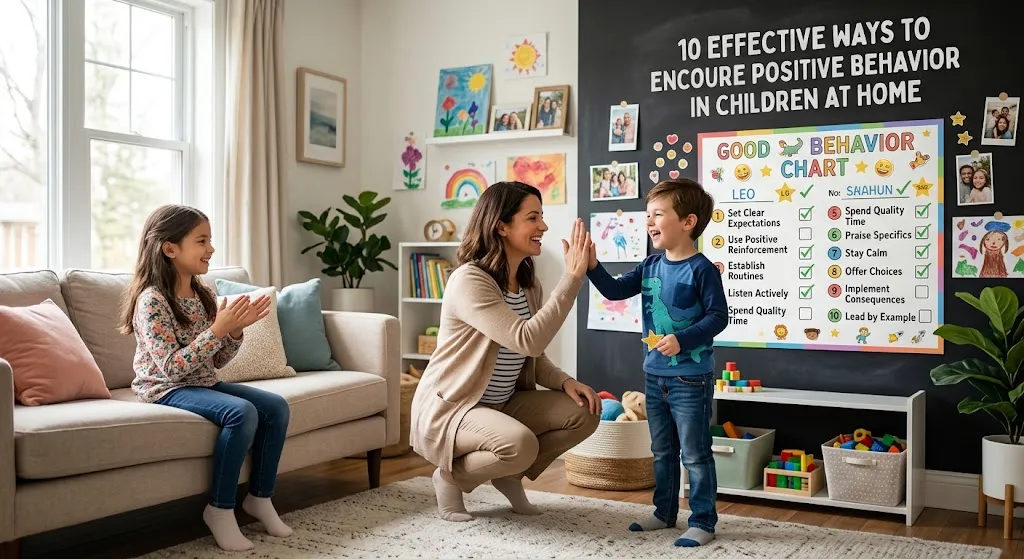
Creating a peaceful home does not mean expecting children to behave perfectly. Children test boundaries, become frustrated, forget instructions, and sometimes react in ways that challenge even the most patient parent. The goal is not to eliminate every difficult moment, but to create an environment where positive behavior in children is understood, practiced, and encouraged.
Parents often focus heavily on correcting unwanted behavior. However, children also need to know what they should do. When parents notice helpful choices, model respectful communication, establish predictable routines, and give children opportunities to practice important skills, good behavior becomes easier to repeat.
The following ten strategies can help parents encourage cooperation, responsibility, kindness, and emotional self-control at home without relying on constant criticism or punishment.
What Is Positive Behavior in Children?
Positive behavior includes actions that help children interact successfully with family members, friends, teachers, and their wider community. Depending on a child's age and developmental stage, this might include sharing, listening, communicating feelings, following reasonable instructions, helping with household tasks, showing empathy, and managing frustration appropriately.
Positive behavior does not mean a child is always quiet, obedient, or agreeable. A child can disagree with a parent respectfully. They can feel angry without hitting. They can be disappointed without being expected to hide their emotions.
The objective is to help children develop practical skills for handling everyday situations. These skills develop gradually through guidance, modeling, practice, and consistent expectations.
Why Encouraging Positive Behavior Matters
Children learn from what happens around them. They observe how adults communicate, how problems are solved, and how people respond when they are frustrated.
A home environment that focuses only on mistakes can make children feel that attention comes primarily when something goes wrong. On the other hand, noticing appropriate behavior helps children understand which actions are useful and worth repeating.
Parents can encourage positive behavior by:
- Recognizing specific helpful actions.
- Setting clear and realistic expectations.
- Providing age-appropriate choices.
- Establishing predictable routines.
- Teaching children how to express difficult emotions.
- Modeling the behavior they expect.
- Allowing children to practice responsibility.
The most effective strategies are usually simple enough to become part of everyday family life.
10 Ways to Encourage Positive Behavior in Children
1. Notice Good Behavior Specifically
One of the easiest ways to encourage positive behavior is to notice it when it happens.
Instead of relying on general praise such as "Good job," describe exactly what the child did:
"You put your toys away without being reminded."
"You waited while your brother finished talking."
"You were frustrated, but you used your words to explain what happened."
Specific feedback gives children useful information. They learn which behavior was appropriate and why it mattered.
This does not mean praising every small action. The goal is to make meaningful positive behavior visible.
2. Establish Clear Expectations
Children cannot always meet expectations they do not understand.
Rather than saying, "Behave yourself," give children a clear description of what is expected. Before visiting a restaurant, for example, a parent might say, "We are going to sit at the table, use quiet voices, and tell me if you need something."
Clear expectations are especially helpful before situations that are likely to be challenging, such as leaving a playground, attending a family gathering, or transitioning from screen time to bedtime.
3. Create Predictable Daily Routines
Children often cooperate more easily when they know what comes next.
A predictable morning routine might include getting dressed, eating breakfast, brushing teeth, packing a backpack, and leaving for school. A bedtime routine might include pajamas, brushing teeth, reading, and settling down.
A routine does not have to be rigid. Its purpose is to reduce unnecessary uncertainty and give children repeated opportunities to practice independence.
Visual checklists can also help younger children remember steps without requiring parents to repeat the same instructions throughout the day.
4. Give Age-Appropriate Choices
Children naturally want some control over their environment. Giving them reasonable choices can support independence while allowing parents to maintain boundaries.
For example:
- "Do you want the blue shirt or the green shirt?"
- "Would you like to brush your teeth before or after putting on pajamas?"
- "Do you want to put the books away first or the blocks?"
The choices should both be acceptable to the parent. Offering unlimited choices can create another source of conflict, while two reasonable options can make cooperation easier.
5. Teach Children to Name Their Emotions
A child who can identify an emotion has another tool for communicating what is happening internally.
Parents can introduce simple words such as angry, worried, disappointed, excited, nervous, frustrated, or proud.
During a difficult moment, a parent might say, "It looks like you're frustrated because the game ended."
This does not excuse inappropriate behavior. A child can be frustrated and still be expected to use gentle hands or respectful language.
Over time, children can learn that emotions are acceptable while certain actions are not.
6. Give Children Meaningful Responsibilities
Responsibility grows through practice. Children can participate in household activities long before they are capable of managing complicated tasks independently.
Age-appropriate responsibilities might include:
- Putting toys away.
- Placing dirty clothes in a hamper.
- Helping set the table.
- Organizing books.
- Feeding a pet with supervision.
- Helping prepare simple foods.
- Putting school supplies in a designated place.
The standard should match the child's abilities. If parents expect an eight-year-old to complete a task exactly like an adult, frustration may follow on both sides.
The purpose of household responsibilities is to help children experience contribution and accountability—not to create a perfectly organized home.
7. Model the Behavior You Want to See
Children watch adults closely, especially during stressful situations.
If parents expect children to speak respectfully, listen when others are talking, apologize after mistakes, and manage frustration without aggression, adults should demonstrate those behaviors whenever possible.
That does not mean parents will never lose patience. Everyone has difficult moments. When an adult makes a mistake, acknowledging it can itself become a valuable lesson:
"I was frustrated and raised my voice. I should have spoken more calmly. I'm sorry."
An apology does not weaken parental authority. It demonstrates accountability.
8. Use Stories to Discuss Choices and Consequences
Books provide a natural way to discuss behavior without turning every conversation into a correction directed at the child.
When reading together, parents can ask questions about a character's choices:
"What do you think she was feeling?"
"Why did he make that choice?"
"What could the character have done differently?"
"How do you think the other person felt?"
Stories are especially useful because children can explore complicated situations through fictional characters. A discussion about a character's behavior may eventually help a child recognize similar choices in their own life.
For families interested in children's stories that provide opportunities to discuss positive behavior in children, books can become a practical part of a broader routine involving empathy, responsibility, communication, and thoughtful decision-making.
9. Let Children Experience Reasonable Consequences
Children learn from consequences, but consequences do not need to be harsh to be meaningful.
When appropriate and safe, allow a child's choices to have logical outcomes.
If a child leaves a favorite toy outside and it gets wet, the experience may reinforce the importance of putting belongings away. If a child refuses to clean up a game, the next activity can wait until the cleanup is completed.
Parents should avoid consequences that are excessive, humiliating, or unrelated to the behavior. The goal is to help children understand cause and effect.
A useful question is: "What would help this child learn from what happened?"
10. Make Time for Connection
Positive behavior is easier to encourage when children regularly experience attention that is not dependent on whether they are behaving well.
A few minutes of focused attention can be valuable. Read together, talk during a walk, cook a simple meal, play a game, or ask a child about something they found interesting that day.
For families in Miami and throughout South Florida, outdoor opportunities can provide especially useful settings for connection. A walk through a neighborhood, visit to a local park, or family outing near the water can combine conversation, movement, and opportunities to practice patience and consideration for shared spaces.
Connection does not mean giving children everything they want. It means creating a relationship in which guidance and boundaries occur alongside attention, affection, and genuine interest.
Common Mistakes to Avoid
Encouraging positive behavior can become less effective when parents unintentionally make a few common mistakes.
Praising Too Generally
"You're such a good child" may sound positive, but it does not explain what behavior was helpful. Specific observations are more useful.
Expecting Immediate Results
Behavioral skills develop through repetition. A child may understand a rule and still need frequent reminders while learning to apply it consistently.
Changing Expectations Constantly
Children benefit from knowing which rules are important. Parents do not have to enforce every minor issue with equal intensity, but important boundaries should be reasonably consistent.
Using Attention Only for Misbehavior
If children receive extensive attention whenever they misbehave but little recognition when they cooperate, the family dynamic can unintentionally reinforce conflict.
Comparing Children
Statements such as "Why can't you behave like your sister?" can create resentment without teaching the desired skill. Focus on the child's own behavior and progress instead.
How to Make These Strategies Work in Real Life
Parents do not need to introduce all ten strategies at once. Trying to change everything simultaneously can make family routines more complicated.
Start with two or three practical goals.
For example:
- Choose one behavior to encourage, such as using respectful words.
- Explain the expectation clearly.
- Model it during everyday conversations.
- Notice when the child uses the behavior.
- Respond consistently when the expectation is not met.
- Review progress after several weeks rather than judging the strategy after one difficult day.
It can also help to consider the circumstances surrounding behavior. A child who becomes irritable when hungry or exhausted may need a routine adjustment rather than another lecture about manners.
Likewise, a child who struggles whenever an activity ends may benefit from advance warnings: "Five more minutes, then we are cleaning up."
Small environmental changes can sometimes prevent repeated conflicts before they begin.
Frequently Asked Questions
How can I encourage good behavior without constantly rewarding my child?
Positive reinforcement does not have to involve prizes or treats. Specific verbal recognition, attention, encouragement, and opportunities for independence can all reinforce useful behavior. The goal is to help children notice the connection between their choices and positive outcomes rather than making them dependent on receiving a reward every time they cooperate.
What is the best way to respond when a child ignores instructions?
First, make sure you have the child's attention and give one clear instruction. Avoid giving several directions at once. If appropriate, offer a limited choice and calmly follow through with the expected consequence. Consider whether the instruction is realistic for the child's age and whether the child understands what you are asking.
How can parents encourage positive behavior in younger children?
Keep expectations simple and concrete. Young children benefit from predictable routines, short instructions, modeling, repetition, and immediate feedback. For example, instead of saying "Be responsible," teach a specific action such as putting toys into a basket after playtime. Consistency helps the child gradually turn the action into a familiar routine.
Should parents praise every positive behavior?
Not necessarily. Constant praise can become distracting or lose its meaning. Instead, notice behaviors that demonstrate effort, progress, cooperation, kindness, self-control, or responsibility. Specific comments such as "You waited for your turn even though you were excited" provide more useful information than repeating "Good job" throughout the day.
How can books help children develop better behavior?
Stories give children opportunities to think about emotions, relationships, decisions, and consequences through characters and situations. Parents can ask questions while reading and connect the story to everyday experiences. This makes books more than entertainment; they become conversation starters for developing empathy, communication, and problem-solving skills.
Conclusion
Encouraging positive behavior in children is less about controlling every action and more about teaching skills that children can eventually use independently. Clear expectations, predictable routines, meaningful responsibilities, emotional vocabulary, specific encouragement, and good adult modeling all contribute to that process.
Parents should also expect mistakes. Children are still learning how to handle frustration, communicate needs, cooperate with others, and make thoughtful decisions. Progress may be gradual, and a strategy that works one week may need adjustment as a child develops.
The practical next step is to choose one behavior you would like to strengthen at home. Define what that behavior looks like, model it, create opportunities to practice it, and notice when your child gets it right. With repetition and patience, everyday family life can become one of the most effective places for children to learn positive behavior.



Sign in to leave a comment.