

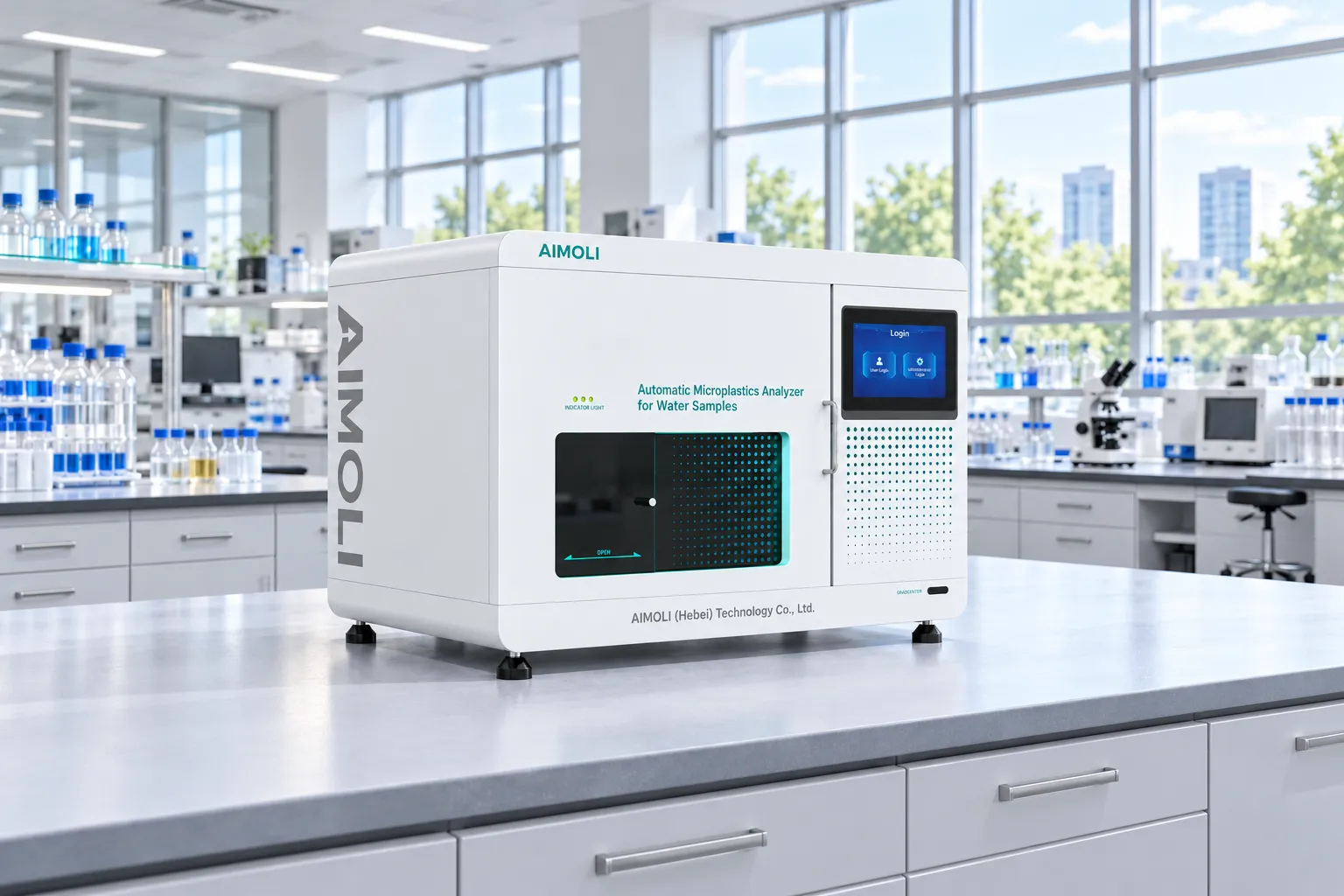
For a university team studying microplastics, the bottleneck can be the queue of samples waiting for analysis. Last week, we delivered another AML518 microplastic analyzer to a university in Jiangsu. The system links Raman microscopy with a robotic arm. It holds up to 100 samples and is designed for unattended operation, giving researchers more time for other work.
An afternoon in the university laboratory
The research team studies microplastics in lake and river sediments. Samples arrive in large batches, so the team needed a microplastic analyzer that could reduce repeated manual handling. We have also worked with university groups in Jiangsu, Zhejiang and Guangdong.
On delivery day, the laboratory set aside an afternoon for installation and training. Our engineer showed the students how to load the tray, use the spectral library and set the report template. By the end of the session, the students could operate the microplastic analyzer themselves. The waiting samples were ready to go on the tray.
Choose the analysis method before the automation
Before choosing a microplastic analyzer, it helps to separate three methods. They answer somewhat different questions, and each has limits.
Infrared spectroscopy identifies plastics from their infrared spectra. The original article describes a workflow that required dry sample preparation and had difficulty with particles below 10 μm. Practical limits depend on the instrument and method, so this experience should not be applied to every infrared microplastic analyzer.
Pyrolysis gas chromatography mass spectrometry breaks down material and measures the resulting compounds. It can provide polymer mass information. It does not directly image or size individual nanoparticles. Cost and sample preparation also need to be considered when comparing it with a spectroscopic microplastic analyzer.
Raman spectroscopy identifies particles from their Raman spectra. Some workflows allow wet measurement, but preparation, fluorescence and the sample matrix still matter. For our microplastic analyzer, the question was how to automate loading and measurement without taking away the option of manual review.
At another university in eastern China, we once saw students spend an afternoon processing only two samples on an imported infrared system. Repeat handling also produced different results. That was one laboratory's workflow, rather than a performance claim about all imported equipment.
Where the manual workload builds up
Buying a microplastic analyzer is only part of the job. Samples still need preparing, someone needs to load them, and an experienced user may need to check the results. If one step falls behind, the queue grows.
Teachers we have spoken with often describe cupboards full of samples waiting to be tested. Their concern is how much staff time the work takes. An automated microplastic analyzer can help with handling and measurement, while researchers remain responsible for preparation and interpretation.
What we automated in the AML518
The AML518 microplastic analyzer combines Raman microscopy with a robotic arm. It has 100 sample positions and automates handling, focusing, spectrum collection and slide changes. It is designed for operation over 24 hours. A full tray does not mean all 100 samples will finish overnight; run time depends on the scan plan and sample.
The microplastic analyzer has 785 nm and 1064 nm lasers. The longer wavelength can help reduce fluorescence in suitable samples. The stated particle identification range is 50–5,000 μm, and the built-in library covers 21 polymers.
The supplied example gives about 18 minutes to capture 1,800 images from one slide. That is an imaging example, not a guaranteed time for full analysis. The original article also reports recovery rates of 91% for 300 μm particles and 97% for 1,000 μm particles. Test conditions are not included, so these figures should be read as reported results.
Automatic, semi-automatic and manual modes are available. If a sample needs closer attention, the operator can take over the microplastic analyzer rather than forcing every sample through the same routine.
Method references in the original article
The article cites SC/T 9452—2025 for a laser infrared imaging method and SL/T 849—2025 for Raman imaging of microplastics in surface water. It gives a particle range of 0.05–5 mm for the latter. The AML518 microplastic analyzer has a stated range of 50–5,000 μm, which is numerically the same interval.
Matching a size interval alone does not establish full compliance with a standard method. The original article gives implementation dates relative to its writing date. Confirm the official text, effective date and project requirements before using either reference in a purchasing decision.
Product specifications
The following microplastic analyzer specifications come from the supplied article. Confirm the agreed configuration in the technical contract.
Item / Supplied specification
Principle: Raman microscopy linked to a robotic arm
Lasers: 785 nm and 1064 nm
Identification range: 50–5,000 μm
Spectral library: 21 polymers
Sample loading: 100 sample positions; successive batches supported
Operation: Designed for 24-hour unattended operation; run time varies
Interface: Chinese touchscreen; automatic, semi-automatic and manual modes
What the system does not do
Particles below 50 μm are outside the stated range of this microplastic analyzer. A project targeting smaller particles needs a separately validated method. Pyrolysis analysis is not a direct substitute for measuring individual particle sizes.
If a polymer is outside the 21-entry library, a researcher needs to collect and check reference spectra before adding it. The microplastic analyzer cannot reliably identify every unknown material simply because a library is installed.
Slide preparation is still manual. Washing, digestion and other preparation steps depend on the sample and method. Automation inside the microplastic analyzer does not remove those tasks.
Questions from laboratory users
Can it measure wet samples? Suitable Raman workflows allow wet measurement. Confirm the sample holder, matrix and procedure with the application team before loading the microplastic analyzer.
Can we load another batch afterwards? Yes. Once positions are available, the next prepared batch can be loaded according to the operating procedure.
What about a polymer missing from the library? Collect and review its spectrum, then add a validated reference. The library can grow as the laboratory gains experience.
Can the outputs support a paper? The microplastic analyzer exports spectra, images and statistics by sample and retains the raw data. The research team still needs to check quality control, methods and interpretation before publication.
What the teacher said after training
After trying the microplastic analyzer, the teacher coordinating the delivery, Mr. Liu, told us that the 100 sample positions made the system much more convenient and freed the students from repeated handling. That was the practical change the team had been looking for.
















Sign in to leave a comment.