

Rudraksha beads are traditionally used as part of meditation, prayer, mantra chanting, and other devotional practices. Although all Rudraksha varieties share a connection with spiritual traditions, their individual identities are determined by their natural Mukhi count and the deity or principle associated with them.
The 16 mukhi rudraksha is considered a higher Mukhi variety and is traditionally associated with Lord Mahamrityunjaya, a revered form of Lord Shiva. Its symbolism is commonly connected with protection, courage, fearlessness, stability, and spiritual resilience.
These associations belong to traditional Hindu beliefs. They should be understood as spiritual and cultural interpretations rather than guarantees of physical protection or specific life outcomes.
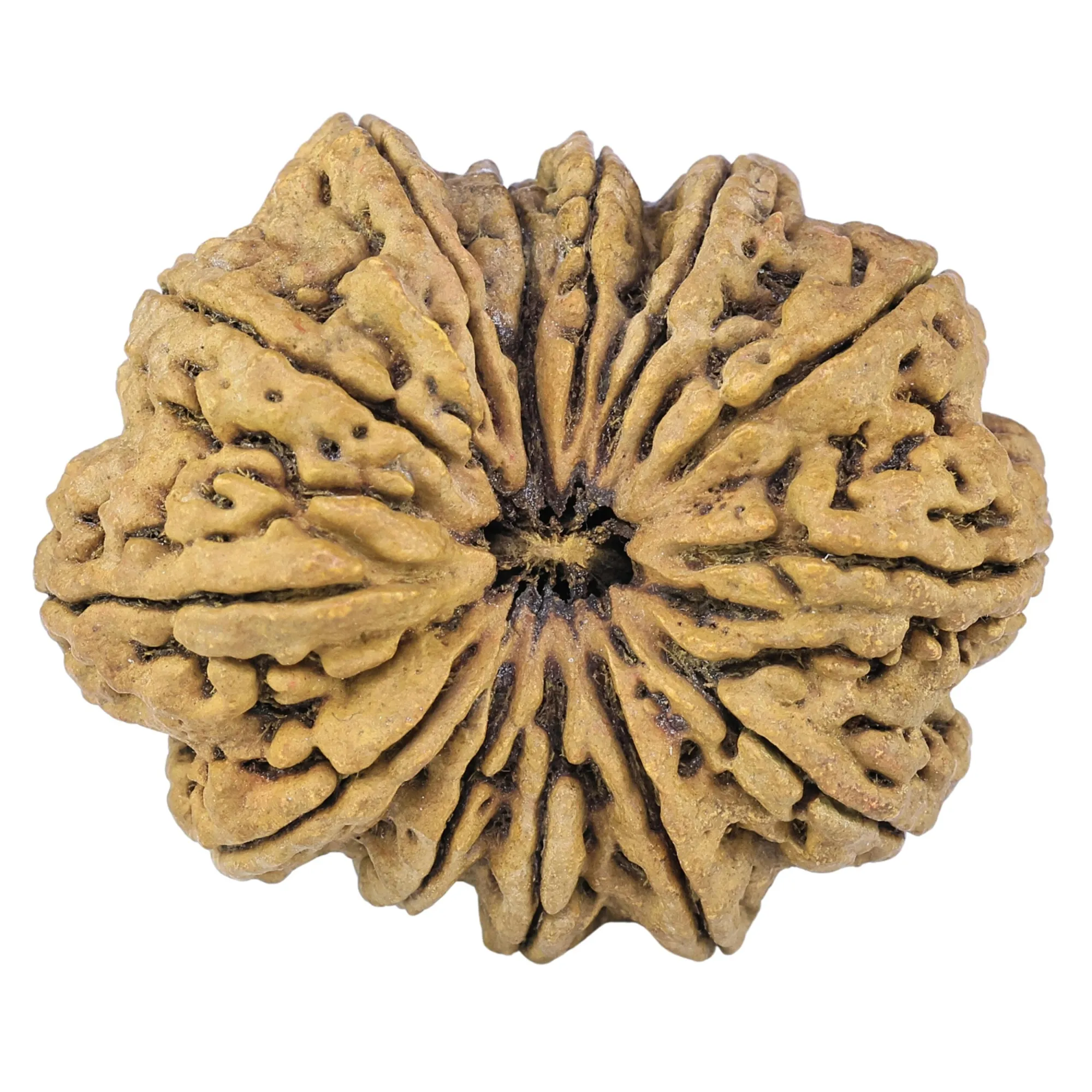
The word "Mukhi" refers to the natural faces or lines that appear on a Rudraksha seed. A 16 Mukhi Rudraksha has sixteen naturally formed faces.
Its traditional identity is closely linked with Lord Mahamrityunjaya, which gives the bead a strong association with protection and overcoming fear.
Traditionally, it is connected with qualities such as:
- Courage
- Protection
- Fearlessness
- Inner strength
- Stability
- Spiritual awareness
- Resilience
The significance of the bead can therefore be understood through the idea of remaining steady when circumstances become uncertain.
The Mahamrityunjaya Tradition
Lord Mahamrityunjaya is a revered form of Shiva and is closely connected with the Mahamrityunjaya Mantra.
This mantra occupies an important place in Shaivite spiritual practices and is traditionally associated with overcoming fear, seeking divine protection, and developing spiritual strength.
The connection between this tradition and 16 Mukhi Rudraksha gives the bead its distinctive meaning.
For practitioners, the Rudraksha may serve as a physical reminder of:
Faith During Difficult Periods
Spiritual practice can provide a sense of continuity when circumstances are uncertain.
Courage
Facing difficult situations without allowing fear to completely determine one's actions.
Inner Stability
Maintaining a balanced approach even when external conditions change.
Devotion
Remaining connected with one's spiritual discipline and beliefs.
What Does Protection Mean in the Traditional Context?
Protection is one of the most frequently associated qualities of 16 Mukhi Rudraksha.
However, this concept can be interpreted in different ways.
Rather than assuming that the bead prevents every external problem, traditional symbolism can be understood as representing the strength required to face difficult circumstances.
Protection may therefore be viewed through:
- Emotional steadiness
- Spiritual confidence
- Courage during uncertainty
- Greater awareness
- Faith and discipline
This interpretation places emphasis on the practitioner's mindset and spiritual practice rather than presenting the Rudraksha as a guaranteed shield against events.
Why Is Fearlessness Important?
Fear can affect how people think and make decisions.
The traditional symbolism of 16 Mukhi Rudraksha is closely connected with the idea of developing fearlessness.
Fearlessness does not necessarily mean having no fear at all. It can mean recognizing fear without allowing it to completely control one's actions.
For a practitioner, this symbolism may encourage reflection on:
- How do I respond to uncertainty?
- Do I avoid difficult decisions because of fear?
- Can I remain calm under pressure?
- Am I able to continue important responsibilities during challenging periods?
The bead can function as a reminder of these questions during meditation or prayer.
Who May Be Interested in 16 Mukhi Rudraksha?
There is no universal rule that says a particular person must wear this Rudraksha.
People may be interested in it because of its traditional association with Mahamrityunjaya Shiva and the themes of courage and protection.
It may appeal to:
- Shiva devotees
- Meditation practitioners
- Spiritual seekers
- Yoga practitioners
- People interested in higher Mukhi Rudraksha
- Individuals going through periods of uncertainty
- People who value devotional practices
Those selecting the bead for a specific astrological or spiritual purpose may prefer guidance from a knowledgeable practitioner.
Why Is This Considered a Higher Mukhi Rudraksha?
The 16 Mukhi variety falls into the higher range of commonly discussed Rudraksha classifications.
Higher Mukhi beads may be less frequently encountered than varieties such as 5 Mukhi Rudraksha, which is widely used for meditation and prayer.
This makes authenticity especially important.
However, a higher Mukhi number should not automatically be interpreted as meaning greater spiritual value.
Each Rudraksha has its own traditional meaning, and the appropriate choice depends on the practitioner's purpose.
How to Identify an Authentic 16 Mukhi Rudraksha
The natural formation of sixteen Mukhi lines is the primary physical characteristic to examine.
The lines should form naturally as part of the seed.
When evaluating a bead, consider:
- Whether all sixteen faces are naturally formed
- Whether the grooves appear continuous
- Whether the surface shows signs of carving
- Whether clear photographs are available
- Whether product-specific information is provided
- Whether certification is available
A natural Rudraksha can have variations in shape, size, texture, and colour.
Therefore, visual irregularity should not automatically be treated as evidence of a problem.
Why Individual Bead Certification Matters
Certification can be particularly useful when evaluating a higher Mukhi Rudraksha.
A generic statement that a seller provides "certified Rudraksha" is less informative than documentation associated with the actual bead.
Ideally, buyers should be able to review information such as:
- Individual bead identification
- Mukhi classification
- Dimensions
- Weight
- Origin
- Certification
- Testing information where available
Rudraksha Sanskar provides product-specific information and certification-related details for its 16 Mukhi Rudraksha offerings.
This type of documentation can help buyers distinguish information about the general category from information about the specific bead they are considering.
Understanding Natural Variations
A natural Rudraksha does not need to look identical to another bead of the same Mukhi count.
Variations may occur in:
- Shape
- Size
- Surface texture
- Colour
- Groove depth
- Overall appearance
This is particularly relevant when comparing higher Mukhi beads.
Buyers should focus on natural formation and available verification rather than assuming that the most symmetrical or polished bead is necessarily the best.
Traditional Ways to Use 16 Mukhi Rudraksha
Rudraksha can be incorporated into spiritual practice in different ways.
A 16 Mukhi bead may be:
- Worn as a pendant
- Used during meditation
- Kept in a prayer space
- Used alongside Shiva-related mantra practices
- Included in a personal devotional routine
Because of its association with Mahamrityunjaya Shiva, some practitioners may include the Mahamrityunjaya Mantra in their spiritual routine.
The exact preparation and wearing method can vary between traditions.
There is no single practice followed universally by every Rudraksha practitioner.
Caring for 16 Mukhi Rudraksha
Rudraksha should be treated as a natural seed.
Basic care includes:
- Avoiding harsh chemicals
- Keeping perfumes away from the bead
- Cleaning it gently
- Storing it safely
- Protecting it from unnecessary impact
- Avoiding aggressive polishing
If the bead is worn regularly, gentle handling can help preserve its natural surface.
There is generally no need to use strong cleaning products or artificial treatments.
16 Mukhi Rudraksha Compared With Other Varieties
Understanding neighbouring Mukhi varieties can help put the bead into context.
11 Mukhi Rudraksha is traditionally associated with Lord Hanuman and themes such as courage, devotion, and strength.
12 Mukhi Rudraksha is associated with Lord Surya and symbolic qualities such as vitality, confidence, and leadership.
14 Mukhi Rudraksha is commonly connected with awareness, intuition, and courage.
15 Mukhi Rudraksha is traditionally associated with Lord Pashupatinath and themes of emotional awareness and transformation.
16 Mukhi Rudraksha has a distinct traditional association with protection and the Mahamrityunjaya aspect of Shiva.
This shows why choosing a Rudraksha should not simply be based on the numerical count.
Rudraksha Sanskar and 16 Mukhi Rudraksha
Rudraksha Sanskar is an online Rudraksha platform offering Mukhi-wise Rudraksha varieties, including higher Mukhi beads.
Its 16 Mukhi Rudraksha collection provides information about the traditional significance of the bead along with product-related details for individuals evaluating this variety.
For someone considering a 16 Mukhi Rudraksha, it is useful to review the specific product's natural Mukhi formation, physical specifications, certification information, and authenticity-related details.
This product-specific approach is particularly relevant for a higher Mukhi bead because individual Rudraksha can vary in size, weight, origin, and appearance.
What Should You Consider Before Buying?
Before purchasing a 16 Mukhi Rudraksha, first consider why this particular variety interests you.
If your interest is devotional, its connection with Lord Mahamrityunjaya and traditional ideas of protection may be most relevant.
If you are purchasing it as a higher Mukhi Rudraksha, authenticity and documentation should receive greater attention.
Review:
- Natural sixteen-Mukhi formation
- Individual product photographs
- Certification
- Dimensions
- Weight
- Origin
- Seller information
- Authenticity and return policies
Avoid relying solely on claims about guaranteed protection, health outcomes, financial success, or other specific results.
Conclusion
The 16 Mukhi Rudraksha has a distinctive place among higher Mukhi Rudraksha varieties because of its traditional association with Lord Mahamrityunjaya. Its symbolism centres on protection, courage, fearlessness, resilience, and spiritual stability.
The idea of protection can be understood broadly as maintaining inner strength and awareness when facing uncertainty rather than assuming that the bead can prevent every external difficulty.
For buyers, authenticity deserves equal attention. Natural sixteen-Mukhi formation, individual product information, certification, physical specifications, and transparent seller details can provide a stronger basis for evaluating the bead.
For those looking to buy Rudraksha online, examining the specific bead and its available authenticity information is a more practical approach than relying only on its rarity or traditional claims.






























Sign in to leave a comment.