

In a modern business, electricity is not just another utility—it is part of the production process. Machines, control systems, computers, medical equipment, automation systems and other electrical assets all depend on a stable power supply. When voltage fluctuates frequently, the problem may not be immediately visible, but the financial impact can slowly add up through equipment failures, production interruptions, maintenance expenses and reduced machine performance.
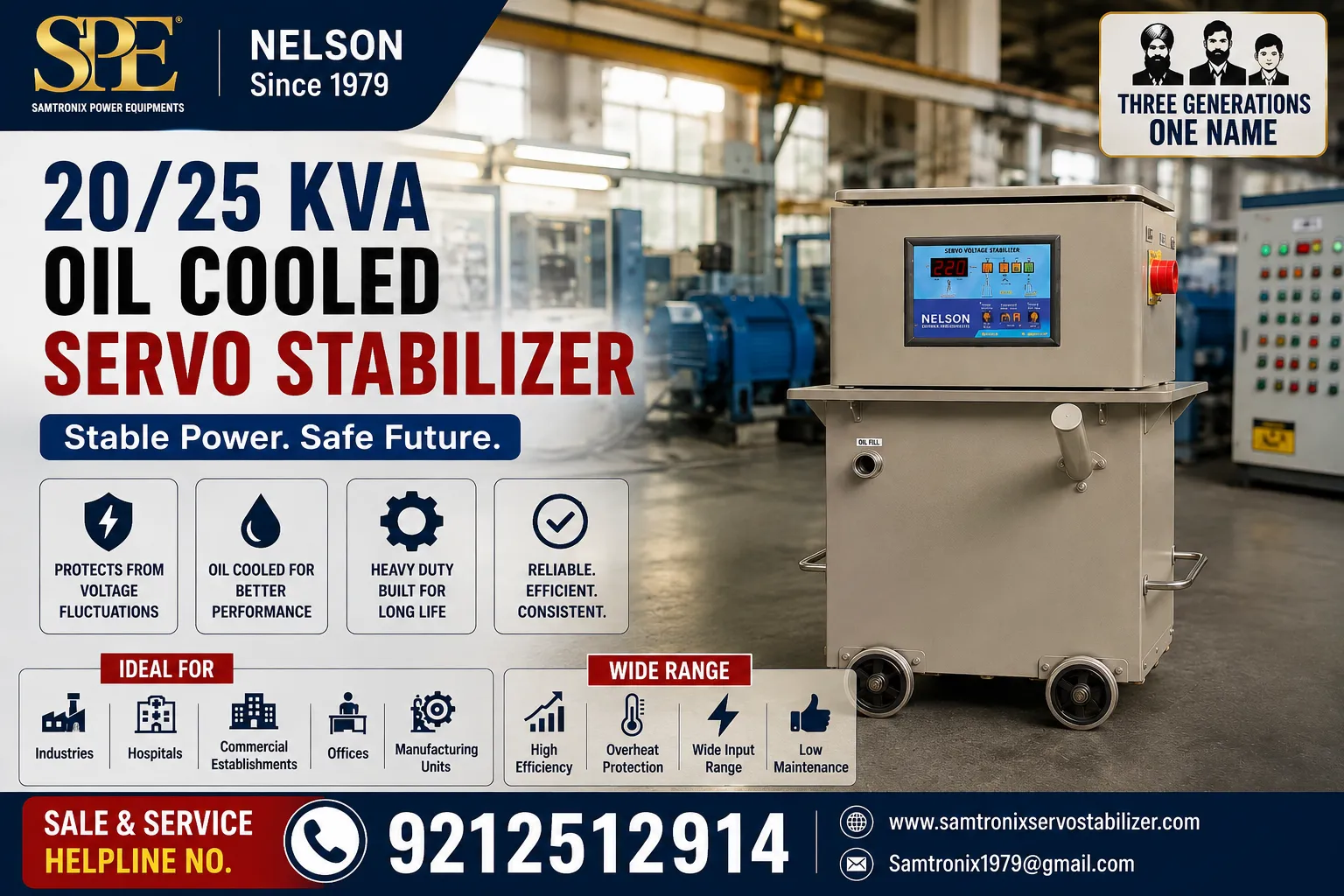
This is where a 20/25 KVA Oil-Cooled Servo Stabilizer can become an important part of a business's power-management strategy. Instead of looking at a stabilizer simply as another electrical purchase, it is more useful to look at it from an ROI perspective: How much money can stable voltage help a business save over time?
The Real Cost of Unstable Voltage
Imagine a manufacturing unit operating normally when the incoming voltage suddenly drops or rises beyond the preferred operating range. A sensitive machine may stop, a control panel may trip, or production may have to be paused while the system is restarted. One incident may seem manageable. But when similar interruptions happen repeatedly, the cost becomes much larger.
The business may lose production time, pay for repairs, replace damaged components and spend valuable employee hours troubleshooting electrical problems. Even when equipment does not fail completely, repeated voltage fluctuations can affect performance and contribute to unnecessary stress on electrical components.
This means the true cost of unstable electricity is often much higher than the electricity bill itself. The question is not only "How much does a stabilizer cost?" but also "How much could voltage-related losses be costing us?"
Why 20/25 KVA Capacity Can Matter
The 20/25 KVA range can be suitable for a variety of commercial and industrial applications where dependable voltage regulation is important. The right capacity, however, depends on the connected load, starting current, operating conditions and the type of equipment being powered.
A properly selected stabilizer can help maintain a more consistent voltage supply for connected equipment. For businesses, this consistency can be particularly valuable when several machines or electrical systems need to operate reliably throughout the working day.
Rather than choosing capacity based only on the machine's nameplate rating, businesses should evaluate their actual and peak load requirements with a qualified electrical professional.
Oil-Cooled Design: Built for Demanding Conditions
Industrial equipment often operates for long hours and under demanding conditions. Heat management therefore becomes an important consideration when selecting power equipment.
An oil-cooled servo stabilizer uses oil as part of its cooling and insulation system, helping manage heat generated during operation. This makes the design particularly relevant for applications where equipment is expected to work continuously or under heavy-duty conditions.
For businesses, better thermal management can contribute to reliable operation and potentially reduce stress associated with excessive operating temperatures. The result is not simply a technical feature—it can support the larger objective of keeping equipment available when production needs it.
Servo Technology and Voltage Regulation
A servo stabilizer continuously monitors the incoming voltage and uses a motor-driven mechanism to make the required correction. The objective is to provide a more stable output voltage to connected equipment despite changes in the incoming supply.
This is especially useful in areas where voltage variation is a regular concern. Instead of allowing connected equipment to experience every major fluctuation directly, the stabilizer works to compensate for changes within its designed operating range.
For a business, stable voltage can mean fewer unnecessary interruptions and a more predictable operating environment for electrical equipment.
Where the ROI Really Comes From
The ROI of a servo stabilizer is not usually created by the stabilizer itself generating revenue. Its value comes from preventing avoidable costs and protecting business continuity.
Consider a production unit where one hour of downtime costs ₹10,000 in lost productivity and associated expenses. If voltage-related problems cause several hours of downtime over a year, the accumulated loss can become significant. Add repair costs, replacement components and maintenance expenses, and the financial impact becomes even clearer.
If better voltage regulation reduces these problems, the stabilizer can effectively pay for itself through avoided losses.
A simple way to think about it is:
Potential ROI = Avoided downtime costs + avoided repair/replacement costs + productivity benefits − stabilizer investment and operating costs.
The actual return will naturally vary from one business to another, but this approach provides a much better way to evaluate the investment than looking at the purchase price alone.
Protecting Expensive Equipment
Many businesses invest heavily in electrical and electronic equipment. Manufacturing machinery, automation systems, control panels, computers, laboratory equipment and other assets can represent a substantial capital investment.
When voltage conditions are unstable, protecting these assets becomes an important part of operational planning. A stabilizer cannot eliminate every possible electrical problem, and it should not be considered a replacement for proper electrical protection. However, voltage regulation can be one component of a broader power-protection system.
The financial logic is straightforward: protecting a valuable machine is generally more economical than repeatedly paying for preventable electrical damage.
Less Downtime, More Productive Hours
For a manufacturing business, productivity depends heavily on machine availability. If equipment stops unexpectedly, workers may have to wait, production schedules can shift and delivery commitments can become harder to maintain.
Even a small reduction in unplanned downtime can have a meaningful financial effect when multiplied across hundreds of operating hours.
This is why power stability should be viewed as an operational issue, not merely an electrical issue. A reliable power environment helps businesses focus on production rather than constantly reacting to avoidable interruptions.
Maintenance Costs Can Add Up
Electrical problems often create a chain reaction. A voltage fluctuation may cause a trip. Repeated trips may lead to troubleshooting. Troubleshooting may require technician visits, replacement parts or machine downtime.
When these events happen repeatedly, maintenance expenses can quietly become a recurring business cost.
A voltage stabilizer designed for the application's load and operating conditions can help reduce voltage-related stress and contribute to a more stable electrical environment. The goal is not to eliminate maintenance completely, but to reduce avoidable disruptions and make maintenance more predictable.
Suitable for Different Business Environments
A 20/25 KVA oil-cooled servo stabilizer can be considered for applications across different sectors, including industries, manufacturing units, hospitals, offices and commercial establishments, depending on their electrical load and requirements.
The needs of a hospital may be very different from those of a manufacturing plant. Similarly, an office may have different power requirements from a commercial facility. Therefore, the important point is not simply buying a stabilizer—it is selecting the correct stabilizer based on the actual application.
Wide Input Voltage Range Can Make a Difference
Businesses operating in locations with significant voltage variation may benefit from equipment designed to handle a suitable input range.
A wide input range gives the stabilizer greater ability to compensate for changes within its specified limits. However, the exact input and output specifications should always be checked before installation because performance depends on the particular model and application.
For businesses, this can contribute to greater confidence that equipment will receive a more appropriate voltage supply during changing grid conditions.
Efficiency Is Also an ROI Factor
ROI should not be calculated only from avoided breakdowns. Efficiency and operating performance also matter.
A well-designed power-conditioning system can help businesses maintain more consistent operating conditions. When machines receive the voltage they are designed to work with, businesses can reduce the uncertainty associated with inconsistent power conditions.
Over several years, even relatively small improvements in reliability and operational continuity can become financially meaningful.
Choosing the Right Stabilizer Is More Important Than Choosing the Biggest One
A common mistake is assuming that a higher KVA rating automatically means a better stabilizer. It does not.
An undersized stabilizer may struggle with the connected load, while an unnecessarily oversized unit may increase the initial investment without providing a proportional benefit.
Businesses should consider connected load, peak demand, motor starting currents, future expansion, input voltage conditions and the nature of the equipment before finalizing capacity.
Professional load assessment is therefore an important step before purchasing a 20/25 KVA stabilizer.
A Practical ROI Example
Suppose a business experiences several voltage-related interruptions every year. The direct repair expenses might be ₹40,000, while lost production and employee downtime add another ₹60,000. The business is therefore potentially losing ₹1 lakh annually because of power-related problems.
If installing an appropriate stabilizer significantly reduces these losses, the investment can potentially recover its cost over time.
The exact numbers will differ from business to business, but the principle remains the same: the financial value of a stabilizer should be measured against the losses it can help prevent.
Why Reliability Matters More Than the Purchase Price
A business may spend considerable time comparing the initial cost of electrical equipment. But focusing only on purchase price can sometimes lead to the wrong decision.
The better question is: What will this equipment cost me over its entire working life?
A reliable stabilizer with appropriate capacity, installation, maintenance and protection features may provide greater long-term value than choosing an option based solely on the lowest initial price.
When electrical equipment supports production, reliability itself becomes a financial asset.
Making Stable Power Part of Your Business Strategy
Voltage stability should not be treated as an afterthought. For businesses that depend on electrical machinery, stable power can support productivity, equipment protection and operational continuity.
A 20/25 KVA Oil-Cooled Servo Stabilizer can be an important part of that strategy when its capacity and specifications match the application's requirements.
The ultimate objective is simple: fewer avoidable interruptions, better equipment protection and more predictable operations.
That is where the real ROI of voltage stabilization lies—not in the stabilizer sitting in the electrical room, but in the business hours, equipment life and maintenance costs it can help protect.
7 Short FAQs
1. What is a 20/25 KVA servo stabilizer?
It is a voltage-regulating system designed to maintain a more stable output voltage for connected electrical equipment.
2. What does oil-cooled mean?
Oil cooling uses insulating oil to help manage heat and provide electrical insulation during operation.
3. Is a 20/25 KVA stabilizer suitable for industries?
It can be suitable for industrial applications, depending on the connected load and electrical requirements.
4. Can a stabilizer reduce downtime?
Proper voltage regulation can help reduce voltage-related interruptions and equipment problems, potentially improving operational continuity.
5. Does a stabilizer protect every electrical fault?
No. A stabilizer primarily addresses voltage variation and should be used alongside appropriate electrical protection systems.
6. How do I select the correct KVA rating?
The rating should be selected based on connected load, peak demand, starting current and future requirements, preferably after a professional load assessment.
7. How does a stabilizer provide ROI?
Its ROI can come from reducing avoidable downtime, repair expenses, equipment-related losses and productivity interruptions over its operating life.























Sign in to leave a comment.