

If you’re comparing an wide-seat wheelchair with the wide-seat mobility scooter, a search for a 20 inch wide wheelchair should start with one question: what exactly does that width describe?
Seat width, space between the armrests, and total chair width are different measurements. Mixing them up can leave you with a chair that feels cramped even though the advertised number looked right, or a comfortable seat attached to a chair that is awkward in your home.
For someone looking at heavy duty electric wheelchairs, those measurements matter more than the category name on the product page.
A 20 inch wide wheelchair is not necessarily 20 inches wide overall
When shoppers type “20 inch wide wheelchair,” they are usually thinking about seating room. The actual device will be wider once you include armrests, wheels, frame parts, and other hardware.
That distinction becomes important as soon as you move from comparing products online to using one in a bedroom, hallway, bathroom, elevator, or vehicle-loading area.
Take the Anywell YS16-1 MAX as an example. Its current specifications list 22.05 inches of usable inner seat width, while its maximum overall width is listed at 27.5 inches. Those two numbers answer completely different questions. The first helps you judge sitting room. The second is more useful when checking the narrowest parts of your route.
That is why choosing by a “20-inch” label alone is risky. A chair with a seat around 20 inches may have a much wider overall footprint.
Measure the person before comparing the chair
A wider seat is useful only when it matches the person using it.
Start with seated hip width rather than relying on clothing size, height, or body weight as a shortcut. Sit in the type of clothing normally worn when using the chair and measure across the widest part of the hips or thighs.
Then compare that measurement with the manufacturer’s definition of seat width. Some pages describe cushion width. Others describe clear space between armrests. Those numbers should not be treated as interchangeable.
A person who needs more room may naturally move from a typical 20 inch wide wheelchair toward a wider-seat model. The YS16-1 MAX, for instance, lists 22.05 inches of clear inner seat space. That extra room may be relevant for users who find narrower seating restrictive, but wider is not automatically more comfortable for every person. Too much side-to-side space can also affect positioning.
If seating posture, pressure management, transfers, or other medical needs are involved, measurements from a clinician or mobility professional matter more than a generic sizing rule.
Doorway clearance deserves its own measurement
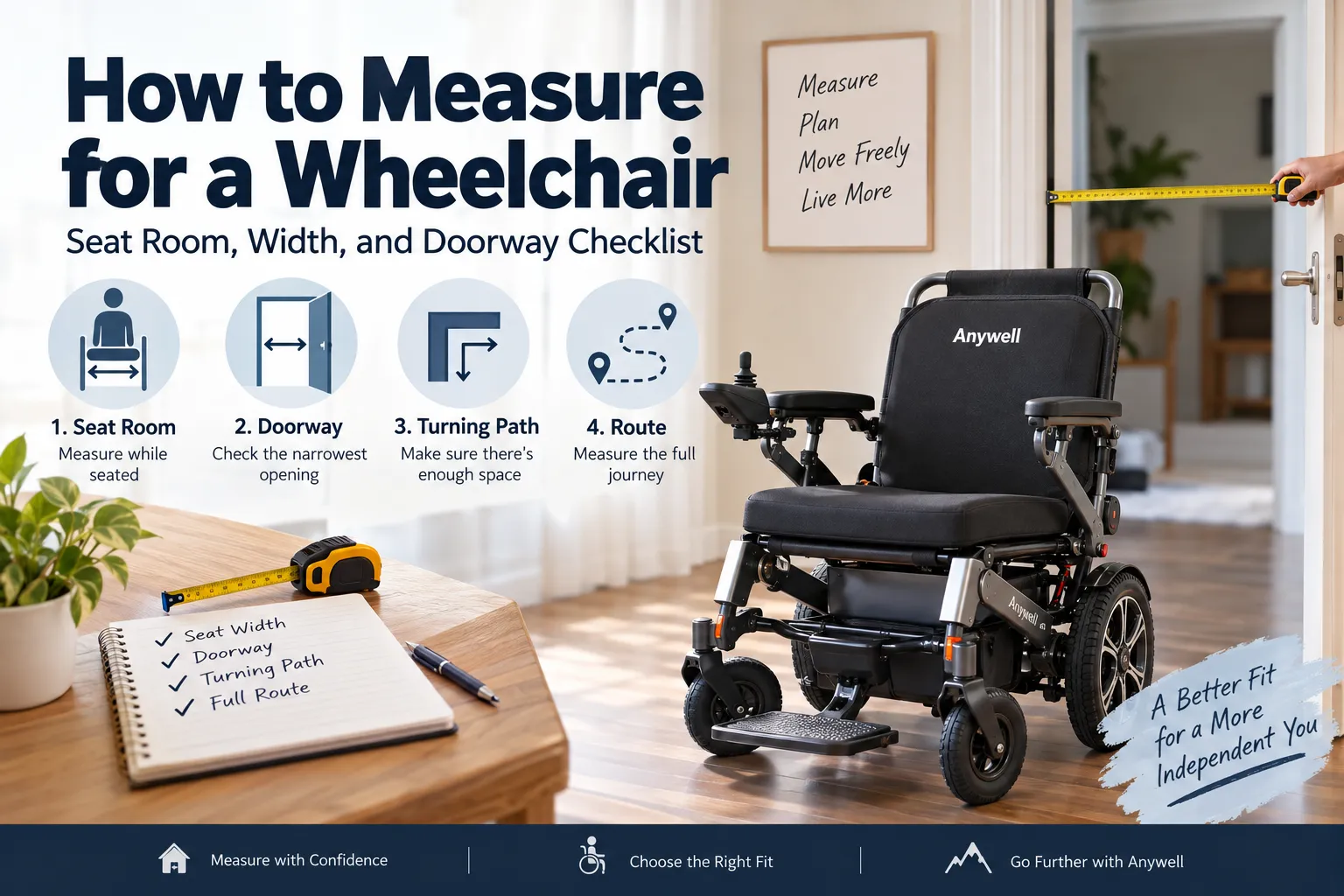
One of the easiest mistakes is measuring the door itself rather than the opening you can actually drive through.
For a swinging door, measure the clear space between the face of the open door and the opposite stop. Do not simply read the width printed on a construction plan or measure from frame to frame while the door is closed.
The 2010 ADA Standards require a minimum 32-inch clear opening for accessible doorways, with the swinging door measured at 90 degrees. That is a useful reference for understanding accessible design, but it does not mean every doorway in a private home will provide 32 inches of usable clearance.
Measure the actual home.
A YS16-1 MAX with a listed maximum overall width of 27.5 inches may appear to fit through a 28-inch opening mathematically, but planning with almost no margin is different from comfortable daily use. Your hands, controller, approach angle, door hardware, baseboards, and the need to correct your steering all consume space.
The narrowest doorway is also only one part of the route. A chair might clear the bedroom door and still struggle with a tight turn immediately afterward.
Check the whole route, not one doorway
Imagine the path from the place where the chair is stored to the places it will be used most often.
A straight doorway is relatively easy. A narrow hall followed by a 90-degree turn into a bathroom is different. So is backing away from a dining table, turning beside a bed, or entering a lift where another person is standing.
A wider bariatric motorized wheelchair can provide useful seating room and higher rated support, but that extra space has to work with the environment around it.
The practical measurement is the narrowest combination of opening and maneuvering space along the route.
Walk the route with a tape measure before ordering. Check door clearances with doors in their normal open position. Look at hallway turns, furniture, ramps, thresholds, storage areas and the space needed to reach a charger.
This takes ten minutes and tells you far more than comparing seat widths in separate browser tabs.
Rated capacity and seat room solve different problems
Weight capacity is another number shoppers often combine with seat size.
They should be checked separately.
Anywell’s current model information lists the YS16-1 MAX platform with a 400 lb rated weight capacity and 22.05-inch inner seat width. The company also notes that rated capacity is not a guarantee of seat fit. That distinction makes sense: two people at the same body weight may need very different amounts of seating room.
For a load-dependent purchase, it is sensible to confirm the current specification on the live product listing before ordering, particularly because product configurations and published specifications can change.
This is one reason searches for “bariatric motorized wheelchair” or “heavy duty electric wheelchairs” should not end with the highest capacity number. You still need to compare usable seat space, total occupied weight, controls, transfers, route clearance and how the chair will be transported.
Battery size should match the route you actually use
Range numbers can look simple until a chair is used outside a test setting.
The YS16-1 MAX has both 12Ah and 20Ah configurations. The current 12Ah version is listed for up to 15 miles of rated range, while the 20Ah configuration is listed for up to 20 miles. Actual range can change with rider and cargo weight, hills, surfaces, temperature, battery condition and driving behavior.
That makes “up to 15 miles” a planning figure rather than a promise that every full charge will produce a 15-mile trip.
A better way to choose between battery options is to map a normal day.
If the chair mostly moves around the house, visits a nearby appointment and returns to a regular charging point, maximum published range may not be the deciding factor. Longer daily routes give battery reserve more importance.
Planning a return margin also matters. Using almost the entire rated range on the outward trip leaves little room for detours, slopes, surface changes or battery performance that differs from ideal conditions.
Wide-seat does not mean lightweight
Another common assumption is that a folding power chair becomes easy to lift once it is folded.
Those are separate features.
The current YS16-1 MAX 12Ah listing gives an assembled weight of about 103.6 lb, while the 20Ah version is listed at about 114 lb. The 20Ah page specifically frames the chair around seat room and daily route reserve rather than frequent solo lifting.
That is an important tradeoff to know before purchase.
This type of chair makes more sense to evaluate as a wide-seat, heavy-duty power wheelchair than as a lightweight travel product. If it needs to go into a vehicle frequently, check the cargo opening and decide beforehand who will load it. Depending on the situation, that may mean another person, a suitable ramp, or a vehicle lift.
Do not wait until the first trip to discover that the folded chair is still too heavy for the person expected to load it.
Wheelchair or scooter?
A wide-seat power wheelchair and a mobility scooter can overlap in capacity, but they are not interchangeable.
The X-024 scooter currently lists a 19.7-inch seat, up to 400 lb capacity, a 350W motor and up to 20 miles of rated range. It uses scooter-style tiller controls rather than the joystick setup found on the YS16-1 MAX. The assembled X-024 is listed at about 106 lb, while its base is about 61 lb after the seat and battery are removed.
That makes the choice partly about how the device will be operated.
A scooter may suit someone who can transfer safely, sit upright and comfortably operate a tiller. A power wheelchair may make more sense when joystick control and chair-style positioning better match the user’s daily routine.
Seat width alone cannot answer that question.
Comfort planning happens before checkout
The most useful way to shop for a 20 inch wide wheelchair is to stop treating “20 inch” as the entire specification.
Measure the person. Confirm what the manufacturer means by seat width. Measure the chair’s overall width. Walk the real route through the home. Check the tight turns as well as the doors. Compare rated capacity separately from seating room. Then look at range and transport weight based on how the chair will actually be used.
For buyers who need more room than a typical 20-inch seat, the YS16-1 MAX is worth comparing because its current specifications show a 22.05-inch usable seat, up to 400 lb rated support in Anywell’s model guide, and 12Ah or 20Ah battery choices. The 12Ah configuration is rated for up to 15 miles, while the larger battery option extends the published range.
Those numbers are useful only after they are matched to the person, the doorway and the daily route.
A wide seat should give you the room you need without creating a new problem everywhere else the chair has to go.























Sign in to leave a comment.