

Rudraksha beads have a long-standing role in Indian spiritual traditions. They are used in meditation, prayer, mantra chanting, and devotional practices, with different varieties identified according to the number of natural Mukhi lines found on the seed.
The 20 Mukhi Rudraksha belongs to the higher range of Rudraksha varieties and is traditionally associated with Lord Brahma. Its traditional significance is commonly connected with knowledge, creativity, learning, awareness, intellectual development, and the ability to transform ideas into meaningful work.
Because 20 Mukhi Rudraksha is relatively uncommon, understanding its physical characteristics and authenticity is particularly important. Its spiritual meaning and the authenticity of an individual bead are two separate aspects that should both be considered.
What Is 20 Mukhi Rudraksha?
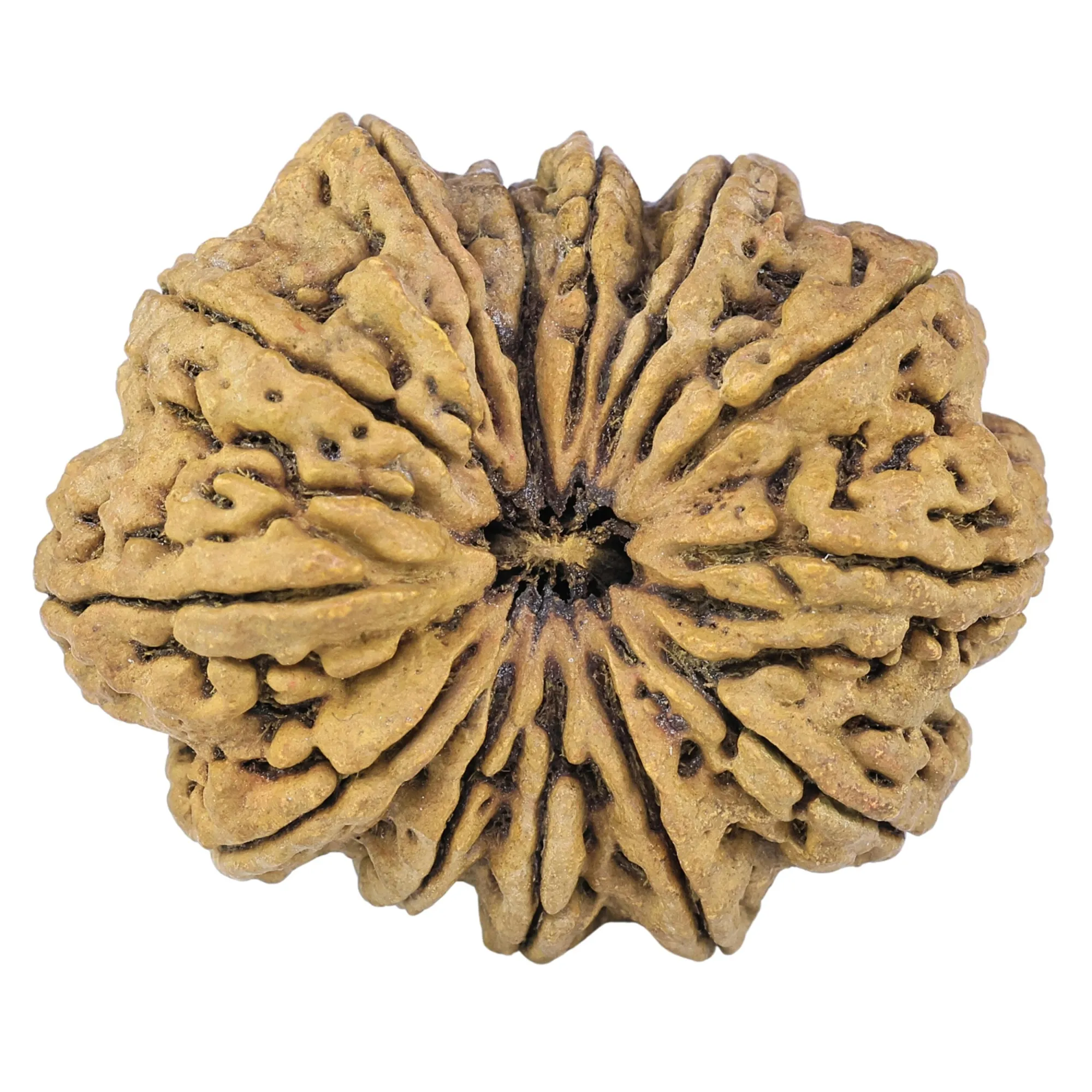
A 20 Mukhi Rudraksha is identified by twenty naturally formed Mukhi lines across the surface of the seed.
The Mukhi count is an important part of Rudraksha classification, while its traditional association gives the bead its spiritual identity.
The 20 Mukhi variety is commonly associated with:
- Lord Brahma
- Knowledge
- Creativity
- Learning
- Awareness
- Intelligence
- Spiritual understanding
- Purposeful creation
These qualities are traditionally interpreted through the symbolism of Lord Brahma as the creator.
Lord Brahma and the Symbolism of Creation
Lord Brahma is traditionally regarded as the creator within the Hindu understanding of the divine trinity.
Creation can be understood in many forms.
It may involve creating:
- Ideas
- Knowledge
- Art
- Systems
- Designs
- Businesses
- Research
- New solutions
This broader understanding helps explain the traditional connection between 20 Mukhi Rudraksha and creativity.
The bead can symbolically represent the process of taking knowledge and imagination and turning them into something useful.
Traditional Benefit: Knowledge
Knowledge is one of the central themes associated with 20 Mukhi Rudraksha.
However, knowledge in a spiritual context does not necessarily mean academic information alone.
It can also include:
- Self-awareness
- Understanding experience
- Learning from mistakes
- Recognizing patterns
- Developing wisdom
For a practitioner, the bead may serve as a reminder to remain curious and continue learning.
It should not be interpreted as a guaranteed way to improve intelligence or academic performance.
Traditional Benefit: Creativity
The connection with creation gives creativity an important place in the traditional meaning of this Rudraksha.
Creativity is not limited to artists.
It can be relevant to:
- Designers
- Engineers
- Writers
- Architects
- Researchers
- Teachers
- Entrepreneurs
- Inventors
The traditional symbolism can encourage the idea of approaching problems from different perspectives.
The bead does not create creative ability by itself. Rather, it can serve as a symbolic focus within an existing spiritual or reflective practice.
Traditional Benefit: Greater Awareness
Awareness is another quality associated with higher spiritual practices.
A person may become more conscious of:
- Thoughts
- Habits
- Decisions
- Emotions
- Responsibilities
The symbolism of 20 Mukhi Rudraksha can therefore be interpreted as encouraging a more observant approach to life.
Instead of reacting automatically, a practitioner may use meditation and reflection to understand why a particular response arises.
Traditional Benefit: Learning and Personal Development
Learning is a continuous process.
Traditional Rudraksha practices often place importance on discipline and self-reflection, making 20 Mukhi Rudraksha meaningful for people interested in intellectual and spiritual development.
The bead may serve as a reminder to:
- Stay open to new ideas
- Learn from experience
- Develop patience
- Improve skills
- Use knowledge responsibly
These are spiritual and symbolic interpretations rather than measurable effects of the bead.
Who May Traditionally Choose 20 Mukhi Rudraksha?
There is no universal rule that determines who should wear this Rudraksha.
Its traditional themes may appeal to:
- Students
- Teachers
- Researchers
- Writers
- Artists
- Designers
- Engineers
- Entrepreneurs
- Spiritual practitioners
Individuals selecting the bead for a particular astrological or spiritual reason may prefer guidance from a knowledgeable practitioner.
Why Is 20 Mukhi Rudraksha Considered Rare?
The 20 Mukhi variety sits close to the upper end of the commonly discussed 1-to-21 Mukhi classification.
Higher Mukhi beads are generally encountered less frequently than commonly used varieties.
This relative rarity can make the bead attractive to collectors and spiritual practitioners.
However, rarity should not be confused with authenticity.
A bead should be evaluated based on its natural structure and supporting documentation.
How to Identify an Authentic 20 Mukhi Rudraksha
The most important physical characteristic is the natural formation of twenty Mukhi lines.
The lines should be part of the seed's original structure rather than artificially carved.
When examining a bead, consider:
- Twenty natural faces
- Continuous Mukhi lines
- Organic surface texture
- Absence of obvious artificial carving
- Clear product photographs
- Individual specifications
Natural Rudraksha can have irregular shapes, colours, and textures.
A perfectly symmetrical appearance is therefore not necessary.
Certification and Laboratory Verification
Certification can provide additional information when purchasing a rare Rudraksha.
For a 20 Mukhi bead, buyers should ideally review documentation connected with the individual product.
Useful information can include:
- Mukhi classification
- Product identification
- Dimensions
- Weight
- Origin
- Certification number
- Laboratory testing information
Rudraksha Sanskar's current 20 Mukhi collection includes individual product listings with specific dimensions, weights, origins, and certification details. Some listed products also include X-ray identification information.
This type of product-specific documentation can be useful when evaluating a higher Mukhi bead.
Nepal and Indonesia-Origin Beads
Rudraksha can be found from different geographic origins.
The 20 Mukhi collection can include both Nepal-origin and Indonesia-origin examples.
Natural differences can occur in:
- Size
- Shape
- Texture
- Mukhi definition
- Weight
Origin should therefore be treated as one part of the product information rather than the only measure of authenticity or quality.
Traditional Ways to Use 20 Mukhi Rudraksha
Rudraksha can be incorporated into different spiritual routines.
A 20 Mukhi bead may be:
- Worn as a pendant
- Used during meditation
- Kept in a prayer space
- Used during mantra chanting
- Included in a devotional practice
Some practitioners prefer to cleanse and prepare the bead before use.
Others focus on meditation, prayer, and personal intention.
The exact method depends on individual beliefs and traditions.
Caring for 20 Mukhi Rudraksha
A rare Rudraksha should be handled carefully.
Basic care includes:
- Keeping it away from harsh chemicals
- Avoiding direct perfume exposure
- Cleaning gently
- Storing it safely
- Protecting it from unnecessary impact
- Avoiding aggressive polishing
The purpose of care is to preserve the natural structure and surface.
20 Mukhi Rudraksha and Nearby Higher Varieties
Different higher Mukhi Rudraksha have different traditional associations.
18 Mukhi Rudraksha is traditionally associated with Goddess Bhumi Devi and themes of grounding and stability.
19 Mukhi Rudraksha is associated with Lord Narayana and prosperity.
20 Mukhi Rudraksha is traditionally connected with Lord Brahma and knowledge and creation.
21 Mukhi Rudraksha is traditionally associated with Lord Kubera and abundance.
This demonstrates that higher Mukhi Rudraksha should not simply be viewed as a numerical hierarchy.
Each variety has its own traditional identity.
Rudraksha Sanskar and 20 Mukhi Rudraksha
Rudraksha Sanskar is an online Rudraksha platform offering different Mukhi-wise varieties, including higher Mukhi Rudraksha.
Its 20 Mukhi collection provides individual product information for listed beads, including physical specifications, origin, and certification-related details.
For someone considering a 20 Mukhi Rudraksha, reviewing the specific bead's photographs, Mukhi formation, dimensions, weight, origin, and certification can provide a more informed basis for evaluation.
This is particularly useful for a rare bead where general category information cannot describe the characteristics of every individual Rudraksha.
What Should You Consider Before Buying?
Before purchasing a 20 Mukhi Rudraksha, consider both its traditional meaning and its physical authenticity.
Review:
- Natural twenty-Mukhi formation
- Individual bead photographs
- Certification
- Dimensions
- Weight
- Origin
- Laboratory information where available
- Seller transparency
- Authenticity and return policies
Avoid choosing a bead solely because it is described as extremely powerful or rare.
Conclusion
The 20 Mukhi Rudraksha is a higher Mukhi variety traditionally associated with Lord Brahma and themes of knowledge, creativity, learning, awareness, and creation.
Its traditional significance can be meaningful for people who value intellectual growth, creative thinking, and spiritual learning.
Because it is a relatively uncommon Rudraksha, authenticity deserves particular attention. Natural Mukhi formation, individual product specifications, origin, certification, and laboratory information can help buyers evaluate the actual bead more carefully.
For those looking to buy Rudraksha online, considering both traditional significance and individual bead documentation provides a more balanced approach to selecting a 20 Mukhi Rudraksha.


























Sign in to leave a comment.