

Choosing an Anywell wide-seat wheelchair starts with a simple question: does a 22 inch wheelchair actually give the rider the right amount of usable seat room without creating new problems with doorways, turning space, or transportation?
A wider seat can make a meaningful difference for people who feel cramped in standard-width chairs, need more room around the hips and thighs, or require a higher rated weight capacity. But “wider” is not automatically “better.” Seat width, total chair width, rider weight, indoor clearance, and transport needs all have to work together.
That is especially important when comparing heavy duty wheelchairs. A chair may provide an extra wide seat and higher rated support, yet also be substantially heavier and wider overall than a folding travel-oriented model.
Here is how to evaluate the fit before buying.
What Does “22 Inch Wheelchair” Actually Mean?
When people search for a 22 inch wheelchair, they are usually talking about seat width, not the total width of the wheelchair.
Those two measurements are very different.
Seat width describes the usable space available to the rider. Overall wheelchair width includes components such as the frame, armrests, wheels, and sometimes the joystick or other hardware. A wheelchair with a roughly 22-inch seat can therefore be several inches wider when measured from its outermost points.
This distinction matters most at home.
A seat may feel spacious and comfortable while the complete chair is too wide for a particular bedroom doorway, bathroom entrance, hallway turn, elevator, or vehicle loading area. So checking only the advertised seat width is not enough.
Professional wheelchair measurement guidance generally begins with the rider's body dimensions. Permobil's mobility guidance recommends measuring across the widest point of the hips, including soft tissue, while the person is sitting on a firm, flat surface. It also notes that seat width affects positioning and the wheelchair's overall footprint.
In other words, start with the person, then check the chair, and finally check the environment.
Who May Benefit From a 22 Inch Wheelchair?
A wide seat can be useful when a narrower wheelchair creates noticeable pressure or makes it difficult for the rider to maintain a natural seated position.
This does not mean everyone with a larger body automatically needs the widest chair available. Two people at the same body weight can have very different hip widths, leg positions, posture, and support needs.
A 22-inch seat is more likely to be relevant for someone who measures wider through the hips or thighs, finds a standard seat restrictive, needs more room for comfortable everyday positioning, or is specifically comparing a bariatric power wheelchair 400 lb capacity class with narrower lower-capacity models.
Clinical seating guidance also warns against choosing a seat that is too narrow. Excessive contact around the hips can create unwanted pressure and encourage compensatory positioning. At the same time, choosing a seat much wider than necessary can also negatively affect positioning and environmental accessibility.
That is why the useful question is not “What is the widest wheelchair I can buy?”
It is “What width gives this rider enough room while still fitting the places where the chair will actually be used?”
How to Measure for a 22 Inch Wheelchair
Do not measure an old wheelchair and assume its nominal size is correct. Measure the rider directly.
Have the person sit in their normal position on a firm surface while wearing the type of clothing they would typically wear when using the chair. Measure horizontally across the widest part of the hips or thighs.
Then compare that body measurement with the manufacturer's definition of seat width. Pay attention to whether the specification describes cushion width, frame width, or actual usable room between the armrests.
That last point is important because two products marketed with similar seat sizes may not provide exactly the same usable space.
For people with significant positioning needs, asymmetry, pressure-management concerns, or difficulty transferring, product dimensions should not replace an assessment from a qualified clinician or seating professional.
A 22-Inch Seat Does Not Mean a 22-Inch-Wide Chair
This is probably the most common planning mistake with wide-seat power wheelchairs.
Consider the Anywell YS16-1 MAX 12Ah as a real example. Its current specifications list a 22.05-inch usable seat width, measured as sitting room between the armrests. The width including the armrests is listed at 25.6 inches, while its maximum overall width is approximately 27.5 inches.
For doorway planning, that 27.5-inch maximum overall width is much more useful than the 22.05-inch seat measurement.
The same principle applies to other wide seat and extra wide seat wheelchairs: always find the widest fixed point on the complete chair.
Then measure the real doorway opening.
Do not simply measure the door itself from edge to edge. Measure the clear opening available when the door is open, including anything that reduces usable space.
The U.S. Department of Justice's ADA Standards specify a minimum clear opening of 32 inches for accessible doorways covered by those standards. But that should not be interpreted as proof that every doorway in a private home is 32 inches wide. Older houses, bathroom doors, interior openings, trim, and unusual layouts can all be narrower.
Your own tape measure is more useful than an assumption.
Doorway Clearance Is Only Part of the Problem
A wheelchair may technically pass through an opening and still be awkward to use there.
Think about the approach to the doorway. Can the rider line up straight, or is there a sharp turn immediately before the door? Does the joystick extend toward a wall? Is furniture reducing maneuvering room? Is there enough space on the other side to turn?
Bathrooms are a common example. The entrance itself may be wide enough, but the chair still needs room around the sink, toilet, shower, or cabinets.
The same applies to kitchens and bedrooms. A wider chair changes how much space remains beside counters, tables, beds, and furniture.
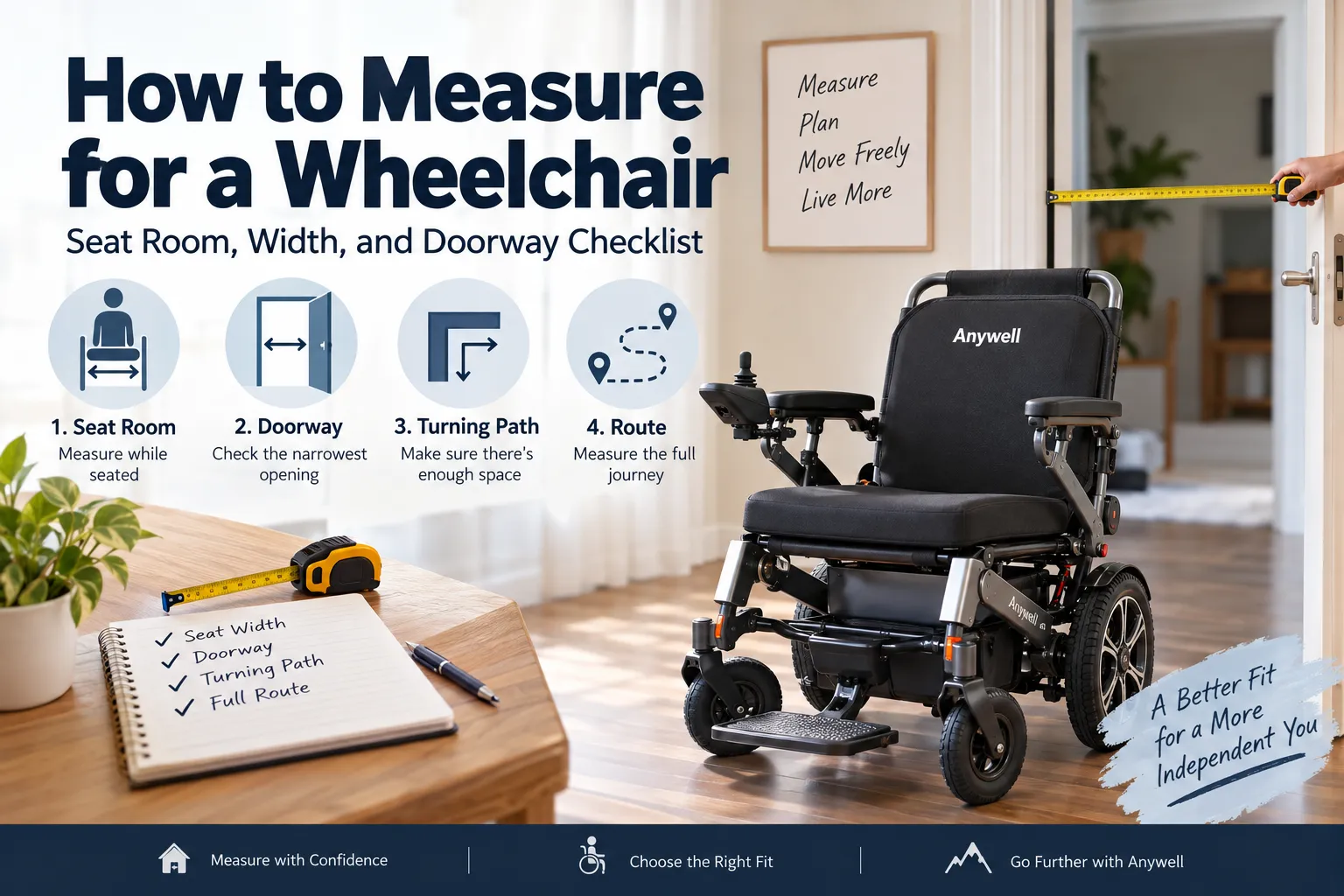
Before ordering, it helps to check the complete everyday route: entrance, hallway, bedroom, bathroom, kitchen, charging location, and any other area the rider expects to access regularly.
Seat Width and Weight Capacity Are Different Measurements
Another common mistake is treating seat width and weight capacity as if they describe the same thing.
They do not.
Seat width is primarily a fit measurement. Weight capacity is the manufacturer's rated load limit. A rider can be within a wheelchair's weight rating and still find the seat too narrow. Someone else may fit comfortably between the armrests but exceed the chair's rated capacity.
Both need to be checked separately.
This distinction is particularly important when comparing a bariatric power wheelchair 400 lb capacity model with ordinary power chairs. The “400 lb” number tells you about rated support, not how wide the person should be or how much room they will have in the seat.
For example, the YS16-1 MAX currently lists both a 22.05-inch usable seat and 400 lb rated support. Those specifications address two different parts of the fit decision.
Wide-Seat Comfort Comes With a Transport Trade-Off
Extra room can be useful, but there is usually a trade-off.
Wider, higher-capacity power chairs are not necessarily designed around frequent solo lifting. This matters if the user regularly plans to put the wheelchair into a car, SUV, or other personal vehicle.
The YS16-1 MAX 12Ah, for example, is listed at approximately 103.6 lb fully assembled. That puts it in a very different category from products marketed primarily as lightweight folding travel chairs. Anywell's own current guidance recommends planning for loading assistance, sufficient vehicle space, or an appropriate ramp or lift rather than treating the chair as a lightweight portable product.
So before choosing an extra wide seat, consider the entire routine.
A person who mainly uses the chair around the house, community, shops, or local appointments may prioritize seating room and rated support. Someone who needs to lift a chair into a vehicle several times each week may give transport weight much greater importance.
Neither priority is inherently right or wrong. They are simply different use cases.
A Real Example: Anywell YS16-1 MAX 12Ah
The Anywell YS16-1 MAX is useful for illustrating what a modern wide-seat power chair looks like in practical terms.
The current 12Ah version lists a 22.05-inch usable seat, 400 lb rated support, 25.6-inch width including the armrests, and a maximum overall width of approximately 27.5 inches. Its 24V 12Ah lead-acid battery is listed for a rated range of up to 15 miles.
That range figure should be treated as a planning maximum rather than a promise for every trip. Anywell states that actual range can vary with rider load, terrain, slopes, temperature, battery condition, and driving behavior.
The product makes the most sense to compare when seat room and higher rated support are important everyday priorities.
It should not be confused with a lightweight portable wheelchair. The assembled weight is over 100 lb, so a realistic loading and transportation plan is part of deciding whether it fits the user's lifestyle.
That distinction may matter just as much as battery size or seat width.
A Practical Fit Check Before Ordering
Before buying any 22-inch or extra wide power wheelchair, check five things: the rider's seated hip width, the manufacturer's usable seat measurement, the chair's maximum overall width, the narrowest doorway and turning area on the normal route, and the real transportation plan.
Then confirm the total occupied load against the manufacturer's rated capacity.
Finally, consider how far the chair actually needs to travel in a normal day. Published maximum range numbers should include a reasonable reserve rather than being treated as a target distance for every outing.
Doing these checks takes a little longer than choosing by weight capacity or battery size alone, but it can prevent the much bigger problem of receiving a chair that is comfortable to sit in yet impractical inside the home.
Common Mistakes When Shopping for Heavy Duty Wheelchairs
One mistake is buying entirely by body weight. Capacity matters, but it does not tell you whether the rider fits the seat.
Another is assuming “22 inch” describes the full chair. Always find the overall width.
A third is measuring the front door but forgetting interior doors. Bathrooms and bedrooms are often more restrictive.
It is also easy to focus on range while ignoring transportation weight. A power chair that works well for daily riding may require another person, a ramp, or a vehicle lift for transport.
Finally, avoid automatically choosing the widest seat available. More space is useful only when it matches the rider's actual dimensions and positioning needs.
FAQ
Is a 22 inch wheelchair considered extra wide?
Compared with many conventional wheelchair seat sizes, a 22-inch seat is generally considered a wide or extra-wide configuration. Exact terminology varies by manufacturer, so the actual usable seat measurement is more important than the marketing label.
Will a 22 inch wheelchair fit through a standard doorway?
You cannot determine that from seat width alone. Find the wheelchair's maximum overall width and measure the doorway's actual clear opening. ADA-covered accessible doorways generally require at least 32 inches of clear opening, but residential doorways can differ substantially.
Does a 400 lb capacity mean the wheelchair has a wide seat?
No. Rated capacity and seat width are separate specifications. Always check both.
Is a wider wheelchair always more comfortable?
No. A seat that is too narrow can create pressure and positioning problems, while excessive width can also reduce useful support and make environmental access more difficult. Proper fit depends on the rider's measurements and individual seating needs.
Is the YS16-1 MAX a lightweight travel wheelchair?
No. The 12Ah version is listed at approximately 103.6 lb fully assembled. Its strengths are its 22.05-inch usable seat and 400 lb rated support rather than lightweight solo portability.
Final Takeaway
A 22 inch wheelchair can be a practical choice for someone who genuinely needs more sitting room, but the seat measurement should never be evaluated in isolation.
Measure the rider first. Then compare usable seat width and rated capacity. After that, check the chair's maximum overall width against real doors, hallways, turning areas, and vehicle space.
For buyers looking specifically at heavy duty wheelchairs, a model such as the YS16-1 MAX shows the trade-off clearly: a 22.05-inch usable seat and 400 lb rated support provide substantially more room and support than many narrower models, while the chair's size and more-than-100-lb assembled weight require a realistic home-access and transportation plan.
The right wide-seat wheelchair is not simply the one with the biggest number on the specification sheet. It is the one whose rider fit, physical dimensions, rated support, range, and everyday route all work together.


























Sign in to leave a comment.