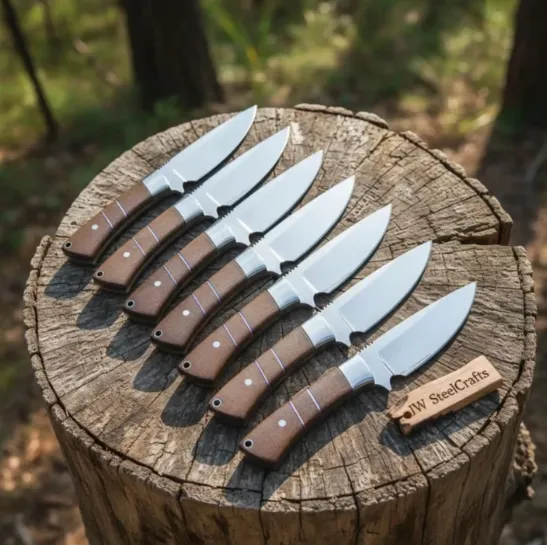

Most experienced hunters don't build their kit around one knife — they build it around roles. A 3-piece hunting knife set is built the same way: a caping or skinning blade for delicate work around the head and hide, a drop-point or clip-point general-purpose blade for field dressing and camp tasks, and a smaller utility blade for finer cuts like caping around eyes and ears or trimming.
This division matters because skinning and field dressing put very different demands on an edge than batoning or general cutting does. A skinning blade needs a thin, controlled edge that won't puncture the hide from the inside. A general-purpose or bushcraft blade needs enough spine thickness to take lateral stress without flexing or chipping. Trying to do both jobs with a single all-purpose knife usually means one task suffers.
What Separates a Good Hunting Knife Set From a Mediocre One
The single biggest quality signal in any hunting or bushcraft knife set is tang construction, not blade count or handle finish.
Full tang construction means the steel runs as one unbroken piece from the blade tip through the entire length of the handle, with handle scales pinned or bolted on either side rather than a narrower rod inserted into a separate handle. You can typically see the exposed steel along the spine and butt of a full tang knife.
This matters specifically for hunting and bushcraft tasks because of the stress involved — twisting during skinning, prying joints apart, or batoning through wood at a bushcraft camp. All of that stress travels down the length of the knife, and on a partial or "rat-tail" tang, it concentrates at the narrow point where the tang meets the handle. That junction is the most common failure point on lower-quality knives, especially under repeated field use. Full tang knives spread that same stress across the entire handle length, which is why almost every knife purpose-built for hard outdoor use is full tang.
A common misconception is that full tang automatically means "better" in every respect. It means more durable under lateral stress — it doesn't guarantee a good heat treat or edge retention. A poorly heat-treated full tang blade can still dull faster than a well-treated partial tang blade. Tang construction and steel quality are separate variables, and a genuinely good set gets both right.
Blade Steel: High-Carbon vs. Damascus for Field Use
| Consideration | High-Carbon Steel | Forged Damascus Steel |
| Edge sharpness | Takes a very fine edge easily | Depends on the specific steels layered together |
| Field resharpening | Generally straightforward with a stone | Comparable, but pattern etching can wear with heavy resharpening |
| Corrosion resistance | Lower — needs drying/oiling after use | Similar, unless stainless-leaning steels are used in the layup |
| Appearance | Plain, functional | Distinct folded wave or ladder pattern, unique per blade |
| Best fit | Buyers prioritizing simplicity and edge performance | Buyers who also value collectible, one-of-a-kind pattern work |
Neither is objectively superior — the right choice depends on how much upkeep you're willing to commit to versus how much the forged pattern and craftsmanship matter to you. Because Damascus is made by folding and forge-welding multiple steel types together, every blade's pattern is a byproduct of that specific forging session, which is part of why no two Damascus blades in a set look identical, even when made by the same hand.
A Buyer's Framework: Matching the Set to the Job
Before comparing specific sets, walk through these questions:
- What's the primary task — field dressing, camp use, or both? A set weighted toward skinning and caping blades suits hunters focused on harvest processing. A set with a longer bushcraft blade included suits campers and bushcraft practitioners who also need chopping and batoning capability.
- How many animals or trips per season? Occasional hunters rarely need more than three matched blades. Guides, outfitters, or anyone processing multiple animals in a season benefit from larger sets with more task-specific redundancy.
- What's your realistic maintenance routine? If knives regularly sit in a truck or pack for days between uses, corrosion resistance and a simple care routine matter more than a fine forged pattern.
- Is the set primarily functional or also a display/gift piece? Presentation cases and finish detailing matter more for gifting; sheath durability and edge geometry matter more for hard field use.
Common Mistakes Buyers Make With Knife Sets
- Confusing tang construction with overall quality. As covered above, full tang is a durability signal, not a complete quality guarantee — check steel type and heat treatment claims too.
- Overbuying piece count. A 7-piece set with several overlapping general-purpose blades doesn't add functional value over a well-chosen 3-piece set — it just adds more edges to maintain.
- Underestimating sheath quality. A knife set is only as field-ready as the sheath system holding it. Loose retention or thin stitching leads to lost or damaged blades faster than the steel itself fails.
- Skipping the factory edge check. Even well-forged blades can ship with slightly uneven edges. Check the edge bevel is consistent before the first hunt, not mid-field.
- Storing blades wet. This is the leading cause of rust spotting on both carbon steel and Damascus, and it's avoidable with a quick wipe-down and light oil coat after each use.
How Should You Care for a Handmade Hunting Knife Set?
The habit that most extends the life of a hunting knife set is drying and lightly oiling each blade before it goes back in the sheath — moisture left against steel is what starts corrosion, even on more corrosion-resistant Damascus layups. Beyond that, hone the edge regularly with a sharpening stone rather than waiting until it's fully dull, since light, frequent honing preserves the original edge geometry better than repeated heavy resharpening. Wood handles, particularly dense hardwoods, also benefit from an occasional light coat of mineral oil to prevent the grain from drying and cracking over time.
Full Tang Multi-Piece Sets as Gifts
A matched, full tang knife set solves a specific gifting problem: it's hard to pick "the one knife" for a hunter or outdoorsman, but a set covering multiple roles reads as more thoughtful and complete than a single blade. This is one reason handmade multi-piece sets have become a common gift category for hunters and collectors — the matching handles and consistent build across the set signal deliberate craftsmanship rather than a single impulse purchase. As one example of how that consistency plays out across an entire set rather than one knife, the <a href="https://www.jwsteelcrafts.com/products/hunting-bushcraft-knife-set">Tan Ridge Bushcraft Knife Set</a> pairs full tang Damascus blades with matching walnut handles across all seven pieces, which is a useful reference point for what "matched" actually means in a set like this.
Bottom Line
Whether you're comparing a 3-piece hunting knife set or a larger bushcraft collection, the deciding factors are the same: full tang construction for durability under stress, a steel type that matches your maintenance tolerance, and a piece count that reflects your actual use case rather than just looking impressive in a case. Buy for the tasks you'll actually do in the field, not the largest set on the shelf.
































Sign in to leave a comment.