
Navigating the 3D Printing Market: Strategic Trends and Commercial Opportunities in Additive Manufacturing
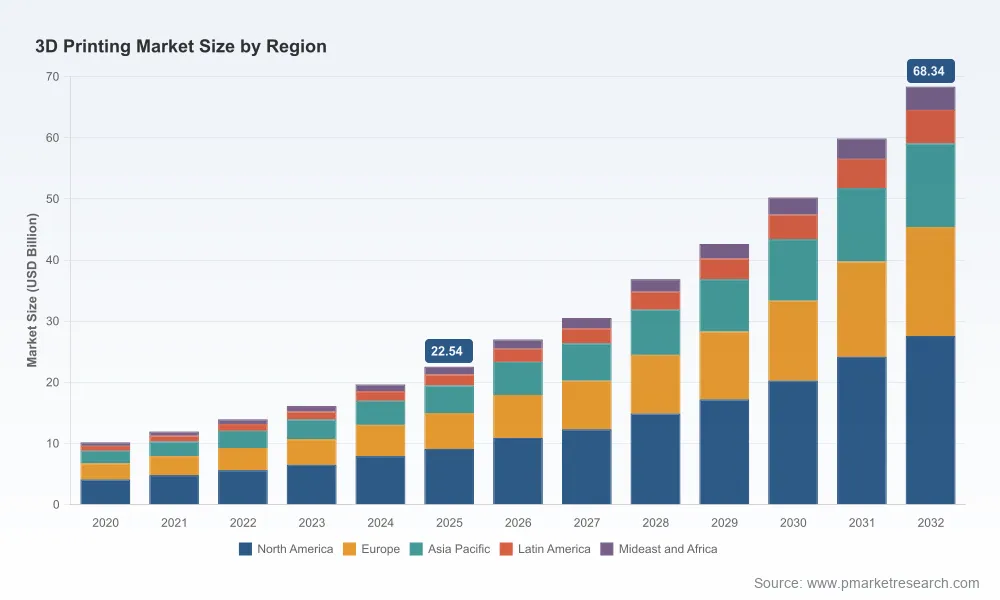
The additive manufacturing sector has transitioned from a niche prototyping tool to a fundamental component of industrial production strategies. Historical data from 2020 to 2025 indicates a compound annual growth trajectory that has consistently outperformed traditional manufacturing segments, with the market expanding from approximately 10.18 billion USD to 22.54 billion USD over this period. Projections through 2032 suggest this momentum will sustain, with the market size anticipated to reach 68.34 billion USD, reflecting a CAGR of 17.2 percent. This growth is not merely a function of adoption rates but signals a structural shift in how value chains are constructed, particularly in sectors demanding high customization, complex geometries, or rapid iteration cycles.
However, interpreting these figures requires looking beyond the aggregate numbers. The expansion is uneven across material types, applications, and geographies. While polymer-based solutions continue to hold significant share, metal additive manufacturing is driving value in high-performance sectors. Similarly, the shift from prototyping to functional end-use parts represents a critical maturation point. For executives and investors, the challenge lies in distinguishing between hype-driven adoption and genuine operational integration. The current landscape presents a inflection point where the technology is no longer questionably viable but is instead facing scrutiny on scalability, cost efficiency, and standardization.
Several key challenges define the current operating environment. First, the capital intensity of professional-grade systems remains a barrier to widespread deployment, with investment costs ranging from tens of thousands to over one million dollars depending on the technology class. This creates a high threshold for entry, particularly for small to mid-sized enterprises seeking to integrate additive processes into legacy workflows. Second, the industry is grappling with fragmented standards. While recent ISO publications have begun to address data protection, product data formats, and specific medical implant principles, the broader ecosystem still lacks universal interoperability. This fragmentation complicates supply chain integration and limits the portability of digital inventory across different vendor platforms. Third, there is a persistent gap between printed capability and certified application. In regulated industries such as aerospace and medical devices, qualification processes remain lengthy, slowing the transition of 3D-printed components from validation to serial production.
Understanding these dynamics is essential for positioning within the market. The growth trajectory suggests that additive manufacturing is moving toward mainstream industrial relevance, but the path is mediated by technological readiness, regulatory clarity, and economic viability. Stakeholders must navigate a landscape where volume is increasing, but value capture depends on strategic alignment with specific use cases rather than broad technology adoption.
Worldwide Thermal Printer Market
Key Drivers Shaping Market Evolution
Technological Innovation and Material Diversification
Innovation in print technologies and material science continues to be the primary engine of market expansion. The shift from single-material prototyping to multi-material and high-performance production capabilities is reshaping application boundaries. Recent developments highlight this progression. For instance, the introduction of large-format binder jet systems, such as the VX7000 with a 7x7x1 meter build volume, demonstrates how additive manufacturing is scaling to accommodate industrial casting and mold-making applications that were previously inaccessible. Simultaneously, advancements in polymer systems are enabling high-temperature and high-strength applications, as evidenced by the roadmap for industrial filament printers capable of processing engineering-grade materials.
Material innovation is equally critical. The emphasis on sustainable materials and UV curing innovations points to a broader industry push toward circularity and process efficiency. Companies are increasingly evaluating the total cost of ownership, which includes material waste, energy consumption, and post-processing requirements. Technologies that reduce support structures, enable faster curing, or utilize recycled feedstocks are gaining traction. This driver is not only technical but economic; as material costs and processing efficiencies improve, the business case for additive manufacturing strengthens in cost-sensitive sectors.
Policy and Regulatory Environment
Regulatory developments are quietly restructuring the market's foundation. The introduction of ISO 5092:2025, which provides general principles for additive manufacturing of non-active implants, signals a maturation in medical applications. Such standards reduce ambiguity for manufacturers seeking to certify printed components, potentially accelerating adoption in healthcare. Similarly, ISO/IEC 23955:2025, which establishes technical requirements for product data protection on additive manufacturing service platforms, addresses growing concerns around intellectual property and digital security. As production moves toward distributed and cloud-connected models, data integrity becomes a competitive differentiator.
Furthermore, standards like ISO/IEC 25422:2025, which define the 3D Manufacturing Format specification suite, aim to improve interoperability across software and hardware ecosystems. These regulatory and standards-driven developments reduce friction in supply chain integration and enable more seamless data exchange between design, simulation, and production environments. For businesses, alignment with emerging standards is no longer optional but a strategic necessity to ensure compatibility, compliance, and scalability. Policy support for domestic manufacturing and supply chain resilience in various regions also indirectly benefits additive manufacturing, as the technology offers localized production capabilities that reduce dependency on extended global supply networks.
Card Printers Market
Demand-Side Shifts and Operational Resilience
Demand is increasingly driven by the need for agility, customization, and supply chain robustness. Enterprises are moving beyond the use of 3D printing for early-stage prototyping toward functional parts and tooling that directly impact production efficiency. The ability to produce complex tooling rapidly reduces lead times and enables iterative design improvements without the constraints of traditional tooling manufacturing. In sectors such as aerospace and automotive, the demand for lightweight, high-performance components aligns closely with the capabilities of metal and advanced polymer additive systems.
There is also a growing recognition of digital inventory as a strategic asset. Instead of maintaining large physical stockpiles, organizations are exploring on-demand production models enabled by additive manufacturing. This shift is particularly relevant in environments where demand volatility, spare parts availability, or geographic dispersion creates logistical challenges. The demand side is thus evolving from a focus on cost-per-part to a broader value proposition encompassing lead time reduction, design freedom, and resilience. As customers and end-markets increasingly expect customized solutions, additive manufacturing provides a pathway to mass customization that traditional mass production cannot easily replicate.
Supply Chain and Cost Structure Dynamics
The cost structure of additive manufacturing is undergoing recalibration. While upfront equipment investment remains high, the economics of production are shifting as throughput improves, material efficiencies increase, and post-processing automation matures. The acquisition of multiple metal 3D printing systems by service providers illustrates how capacity expansion is being pursued to meet growing demand for metal components. This scaling effort is essential to move from low-volume specialty production to more sustained industrial output.
Supply chain dynamics are also influenced by the localization trend. Additive manufacturing enables distributed production networks, reducing the need for centralized manufacturing and long-distance logistics. This has implications for cost structures, as regional production can mitigate tariffs, shipping costs, and supply disruptions. However, it also requires investment in local expertise, material availability, and quality control infrastructure. Companies that can integrate additive capabilities into regional hubs while maintaining consistent quality standards are better positioned to capitalize on these shifts. The interplay between equipment cost, material supply, and operational expertise defines the economic viability of additive manufacturing in different contexts, making strategic site selection and capacity planning critical decisions.
Competitive Landscape and Strategic Positioning
Core Players and Differentiation Strategies
The competitive arena is characterized by a mix of established industrial manufacturers, specialized technology providers, and software-centric enablers. Companies such as Stratasys and 3D Systems have long been associated with polymer and resin-based systems, with recent product launches focusing on high-mix, low-volume plastics and tough material formulations. Their strategies emphasize expanding the application envelope for plastic additive manufacturing, targeting sectors where durability and material properties are critical. HP Inc. has positioned itself around speed and production-scale polymer and metal systems, with product roadmaps indicating continued investment in high-temperature industrial filament printing and larger-format systems. This focus on throughput and industrial readiness aligns with the demand for production-oriented solutions.
On the metal side, EOS GmbH and SLM Solutions are prominent players in laser powder bed fusion technologies, with EOS also expanding its footprint through partnerships and facility-related investments. The collaboration between EOS and ACMI to support domestic manufacturing underscores a strategy of embedding additive technology within broader industrial ecosystems. GE Additive contributes a strong presence in metal systems including electron beam melting and directed energy deposition, leveraging its industrial heritage to drive adoption in high-performance sectors. Meanwhile, companies like Renishaw and Desktop Metal are pursuing end-to-end workflows and metal binder jet approaches, respectively, highlighting the diversity of technological pathways being pursued.
Service and software-oriented companies such as Materialise play a distinct role by focusing on design software, materials, and customization services. Their value proposition lies in enabling efficient use of additive technologies rather than selling hardware alone. This reflects a broader industry trend where software, simulation, and process optimization are becoming integral to realizing the full potential of additive manufacturing. voxeljet and ExOne have carved out niches in large-format binder jetting for industrial and casting applications, with recent launches like the VX7000 demonstrating continued investment in scaling build volumes for specific industrial use cases. Formlabs has maintained a strong position in resin-based SLA and DLP systems, catering to prototyping and production needs with a focus on accessibility and workflow integration.
Market Evolution: Consolidation, Differentiation, and New Entrants
The market structure is evolving along multiple axes. Consolidation is evident in the movement of assets and capabilities, as seen in recent facility expansions and equipment acquisitions that increase production capacity and technological breadth. Such moves suggest a trend toward scaling operations to meet industrial demand, rather than remaining purely in the prototype or low-volume space. At the same time, differentiation is intensifying as companies seek to avoid commoditization by focusing on specific material systems, application verticals, or workflow ecosystems. The coexistence of polymer, metal, ceramic, and binder jet technologies indicates that no single approach dominates across all use cases; instead, competitive advantage is increasingly tied to matching technology to application requirements.
New entrants and cross-industry players continue to inject innovation into the market. Trade shows and industry events showcase a broad range of companies, from established manufacturers to specialized technology providers, reflecting a dynamic and diverse ecosystem. The presence of major industrial names alongside additive specialists indicates growing convergence between traditional manufacturing and additive processes. This convergence is likely to accelerate as integration improves and the perceived boundaries between subtractive, formative, and additive manufacturing blur. For incumbents, the challenge is to maintain technological leadership while adapting to new integration models. For newer players, the opportunity lies in addressing unmet needs in materials, software, or application-specific workflows that established players may overlook.
Future Trends and Strategic Implications (2026-2031)
Convergence of Additive and Traditional Manufacturing
One of the most significant trends over the next few years is the deepening integration of additive manufacturing with conventional production methods. Rather than replacing traditional processes, additive technologies are increasingly being combined with machining, casting, and assembly operations to create hybrid workflows. This convergence enables manufacturers to leverage the strengths of each approach: additive for complex geometries, lightweight structures, and rapid iteration, and traditional methods for high-volume consistency and surface finish requirements. The trend toward large-format printed molds and tooling, as recognized in recent industry awards for accelerating nuclear reactor construction, illustrates how additive components are being embedded into large-scale industrial projects. Expect to see more production lines designed around hybrid philosophies, where additive steps are strategically placed to reduce lead times, enable customization, or solve geometric constraints that would be costly or impossible with conventional tooling.
The commercial implication is clear: businesses should evaluate additive not as a standalone solution but as an enabling layer within broader manufacturing strategies. Investment decisions should consider how additive capabilities can complement existing operations, reduce bottlenecks, or open new design possibilities. Companies that succeed will be those that develop internal expertise in identifying where additive adds value within a process chain, rather than pursuing technology adoption for its own sake.
Standardization, Certification, and Scalable Quality Assurance
As the market moves toward higher production volumes and more critical applications, standardization and certification will become central to commercial viability. The recent publication of ISO standards related to medical implants, data protection, and manufacturing formats indicates a trajectory toward greater formalization. In the coming years, expanded qualification frameworks for metal and polymer components in regulated industries will likely reduce the uncertainty that currently slows adoption. This trend will benefit companies that proactively align their processes with emerging standards, as certification readiness will become a competitive advantage in sectors such as aerospace, medical, and automotive.
Scalable quality assurance is another critical dimension. High-growth markets demand consistent material properties, reliable process control, and traceability. Technologies that integrate in-process monitoring, closed-loop correction, and digital thread traceability will gain prominence. The commercial opportunity lies in developing or acquiring capabilities that ensure repeatable quality at scale. For service providers and manufacturers alike, demonstrating robust quality systems will be essential to win contracts in demanding applications. The risk, however, is that fragmentation in standards or slow regulatory progress could delay the transition of certain applications from pilot to production. Stakeholders should monitor regulatory developments and engage with standards bodies where relevant to influence and prepare for future requirements.
Material Innovation and Sustainable Production
Material development will continue to shape the market's trajectory. The emphasis on sustainable materials, UV curing innovations, and high-temperature engineering filaments points to a broader push toward performance and environmental responsibility. Expect to see expanded portfolios of recyclable or bio-based materials, as well as material systems designed to reduce post-processing energy and waste. Material innovation will also enable new applications; for example, ceramics and advanced composites may find increased use in thermal, electrical, or wear-resistant contexts. The commercial implication is that material availability and performance will increasingly dictate application feasibility. Companies that secure reliable supply chains for advanced materials and develop expertise in material-specific processing will be better positioned to capture high-value segments. Sustainability is also becoming a procurement consideration; organizations seeking to reduce carbon footprints may favor additive solutions that minimize waste or enable localized production, adding another layer of value to the technology proposition.
Actionable Insights for Decision Makers
For Manufacturers and Production Leaders
Evaluate additive manufacturing within the context of specific process bottlenecks rather than as a blanket technology upgrade. Identify use cases where design complexity, lead time, or customization create disproportionate costs in current operations, and assess whether additive can address these pain points. Prioritize technologies that align with your material and performance requirements, and invest in workforce training to build internal competency in design for additive manufacturing. Consider hybrid integration strategies that combine additive with conventional processes to maximize flexibility and efficiency. Monitor emerging standards and certification pathways relevant to your industry, and engage early with qualification processes to reduce time-to-market for printed components. Finally, assess the total cost of ownership, including material, post-processing, and quality control, to ensure that adoption delivers sustainable operational value.
PW Consulting Information & Electronics Research Center
For Investors and Capital Allocators
Focus on companies and segments that demonstrate a clear path from prototyping to production-scale value creation. The market's growth is increasingly driven by functional parts, tooling, and metal applications, rather than solely by prototyping volume. Evaluate technological differentiation, material portfolios, and software ecosystems as indicators of long-term competitiveness. Pay attention to partnerships and capacity expansions that signal commitment to industrial-scale operations, as these can be leading indicators of market positioning. Be mindful of risks related to standardization delays, raw material supply constraints, and the capital intensity of scaling production. Diversify exposure across technology types and application verticals to mitigate the risk of overconcentration in a single approach or sector. Monitor regulatory and standards developments as potential catalysts or barriers to adoption in high-value industries.
For Procurement and Supply Chain Strategists
Explore additive manufacturing as a tool for supply chain resilience and responsiveness. Digital inventory and on-demand production capabilities can reduce dependency on long lead times and centralized warehousing, particularly for spare parts, custom tooling, and low-volume components. Assess vendor ecosystems based on interoperability, data security, and material availability, as these factors will influence the scalability and reliability of additive solutions within your operations. Engage with suppliers that demonstrate alignment with emerging data and quality standards, and consider pilot programs that test integration with existing procurement and quality workflows. Evaluate the total lifecycle cost, including logistics savings and flexibility benefits, rather than focusing solely on unit cost comparisons. Building relationships with service providers and technology partners that offer end-to-end support can accelerate the learning curve and reduce implementation risk.
The 3D printing market is entering a phase where strategic differentiation will depend on the precision of application selection, the robustness of integration, and the ability to navigate evolving standards and material landscapes. For those seeking a deeper examination of segment-level dynamics, regional nuances, and tailored scenario analysis, comprehensive research reports provide detailed data and structured frameworks to support decision-making. Engaging with such resources can help translate these strategic insights into concrete plans aligned with specific organizational goals and market conditions.
For detailed analysis of this topic, please visit the official page: 3D Printing Market
Lacy Lee
Senior Marketing Manager
[email protected]
PW Consulting: www.pmarketresearch.com


























Sign in to leave a comment.