
Choosing a 4 wheel mobility scooter for adults is not only about finding a scooter that moves from point A to point B. For many adults and seniors, the more important questions are practical:
- Does the seat provide enough room?
- Will the scooter feel predictable on everyday paved surfaces?
- Can it turn through the spaces you normally use?
- Is there enough range for shopping and neighborhood trips?
- Where will groceries, a handbag, or other personal items go?
- Can the scooter be loaded into a vehicle when necessary?
Four-wheel scooters are popular for everyday mobility because they offer a familiar scooter-style layout and a broad wheelbase. However, they also typically need more turning space than smaller mobility devices, so buyers should consider stability and maneuverability together rather than focusing on one specification alone.
Below is a practical way to compare a four-wheel scooter for daily errands, with the Anywell X-024 as an example of a wide-seat model designed around everyday outdoor mobility.
Why Choose a 4 Wheel Mobility Scooter for Adults?
A four-wheel mobility scooter can make sense for adults who are comfortable transferring onto a scooter seat, sitting upright, steering with a tiller, and traveling primarily on suitable hard surfaces.
Compared with very compact mobility devices, a four-wheel layout may be especially appealing when your routine includes:
- Trips around the neighborhood
- Grocery shopping
- Pharmacy visits
- Community centers
- Large shopping areas
- Outdoor paved paths
- Moving between buildings in a retirement community
- Regular short-to-medium-distance errands
The key is to match the scooter to your actual environment.
A scooter that works well in a wide supermarket aisle may not be ideal for a very narrow apartment hallway. Research into powered mobility devices has also found that four-wheel scooters may require considerably more maneuvering space than wheelchairs, which makes measuring your normal routes especially important before purchasing.
1. Start With Stability, but Do Not Ignore Turning Space
One reason shoppers look specifically for a 4 wheel mobility scooter for seniors is the expectation of a planted, predictable platform.
Four contact points can make a scooter feel well suited to routine travel on suitable paved and hard surfaces. But the tradeoff is usually maneuverability.
Instead of asking only, “Is a four-wheel scooter stable?” ask:
Where will I actually need to turn it?
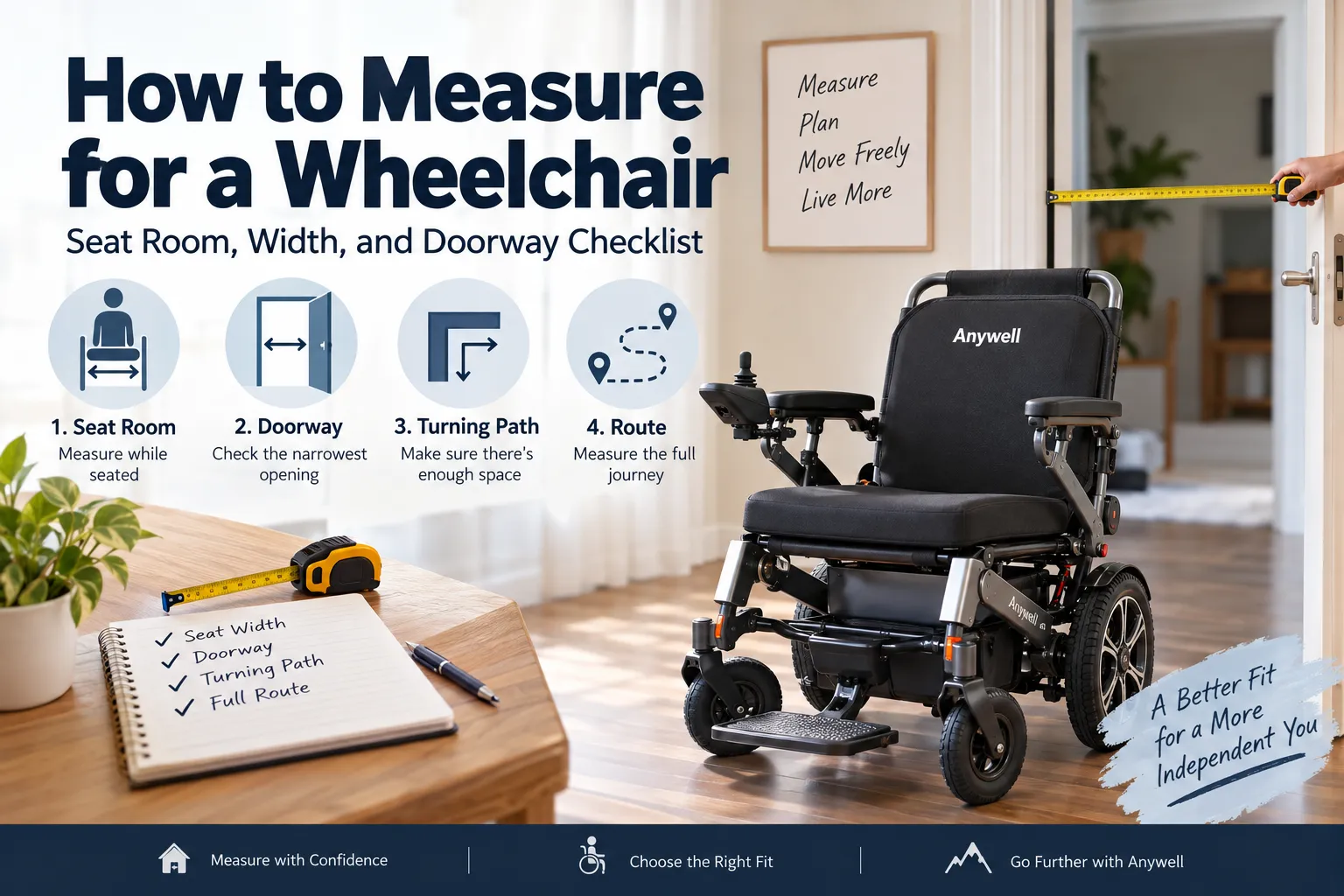
Measure:
- Your narrowest doorway
- Hallway width
- Hallway corners
- Garage or storage area
- Elevator dimensions
- Building entrances
- Store aisles you commonly use
- Space available beside your parked vehicle
You should also think about whether you can complete a three-point turn when a full circular turn is not possible.
The Anywell X-024 product guidance specifically recommends checking doorway width, hallway turns, storage areas, entrance thresholds, aisle width, and available turning space before ordering.
That is a better approach than choosing a scooter based solely on photos.
2. Seat Width Matters More Than Many Buyers Expect
Comfort begins with fit.
A seat that feels acceptable during a five-minute test may become uncomfortable during a longer grocery run or community outing.
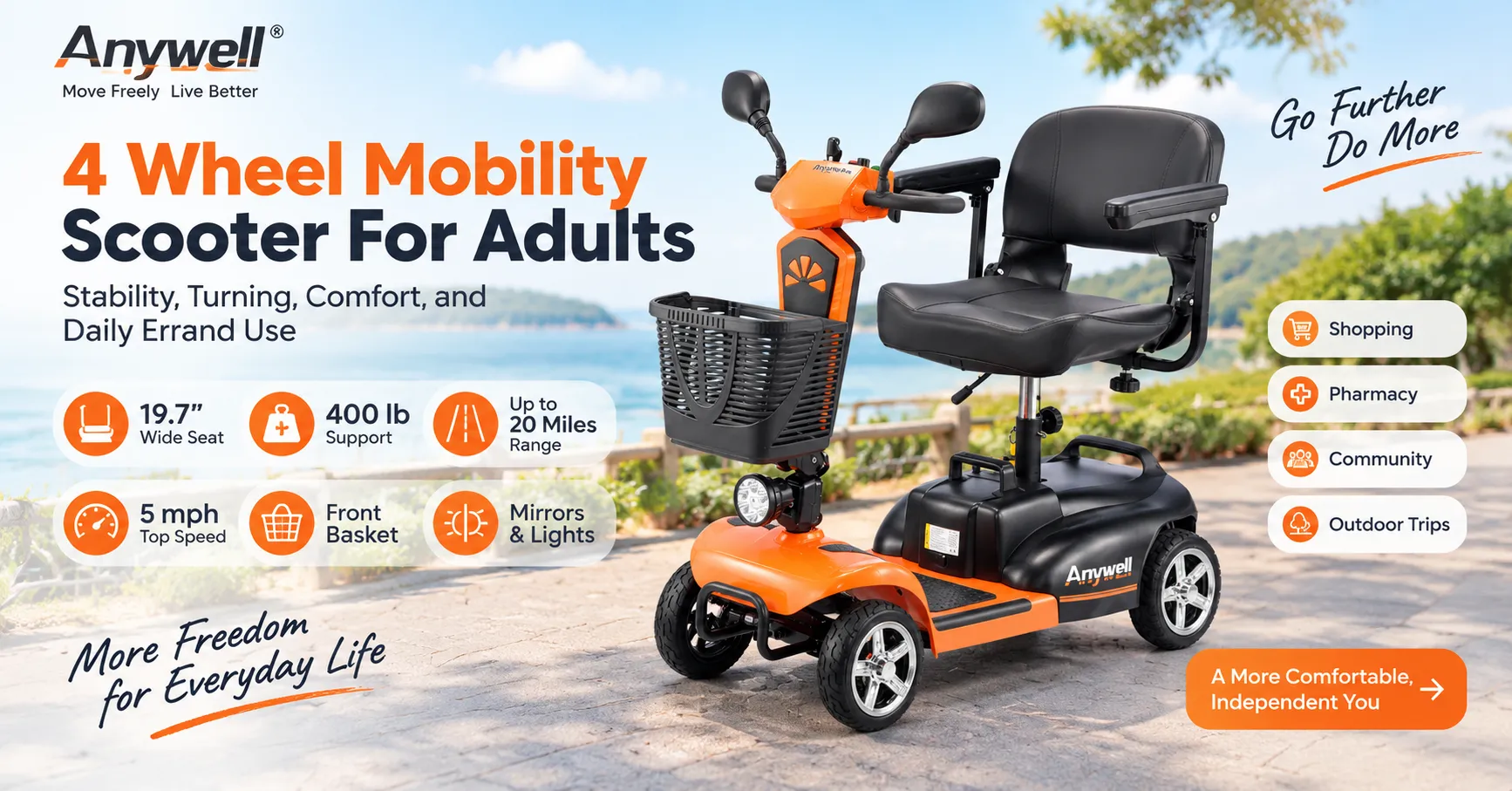
For riders who want extra room, the X-024 has a 19.7-inch seat cushion and adjustable armrests that can provide up to approximately 23.6 inches of clear inside space between the armrest pads.
Those two measurements are different.
The 19.7-inch figure refers to the actual seat cushion width. The larger armrest measurement describes clearance between the arm pads and should not be mistaken for a 23.6-inch seat.
Before choosing any scooter:
- Measure your seated hip width.
- Compare it with the actual seat cushion width.
- Check armrest clearance.
- Consider clothing and coats you normally wear.
- Make sure you can sit centered rather than being compressed between the armrests.
For adults who prioritize extra seating room, the Anywell wide-seat mobility scooter is built around a 19.7-inch seat and up to 400 lb of rated support.
3. Do Not Treat Weight Capacity as a Comfort Measurement
Another common shopping mistake is assuming that a higher weight capacity automatically means a larger or more comfortable scooter.
It does not.
Weight capacity tells you the manufacturer's rated support limit. Seat dimensions tell you whether the scooter physically fits the rider.
The X-024 is rated for up to 400 lb, but buyers should still separately examine:
- Seat cushion width
- Armrest spacing
- Seat height
- Leg position
- Steering reach
- Ability to transfer safely
This is especially important when searching for a heavier-duty or wide-seat scooter.
A 400 lb capacity may be useful, but it should be considered alongside actual body measurements and control reach.
4. Think About Range as a Daily Route, Not a Maximum Number
The X-024 lists a rated range of up to 20 miles.
That sounds straightforward, but maximum-range figures should never be interpreted as a guaranteed 20-mile trip in every situation.
Real-world range can change with:
- Rider weight
- Cargo weight
- Terrain
- Inclines
- Temperature
- Battery condition
- Driving behavior
- Stop-and-start use
For everyday errands, a safer way to plan is to map your entire round trip.
For example:
Home → pharmacy → grocery store → home.
If that route is six miles, do not think only about whether six is below twenty. Leave a comfortable battery reserve rather than planning to use every advertised mile of capacity.
The X-024 uses a 24V 20Ah lead-acid battery and a 350W motor, with a listed top speed of approximately 5 mph.
For many buyers, this type of specification is more relevant to planned neighborhood errands than trying to maximize speed.
5. Everyday Accessories Can Matter More Than Extra Speed
A mobility scooter used for errands is part transportation and part everyday utility tool.
Small features can make a meaningful difference.
The X-024 includes or visibly incorporates:
- Front basket
- Rearview mirrors
- Headlight
- Rear lighting
- Scooter-style tiller controls
For a grocery or pharmacy trip, the basket may be more useful than an additional mile per hour of top speed.
Mirrors can help the rider maintain awareness of the surrounding environment, while lighting can improve visibility. They should not replace careful driving or route planning, but they are practical features for an errand-oriented scooter.
Before buying, imagine your normal outing from beginning to end.
Where does your bag go?
Where do you put groceries?
Can you reach the controls comfortably?
Can you see around you?
Can you get on and off safely?
Those questions often tell you more than a long feature list.
6. What About a Mobility Scooter With Suspension?
“Mobility scooter with suspension” is another common search when comfort is a priority.
Suspension can help manage vibration and surface irregularities on models specifically equipped with it, but it should not be confused with permission to ride on unsafe or unsuitable terrain.
More importantly, shoppers should verify whether the exact scooter they are considering actually lists suspension in its official specifications.
For the current X-024, Anywell's published product specifications emphasize its 19.7-inch seat, 400 lb capacity, 350W motor, 24V 20Ah battery, approximately 5 mph speed, and up-to-20-mile rated range. Suspension is not currently listed as a verified X-024 specification.
Therefore, if suspension is one of your must-have features, confirm it separately rather than assuming that every four-wheel or outdoor-oriented scooter includes it.
For primarily paved neighborhood routes, also evaluate:
- Tire size
- Seat cushioning
- Route surface
- Threshold height
- Overall speed
- Rider posture
Comfort comes from the full setup, not a single feature.
7. Vehicle Transport Is an Important X-024 Consideration
One of the biggest differences between mobility scooters is portability.
The X-024 weighs approximately 106 lb fully assembled.
The seat and battery can be removed, leaving a vehicle-loading base of approximately 61 lb.
That is lighter than lifting the fully assembled scooter, but 61 lb is still substantial.
If you cannot safely lift that weight, plan on:
- A second person
- A suitable ramp
- A vehicle lift
- Another transport arrangement
Do not buy a scooter assuming that “removable” automatically means “lightweight.”
One customer review on the current product page specifically notes needing a ramp because the scooter was too heavy for her husband to lift into their vehicle.
For shoppers who plan to transport their scooter several times per week, loading weight deserves almost as much attention as seat width and range.
8. Is the X-024 Good for Daily Errands?
The X-024 is best understood as an everyday scooter-style mobility option rather than an ultra-light travel scooter.
Its current headline specifications include:
| Feature | X-024 |
|---|---|
| Seat width | 19.7 in |
| Rated weight capacity | Up to 400 lb |
| Rated range | Up to 20 miles |
| Top speed | Approx. 5 mph |
| Motor | 350W |
| Battery | 24V 20Ah lead-acid |
| Fully assembled weight | Approx. 106 lb |
| Base after seat + battery removal | Approx. 61 lb |
| Everyday equipment | Basket, mirrors, lighting |
The combination is most relevant to adults who prioritize:
- A wider seat
- Higher rated support
- Neighborhood errands
- Shopping trips
- Basket storage
- Scooter-style controls
- Suitable paved or hard-surface routes
It is less attractive if your number-one priority is lightweight solo vehicle loading or very tight indoor maneuvering.
9. Checklist Before Buying a 4 Wheel Mobility Scooter for Seniors or Adults
Before ordering, run through this checklist:
Rider fit
- Is the seat wide enough?
- Are the armrests comfortable?
- Can the rider sit upright?
- Can the rider safely transfer onto and off the seat?
- Can the tiller and controls be reached comfortably?
Home fit
- Measure doorways.
- Measure hallway turns.
- Check elevator dimensions.
- Identify a safe charging and storage area.
Daily route
- Are the surfaces appropriate?
- Are there steep slopes?
- Are there difficult curbs or thresholds?
- Is there enough space to turn at common destinations?
Range
- Calculate the complete round trip.
- Leave battery reserve.
- Remember that real range varies.
Transportation
- Check the fully assembled weight.
- Check the heaviest section after disassembly.
- Decide whether you need help, a ramp, or a lift.
Errand use
- Check basket space.
- Consider mirrors and lighting.
- Think about how you will carry purchases.
Final Thoughts
The best 4 wheel mobility scooter for adults is not necessarily the one with the biggest battery, highest weight rating, or longest feature list.
It is the one that fits the rider and the environment.
For everyday shopping, neighborhood routes, pharmacy trips, and other paved errands, prioritize four things:
fit, turning space, practical range, and transport planning.
The Anywell X-024 combines a 19.7-inch seat, up to 400 lb rated support, a listed range of up to 20 miles, basket storage, mirrors, lighting, and scooter-style controls in a package intended for everyday outings.
Just remember that rated range varies in real-world use and that its 61 lb transport base means vehicle loading should be planned in advance.
Measure first, think through your normal route, and choose the scooter around how you actually live—not simply around the largest number on the specification sheet.



























Sign in to leave a comment.