

Choosing the right Anywell X-024 or another 4 wheeled mobility scooter starts with understanding how stability, turning space, seat comfort, range, and everyday usability work together.
Specifications matter, but a scooter that looks impressive on paper can still be inconvenient if it feels cramped, needs too much room to turn, is difficult to load into a vehicle, or does not suit the surfaces you regularly travel on.
For someone mainly using a scooter for neighborhood trips, shopping, appointments, or moving around a retirement community, the better question is not simply, “How far does it go?” It is: How well does it fit the way I actually move through a normal day?
Why Choose a 4 Wheeled Mobility Scooter?
Four-wheel mobility scooters are generally chosen by people who value a stable platform and a familiar scooter-style seating position.
Compared with a three-wheel configuration, four wheels create a wider footprint. That can make the scooter feel more planted during straightforward travel, especially when the route includes sidewalks, paved paths, parking areas, and other everyday outdoor environments.
That does not mean a four-wheel scooter cannot tip. Safe cornering still matters. Mobility-scooter guidance consistently advises users to reduce speed around sharp corners, slopes, cambers, loose gravel, and slippery surfaces because turning too quickly can affect stability.
The trade-off is turning space. A scooter designed around four wheels may need more room to maneuver than a tighter three-wheel design. That difference becomes noticeable in small kitchens, narrow apartment hallways, crowded stores, elevators, and tight parking areas.
So before buying, think about your most common environment rather than choosing based on wheel count alone.
Start With the Routes You Actually Travel
Imagine a typical Saturday.
You leave home, travel along a paved sidewalk, stop at a neighborhood store, carry a few groceries back in a basket, cross a parking lot, and return home.
That route creates very different requirements from someone whose priority is navigating narrow rooms indoors or lifting a scooter into a car several times each week.
For daily errands, ask yourself about the entire route.
Is the pavement mostly smooth or broken?
Are there steep driveways?
Will you cross curb ramps?
Do you regularly enter small stores?
Do you need to reverse in tight areas?
Where will the scooter be parked and charged?
Answering these questions gives specifications such as width, range, speed, and weight much more meaning.
Official safety guidance also recommends planning routes around safer crossings and dropped curbs where possible, and approaching curbs or curb ramps carefully rather than taking them diagonally.
Stability Is More Than Having Four Wheels
One reason people search for a 4 wheeled mobility scooter is stability, but wheel count is only part of the picture.
Rider position, speed, surface condition, slopes, tire contact, carried weight, and the sharpness of a turn all influence how secure a scooter feels.
A simple habit makes a major difference: slow down before turning rather than entering a corner quickly and trying to correct halfway through.
Uneven or loose surfaces deserve extra attention as well. Gravel, deep grass, broken pavement, wet surfaces, and steep transitions can change how the scooter responds. Guidance for mobility-device users recommends extra care on rough ground and inclines and stresses the importance of maintaining seated balance while the device is moving.
For many owners, this makes a four-wheel model most useful on predictable surfaces such as sidewalks, paved community paths, parking lots, shopping areas, and other firm routes.
It should not be treated like an off-road vehicle simply because it has four wheels.
Turning Space Can Matter More Than Top Speed
Top-speed figures are easy to compare. Turning behavior is easier to overlook.
Before ordering a scooter, look at the places where you will make the tightest turns.
A hallway corner is a good example. You may have enough width to drive straight through the hallway but not enough space to swing the front of the scooter around a 90-degree corner.
The same issue appears in elevators, checkout lanes, restaurants, apartment entrances, and small storage areas.
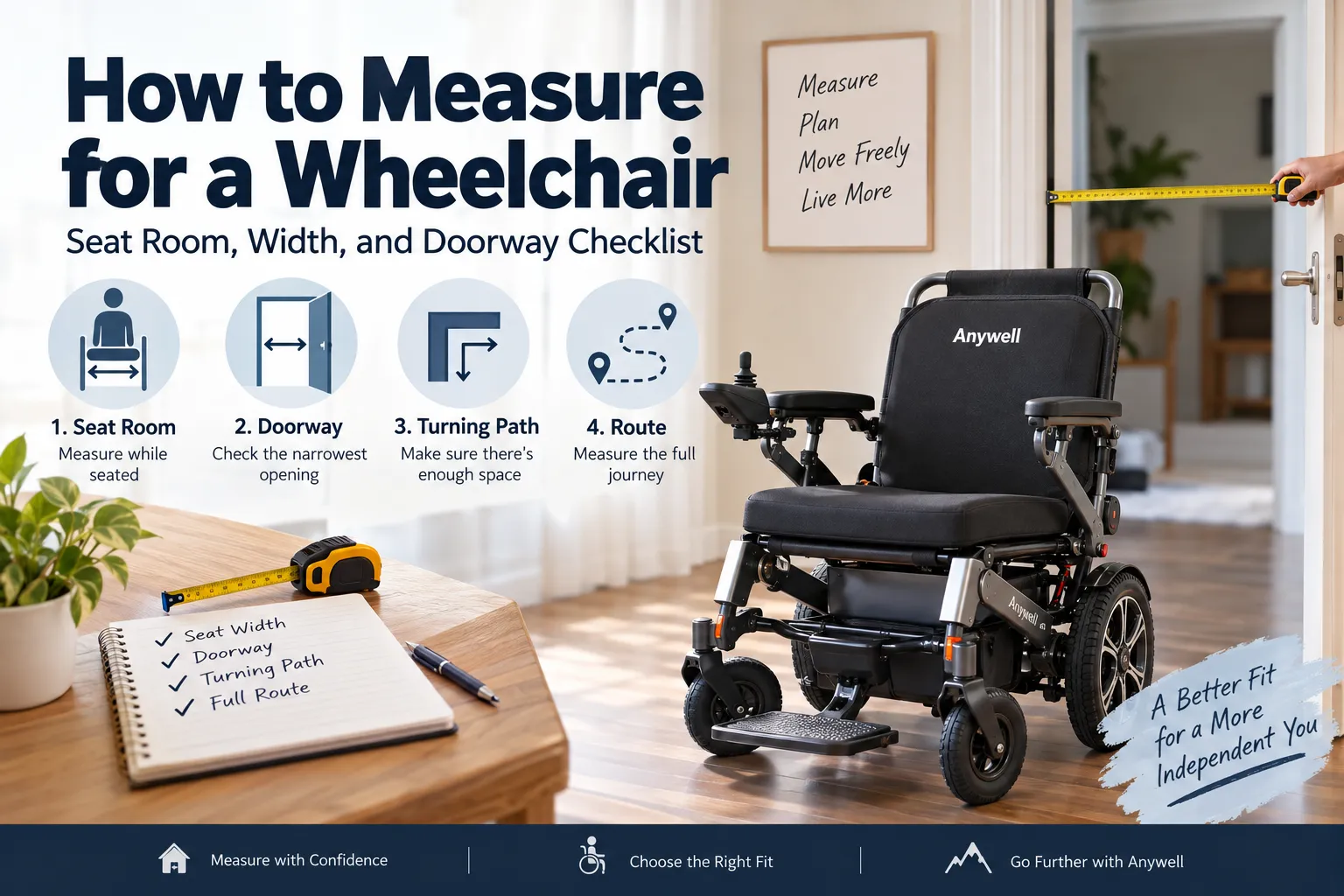
A useful test is to mark out the scooter's approximate dimensions on the floor with tape and mentally trace the route from storage to your front door. Include the scooter's front end and steering column rather than considering only the seat.
For outdoor-focused users, the slightly larger maneuvering footprint of many four wheel mobility scooters may be a reasonable compromise for the type of ride they want. For someone who spends most of the day navigating tight indoor spaces, maneuverability deserves more weight in the decision.
Seat Width and Rated Capacity Need to Be Considered Separately
This is especially important when comparing heavy duty mobility scooters.
A high weight-capacity number does not automatically mean the seat will feel spacious.
Look at seat width separately.
Measure your seated hip width in the clothing you normally wear, then compare it with the actual seat cushion dimensions. Also pay attention to armrest clearance, because that may differ from the cushion width.
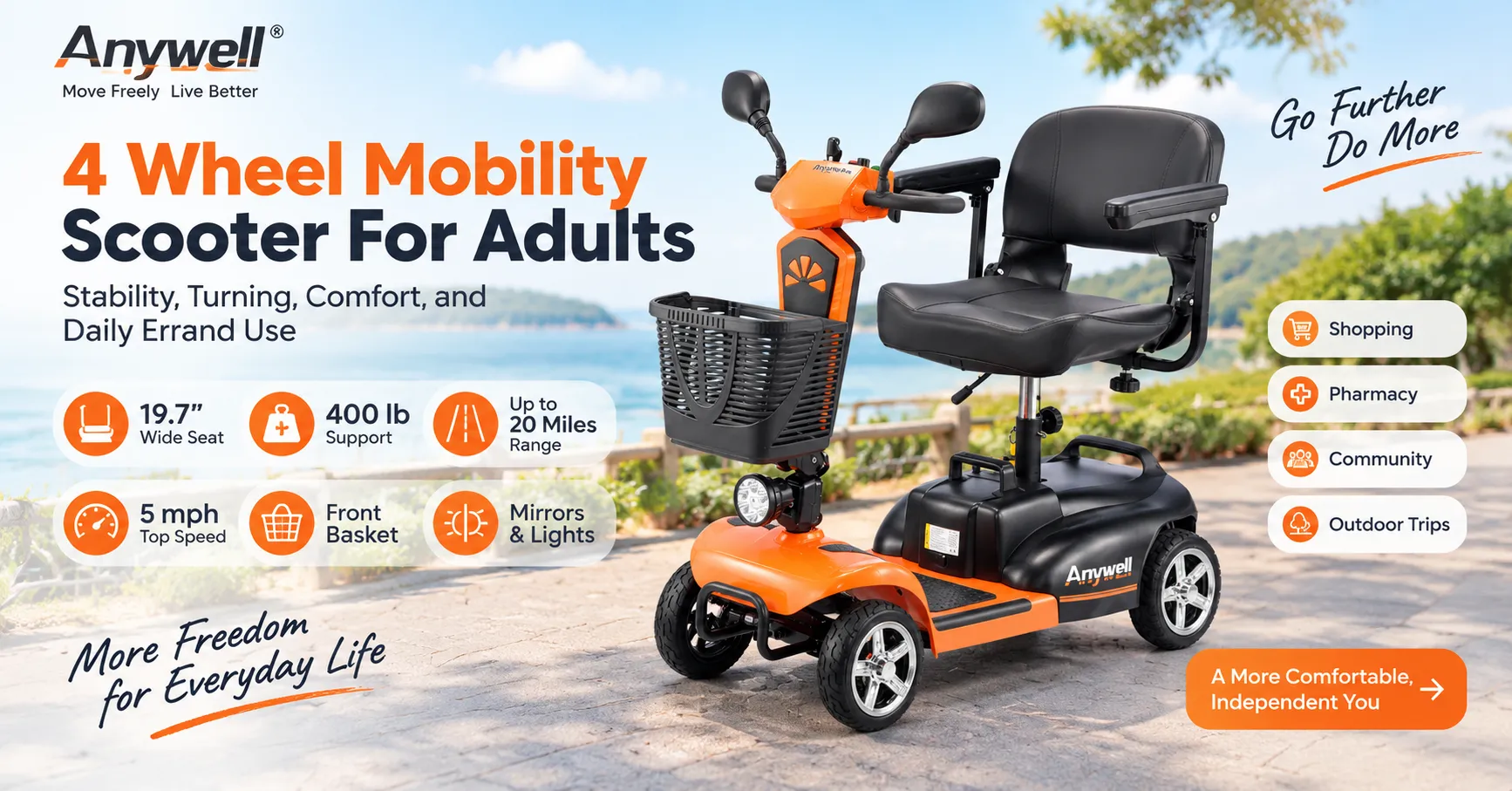
The X-024, for example, lists a 19.7-inch seat cushion and a 400-pound rated weight capacity. Its armrests can also adjust outward, with the manufacturer listing up to 23.6 inches of clear inside space between the armrest pads. The manufacturer specifically distinguishes this armrest clearance from the 19.7-inch cushion width.
That distinction is useful when comparing scooters: “wide seat,” “wide armrests,” and “high capacity” describe different things.
A scooter should give you sufficient room to sit in a comfortable, controlled position while still allowing you to use the tiller and controls confidently.
Think About Range as a Route Budget
Maximum range numbers should not be interpreted as guaranteed mileage.
A scooter advertised with a range of up to 20 miles does not mean every rider will travel exactly 20 miles between charges.
Load, hills, temperature, surface conditions, battery condition, stop-and-start driving, and driving behavior can all affect real-world distance. Anywell explicitly notes these variables for the X-024.
A more practical approach is to treat battery range as a route budget.
If your usual round trip is three miles, you have a very different requirement from someone planning longer community trips. Start with shorter familiar routes after receiving a scooter so you can learn how its battery indicator behaves under your own conditions.
Do not routinely plan trips that depend on achieving the absolute maximum advertised range.
For everyday errands, predictability is usually more useful than chasing the largest number on the specification sheet.
Basket, Mirrors, and Lights Can Matter Every Day
Small convenience features become more important when a scooter is used regularly.
A front basket gives you somewhere to place lightweight shopping or personal items without hanging bags from the steering controls. Safety guidance specifically warns against hanging carrier bags from a mobility scooter's tiller or handlebars because doing so can interfere with safe operation.
Mirrors can help when checking the area around you, especially before changing direction.
Lights improve visibility in lower-light conditions.
These features may not be the headline specification, but they can make a noticeable difference during repeated trips to a store, mailbox, community center, or nearby appointment.
This is one area where the Anywell X-024's intended use is fairly clear: Anywell presents it as a scooter for everyday errands and paved routes, with basket storage, mirrors, lights, a 19.7-inch seat, and up to 400 pounds of rated support.
Where the X-024 Fits Into Daily Errand Use
The X-024 is designed around scooter-style outdoor mobility rather than lightweight portability.
Its current specifications list a 350W motor, 24V 20Ah lead-acid battery, approximately 5 mph top speed, and a rated range of up to 20 miles. Fully assembled weight is approximately 106 pounds.
That combination makes the model more relevant to someone thinking:
“I want a scooter I can keep at home and use for neighborhood errands.”
It is less naturally suited to someone thinking:
“I need to lift my scooter into my car by myself every morning.”
The seat and battery can be removed for vehicle loading, but Anywell still lists the remaining transport base at 61 pounds and recommends assistance or a ramp if that weight is not manageable for the user.
That is a good example of why overall product fit matters more than a single impressive specification.
A scooter can offer plenty of seat room and useful range while still being the wrong choice for someone whose main requirement is solo lifting.
Do a “Normal Day” Test Before You Buy
Instead of comparing twenty specifications at once, walk through one realistic day in your head.
Think about leaving your home, opening the door, reaching the sidewalk, making the first tight turn, crossing the street, entering your most common destination, carrying your purchases, returning home, parking, and charging.
Then evaluate the scooter against that scenario.
A practical pre-purchase check should cover:
- Fit: Can you sit comfortably and operate the tiller without reaching awkwardly?
- Route: Are your usual surfaces firm and suitable, with manageable slopes and curb transitions?
- Turning: Is there enough room at your home's tightest corners and entrances?
- Range: Is your typical round trip comfortably below the manufacturer's rated maximum?
- Transport: If you need a car, can you safely handle the heaviest remaining section?
- Storage: Do you have a dry, accessible place to park and charge the scooter?
This approach tends to reveal problems that a specification chart cannot.
Common Mistakes When Comparing Heavy Duty Mobility Scooters
One common mistake is focusing entirely on rated capacity.
A 400-pound capacity sounds useful, but it does not tell you whether the seat dimensions fit your body, whether your hallway is wide enough, or whether you can transport the scooter.
Another mistake is assuming more range is always better. Additional battery capacity matters only if your routes require it.
A third is ignoring total scooter weight until delivery day.
For larger scooters, “removable” does not necessarily mean “light.” Check the weight of the heaviest section after disassembly rather than assuming it will be easy to lift.
Finally, do not ignore your ability to operate the controls comfortably. Government mobility guidance emphasizes that safe scooter use involves transferring onto and off the device, maintaining seated balance, steering, using the controls, judging obstacles, and responding to changing conditions.
If any of these areas are uncertain, discussing the choice with a clinician, occupational therapist, mobility specialist, or another qualified professional can be useful before purchasing.
Frequently Asked Questions
Is a 4 wheeled mobility scooter more stable than a 3-wheel scooter?
Four-wheel layouts generally provide a broader support footprint and are commonly chosen for stability-focused outdoor use. However, stability still depends on speed, slopes, surfaces, rider position, and turning technique. No scooter should be cornered aggressively simply because it has four wheels.
Are four wheel mobility scooters good for shopping?
They can be well suited to shopping when the store has enough aisle and turning space. Features such as a basket, mirrors, comfortable seating, and predictable range can be particularly useful for errands. Check doorway widths and maneuvering space at places you visit frequently.
What does “400 lb capacity” actually mean?
It is the manufacturer's rated maximum supported load for the scooter. It does not tell you how wide the seat is. Capacity and seat dimensions should always be checked separately.
Is a 20-mile scooter range guaranteed?
No. A specification such as “up to 20 miles” is a rated maximum under particular conditions. Rider weight, hills, temperature, battery condition, surface type, and driving style may reduce actual travel distance.
Can I put a mobility scooter in a car?
That depends heavily on the scooter's dimensions, disassembly design, the weight of its individual sections, your vehicle, and your ability to lift them safely. For the X-024 specifically, the seat and battery can be removed, but the remaining base is listed at 61 pounds.
Final Takeaway
Choosing a 4 wheeled mobility scooter becomes much easier when you stop asking which model has the longest specification list and start asking which one fits your normal day.
For errand-focused use, concentrate on stable handling, sufficient turning space, comfortable seat dimensions, realistic battery range, convenient storage, and practical features such as a basket, mirrors, and lights.
The X-024 is one example of that approach: a 19.7-inch seat, 400-pound rated capacity, scooter-style controls, up to 20 miles of rated range, and everyday accessories aimed at paved neighborhood and shopping trips.
But the most useful scooter is ultimately the one that matches your body, your route, your home, and the way you actually plan to use it.
























Sign in to leave a comment.