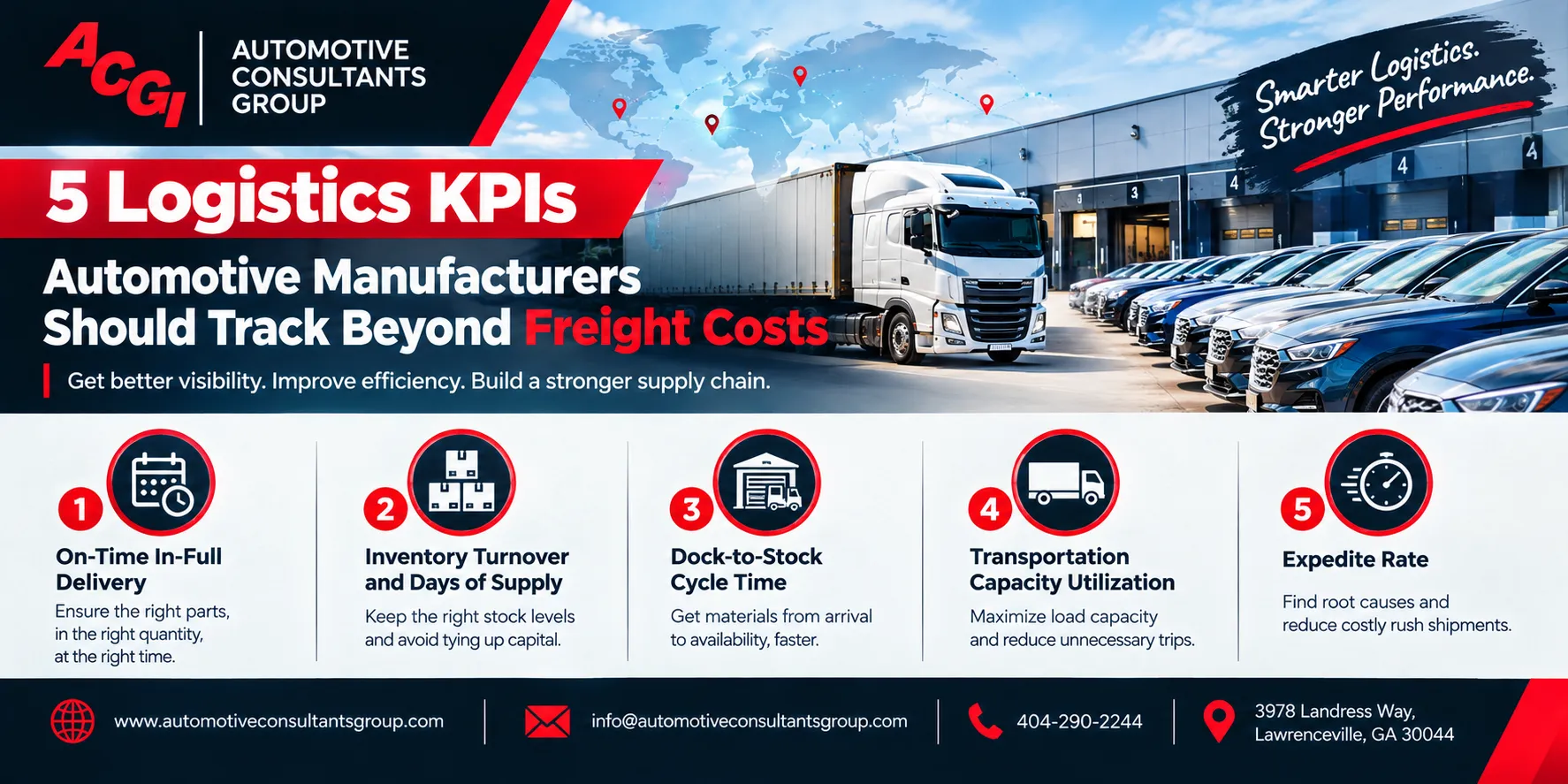
5 Logistics KPIs Automotive Manufacturers Should Track Beyond Freight Costs

A shipment arriving on time does not necessarily mean the logistics operation is performing well. In automotive manufacturing, a single delayed component, excess inventory day, or poorly utilized truck can disrupt production schedules and increase costs across the supply chain. Freight spend is only one visible part of the equation. Manufacturers need a broader view of logistics performance to identify hidden inefficiencies, protect production continuity, and improve supply chain resilience. That is where the right logistics KPIs become essential.

1. On-Time In-Full Delivery
On-Time In-Full (OTIF) measures whether suppliers deliver the correct quantity of components within the agreed delivery window. For automotive manufacturers, this KPI is particularly important because production lines depend on precisely timed material availability.
A delivery that arrives two hours late can be more damaging than a moderately higher freight charge if it interrupts production. Similarly, receiving only part of an order can force manufacturers to delay assembly or arrange emergency shipments for missing components.
A logistics automotive consultant can help manufacturers establish OTIF benchmarks based on supplier categories, production requirements, transportation modes, and plant-level schedules. Tracking OTIF by supplier and component type also helps identify recurring reliability problems instead of treating every delay as an isolated incident.
2. Inventory Turnover and Days of Supply
Automotive logistics involves managing thousands of components, from fasteners and electronic modules to engines and body components. Holding too much inventory ties up working capital, increases storage requirements, and raises the risk of obsolete or damaged parts. Holding too little can expose production to shortages.
Inventory turnover and Days of Supply (DOS) provide visibility into how efficiently materials are moving through the supply chain. Manufacturers can compare actual inventory levels against production requirements and identify components that are consistently overstocked or approaching shortage thresholds.
Working with automotive industry consultants can help manufacturers segment inventory according to component criticality, lead time, demand variability, and supplier risk. This creates a more practical inventory strategy than applying the same stock target to every part.
3. Dock-to-Stock Cycle Time
The logistics process does not end when a truck reaches the manufacturing facility. Receiving, unloading, inspection, documentation, and material put-away can all influence how quickly components become available for production.
Dock-to-stock cycle time measures the time between a shipment arriving at the facility and the material becoming available in the inventory or production system. A long cycle time can indicate problems with dock scheduling, receiving capacity, paperwork, barcode processes, inspection procedures, or warehouse organization.
A logistics automotive consultant can evaluate this KPI across facilities to determine whether delays originate in transportation or internal material handling. Reducing unnecessary receiving time can improve material availability without increasing transportation spend or expanding warehouse capacity.
4. Transportation Capacity Utilization
Paying for transportation capacity does not automatically mean manufacturers are using that capacity efficiently. Trucks may leave with unused space, containers may not be filled to practical limits, and inefficient routing can increase the number of required trips.
Transportation capacity utilization measures how effectively available vehicle or container capacity is being used. Depending on the operation, manufacturers can monitor cube utilization, weight utilization, pallet utilization, or a combination of these metrics.
For automotive operations with frequent inbound and outbound movements, even modest improvements can have a significant operational impact. Automotive industry consultants can analyze shipment patterns, packaging dimensions, delivery frequencies, and route structures to identify opportunities for consolidation and better load planning.
5. Expedite Rate
Expedited shipments are often treated as unavoidable exceptions in automotive manufacturing. However, a consistently high expedite rate can indicate deeper supply chain problems.
The expedite rate measures the proportion of shipments requiring premium transportation or emergency handling outside the standard logistics plan. Manufacturers should track not only how often expedites occur but also why they happen. Common causes may include supplier delays, inaccurate forecasts, production schedule changes, inventory shortages, transportation disruptions, or planning errors.
A logistics automotive consultant can help categorize expedite events according to their root causes. This distinction is important because simply reducing expedited shipments without addressing the underlying issue can create new risks elsewhere in the supply chain.
Why These KPIs Should Be Viewed Together?
Individual logistics metrics can provide useful information, but automotive manufacturers gain greater visibility when KPIs are analyzed as a connected system.
For example, low freight costs may appear positive until manufacturers discover that transportation capacity utilization is poor. Strong inventory levels may look reassuring until Days of Supply reveals that excessive stock is tying up capital. Similarly, high OTIF performance may conceal growing expedite activity caused by unreliable suppliers.
This is why automotive industry consultants often evaluate logistics performance across multiple operational dimensions rather than focusing on one cost metric. The objective is to understand how transportation, inventory, warehousing, suppliers, and production interact.
Turning KPI Data into Operational Improvements
Tracking KPIs is only the first step. Manufacturers need clearly defined measurement methods, consistent data sources, ownership, and review processes. Each KPI should have a defined target, reporting frequency, responsible team, and escalation process when performance falls outside the expected range.
Digital supply chain platforms can also connect transportation management, warehouse systems, enterprise resource planning, and supplier data to provide a more complete view of logistics performance. When these systems are supported by effective analysis, manufacturers can identify patterns before they become production disruptions.
A logistics automotive consultant can support this process by helping manufacturers select relevant KPIs, establish benchmarks, identify root causes, and align logistics metrics with broader manufacturing objectives.
Conclusion
Freight cost remains an important logistics metric, but it cannot provide a complete picture of automotive supply chain performance. OTIF, inventory turnover, dock-to-stock cycle time, transportation capacity utilization, and expedite rate reveal operational issues that freight spend alone may overlook.
By monitoring these KPIs together, manufacturers can identify inefficiencies earlier, improve production continuity, and make more informed logistics decisions. Automotive industry consultants can further help turn KPI data into practical strategies for a more responsive and measurable supply chain.


Sign in to leave a comment.