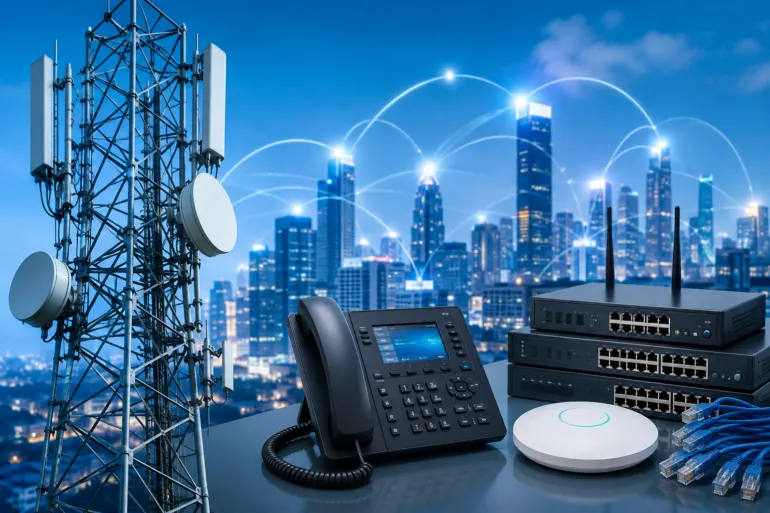

Business communication is becoming more connected, intelligent, and flexible. Companies now expect communication infrastructure to support remote employees, cloud applications, connected devices, customer interactions, and secure data exchange without creating unnecessary complexity.
That shift is accelerating several Telecom Services Trends that directly affect how organizations communicate and operate. AI-driven network management, 5G connectivity, cloud communications, stronger cybersecurity, and open network architectures are becoming increasingly important.
For businesses evaluating Telecom Services, the key question is no longer whether communication technology needs to evolve. It is which changes can deliver measurable improvements in productivity, reliability, security, and scalability.
Here are five trends worth watching.
1. How Is AI Changing Telecom Services for Businesses?
AI is moving from an experimental technology to a practical tool for network optimization and service management. Telecommunications organizations are exploring AI and machine learning for network monitoring, resource management, predictive analysis, and automated responses.
NIST's research into 5G and 6G networks specifically includes AI-native architectures, edge AI, automated network management, and automated network resilience.
For businesses, this can translate into:
- Faster identification of network problems
- Predictive maintenance
- Automated traffic optimization
- More efficient resource allocation
- Intelligent customer-service workflows
- Better visibility into network performance
For example, an organization with multiple offices could use intelligent monitoring to identify unusual traffic patterns before they become major service disruptions.
The important point is that AI should support measurable operational goals. Businesses should prioritize solutions that improve uptime, response times, service quality, or operating efficiency rather than adopting AI simply because it is a current technology trend.
2. Why Is 5G Becoming More Important for Business Communication?
5G is expanding the role of wireless connectivity beyond smartphones. Higher capacity, lower latency, and support for large numbers of connected devices make 5G relevant to industrial operations, IoT deployments, logistics, healthcare, remote facilities, and other enterprise applications.
NIST notes that 5G can provide increased bandwidth, capacity, and low latency, while its research also examines private 5G networks for industrial and mission-critical applications.
Businesses should consider 5G when they need:
- Reliable wireless connectivity
- High device density
- Low-latency applications
- Connected machinery or sensors
- Flexible connectivity across large facilities
- Support for mobile or distributed operations
Private 5G can be particularly relevant for organizations that need greater control over connectivity within campuses, factories, warehouses, or specialized environments.
However, businesses should evaluate coverage, device compatibility, security, application requirements, and total deployment cost before replacing existing connectivity.
3. Are Cloud-Based Communications Replacing Traditional Business Phone Systems?
Cloud-based communications are changing how organizations manage voice and collaboration. Instead of depending entirely on hardware located at a single office, businesses can use IP-based and cloud-hosted platforms that support distributed employees and multiple locations.
The FCC has highlighted how the migration toward all-IP networks enables services such as video conferencing, cloud computing, enterprise connectivity, and other advanced communication applications.
Modern Telecommunication Services can therefore bring voice, messaging, video, collaboration, and business applications closer together.
Key advantages include:
- Easier remote access
- Faster employee onboarding
- Centralized administration
- Flexible user management
- Easier multi-location expansion
- Integration with business applications
- Reduced dependence on legacy phone hardware
This does not mean every organization should immediately replace its existing phone infrastructure. A phased migration can make more sense for businesses with complex legacy systems.
Before moving to cloud communications, evaluate existing numbers, call flows, integrations, emergency communication requirements, security controls, and business continuity needs.
4. Why Is Telecom Security Becoming a Business Priority?
As communication networks become more software-driven and interconnected, security can no longer be treated as a separate IT concern.
Modern telecom environments can include routers, switches, cloud platforms, mobile devices, voice systems, remote users, IoT endpoints, and network management interfaces. Each connection can introduce additional risk.
NIST is applying Zero Trust principles to emerging 5G and 6G environments, while CISA recommends stronger visibility, network segmentation, centralized logging, secure management, patching, and phishing-resistant MFA for communications infrastructure.
Businesses should therefore look for Telecom Services that support security through:
- Multi-factor authentication
- Network segmentation
- Encryption
- Centralized monitoring
- Access controls
- Secure remote management
- Regular patching
- Detailed logging
A useful starting point is to review CISA's communications infrastructure hardening guidance and NIST's Zero Trust Networks guidance.
The practical goal is simple: every user, device, application, and connection should receive only the access required for legitimate business operations.
5. How Are Open and Interoperable Networks Changing Telecommunication Services?
Businesses increasingly want communication infrastructure that can evolve without being locked into one technology or vendor.
Open and interoperable network architectures can make it easier to integrate different components, introduce new capabilities, and support multi-vendor environments. NIST describes Open RAN as an approach based on disaggregated network elements and standardized interfaces, while current research also explores automation and intelligent control.
This trend matters because telecom infrastructure is becoming more software-based.
Potential advantages include:
- Greater vendor flexibility
- Easier technology integration
- More scalable infrastructure
- Reduced dependency on proprietary systems
- Support for automation
- Faster adoption of emerging technologies
For organizations planning long-term telecom investments, interoperability should be an important evaluation criterion.
Businesses can also review NIST's Open RAN research to understand how open interfaces and multi-vendor architectures are being explored.
Which Telecom Services Trends Should Your Business Prioritize?
Not every trend deserves immediate investment. The right priority depends on business size, workforce structure, application requirements, security exposure, and growth plans.
| Business Requirement | Priority Trend | Main Benefit |
| Remote and hybrid teams | Cloud communications | Flexible collaboration |
| Large connected facilities | 5G/private 5G | High-capacity wireless connectivity |
| Complex network operations | AI automation | Faster monitoring and optimization |
| Security-sensitive communications | Zero Trust | Stronger access control |
| Long-term infrastructure flexibility | Open networks | Interoperability and scalability |
A practical approach is to begin with an infrastructure audit. Identify communication bottlenecks, recurring outages, outdated systems, security weaknesses, and integration gaps.
Then compare potential Telecommunication Services based on reliability, scalability, security, integration capabilities, support, and total cost of ownership.
How Can Businesses Prepare for the Next Generation of Telecom Services?
The strongest telecom strategy is not simply about buying newer technology. It is about creating an infrastructure roadmap that supports business objectives.
Start by documenting current communication requirements. Next, identify where employees, customers, applications, and connected devices experience friction. From there, prioritize improvements that can produce measurable results.
For example, a growing company may benefit first from cloud communications, while a manufacturing organization may gain more value from private 5G and connected-device infrastructure.
Businesses should also assess cybersecurity before expanding connectivity. CISA's guidance emphasizes visibility, secure configuration, segmentation, monitoring, patch management, and stronger authentication for communications infrastructure.
The best Telecom Services Trends to follow are therefore the ones that connect technology improvements to real business outcomes: better availability, faster communication, stronger security, easier scaling, and lower operational friction.
Conclusion
The next phase of business communication will be shaped by more than faster connectivity. AI, 5G, cloud platforms, cybersecurity, and open network architectures are changing how organizations design and manage communication infrastructure.
Businesses that evaluate these developments based on actual operational requirements can avoid unnecessary technology spending while building a more scalable foundation.
The priority should be clear: choose Telecom Services that improve communication today while remaining flexible enough to support tomorrow's applications, employees, devices, and security requirements.

























Sign in to leave a comment.