5QI vs QFI in 5G: Why Voice and Video Get Different Treatment

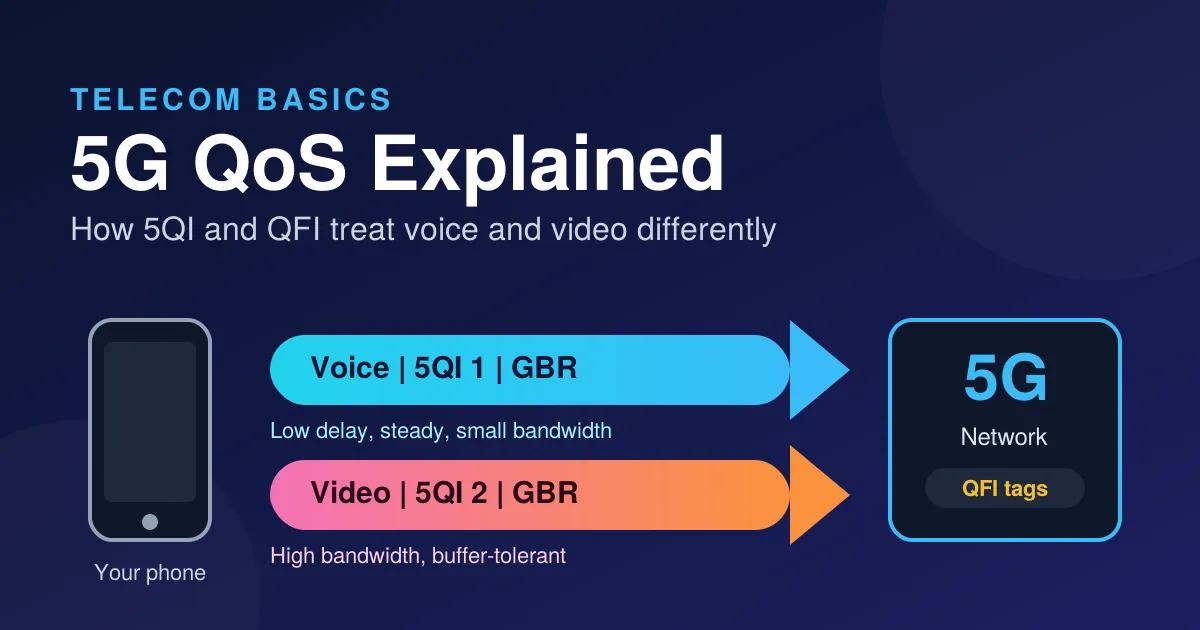
5G QoS is the reason your voice call stays clear even while someone else on the same network is streaming a video. Both travel over the same 5G connection, yet the network handles them very differently. If you prefer a quick visual first, watch the 50-second explainer here: 5G QoS Explained in 50 Seconds | Voice vs Video, 5QI & QFI.

What Is QoS in 5G?
Quality of Service (QoS) is the set of rules that decides how each type of traffic is treated: how fast it moves, how much delay is acceptable, and how many lost packets are tolerable.
- A voice call needs low, steady delay but very little bandwidth.
- A video stream needs high bandwidth but can survive some buffering.
- A file download only needs to finish eventually.
Without QoS, all of these compete equally. With it, each gets what it actually needs.
QoS Flows: The Basic Building Block
In 5G, your data connection is called a PDU Session. Inside it, traffic is divided into QoS Flows, and each flow gets its own treatment. This replaced the bearer-based model of 4G LTE and made QoS handling more flexible.
5QI: The Treatment Recipe
The 5G QoS Identifier (5QI) is a number that points to a predefined set of QoS characteristics:
- Resource type: GBR, Non-GBR or Delay-Critical GBR
- Packet Delay Budget: the maximum acceptable delay
- Packet Error Rate: the tolerable loss
- Priority level: who goes first when resources are tight
| 5QI | Typical use | Resource type |
|---|---|---|
| 1 | Conversational voice | GBR |
| 2 | Conversational video (live) | GBR |
| 5 | IMS signalling | Non-GBR |
| 9 | Default internet traffic | Non-GBR |
QFI: The Label on Every Packet
If 5QI says how a flow should be treated, the QoS Flow Identifier (QFI) says which flow a packet belongs to. It is carried in the packet header, so every network element on the path can apply the right treatment.
A simple analogy: 5QI is the shipping service (express, standard, economy), and QFI is the label on each parcel.
Which Network Element Does What?
- SMF creates and manages QoS rules for the session.
- UPF applies those rules on the user-plane path.
- gNB maps QoS flows to radio bearers and schedules them over the air.
- UE (your phone) applies rules for uplink traffic.
Voice vs Video: The Practical Difference
Voice gets a GBR flow with a tight delay budget because even small delays are noticeable in a conversation. Video needs more bandwidth but tolerates delay better, so it is treated differently. Both are “just data,” but their needs are not the same, and that is exactly why 5QI exists.
Frequently Asked Questions
What is 5QI in 5G?
5QI is a 5G QoS Identifier that maps a traffic flow to a set of characteristics such as delay budget, error rate, priority and resource type.
What is QFI in 5G?
QFI is the QoS Flow Identifier carried in each packet so the network knows which QoS flow the packet belongs to.
What is the difference between 5QI and QFI?
5QI defines the treatment a flow should get, while QFI identifies which flow a packet belongs to.
Does 5G treat voice and video differently?
Yes. They usually use different 5QI values, so they get different delay, priority and resource guarantees.
What is a QoS Flow?
A QoS Flow is the finest level of QoS differentiation inside a 5G PDU Session. Each flow carries traffic with the same treatment.
Final Thoughts
5G QoS works through three simple ideas: traffic is split into QoS Flows, 5QI defines the treatment, and QFI tags each packet. For more 5G and LTE explainers, follow TechLTEWorld on YouTube.


Sign in to leave a comment.