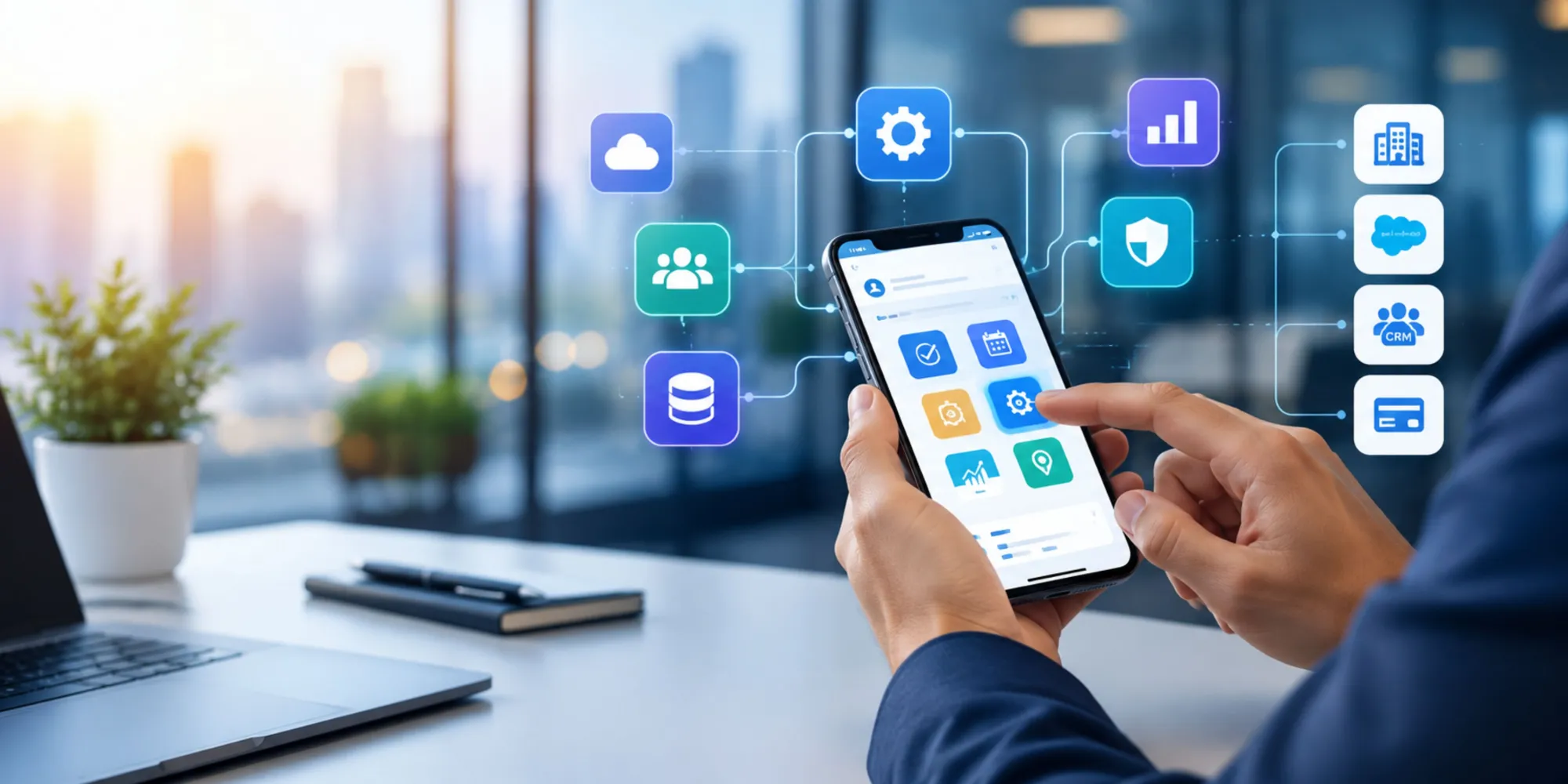

Businesses rarely operate from a single software system. Sales teams use CRMs, finance relies on ERP platforms, operations depend on specialized tools, and field employees often collect information through spreadsheets, paper forms, or disconnected apps.
The problem is not simply having too many systems. It is the manual work required to move information between them.
Custom mobile app development services can solve this gap by creating a mobile workflow layer that connects employees, business systems, APIs, and automated processes. Instead of forcing employees to work around existing software, a custom app can bring the right data and actions into a single mobile experience.
Here are seven business benefits that matter most.
1. Automates Multi-Step Business Workflows
Custom mobile apps can turn repetitive processes into automated workflows.
Consider a field-service company. A technician can open a job from the mobile app, capture equipment readings, upload photos, complete a digital checklist, and submit the service report. Once submitted, the application can automatically update the CRM, trigger an invoice in the ERP, notify the customer, and create a follow-up task.
This is more valuable than simply replacing paper forms. It removes multiple manual handoffs from the workflow.
Modern enterprise applications are increasingly moving toward hyperautomation, where several departmental processes are connected into one end-to-end sequence rather than automated individually.
2. Connects Disconnected Business Systems
System integration is one of the strongest reasons to build a custom mobile application.
A well-designed app can connect with CRM, ERP, HRMS, inventory, payment gateways, analytics platforms, databases, and third-party SaaS applications through APIs and integration layers.
For example, when a salesperson updates a customer record from a mobile device, the change can immediately synchronize with the CRM. If the customer places an order, inventory information can be retrieved from the ERP while payment status comes from the payment platform.
The employee sees one interface while the underlying systems remain connected.
API-based and low-code integration approaches are also becoming more important as businesses manage increasingly fragmented cloud and SaaS environments.
3. Eliminates Duplicate Data Entry
Manual data entry creates two problems: wasted employee time and inconsistent records.
A custom mobile application can capture information at the point where the work actually happens. A warehouse employee can scan a barcode, a sales representative can update a lead immediately after a meeting, or a technician can record an equipment reading directly from the job site.
That data can then flow automatically into the relevant backend systems.
This makes mobile applications an important part of the enterprise data pipeline. Current enterprise technology trends increasingly position mobile apps as the first point where operational data is captured, rather than simply a remote interface for existing software.
4. Speeds Up Approvals and Decision-Making
Many business processes slow down because approvals depend on people being at their desks.
Custom apps can bring approval workflows to mobile devices. A manager can review a purchase request, expense claim, contract, discount request, or inventory exception and approve or reject it immediately.
Rules can also determine who receives an approval request based on department, transaction value, location, or employee role.
For example, an expense under $500 could go directly to a department manager, while a higher-value request could automatically move to finance leadership.
This reduces approval bottlenecks without removing necessary controls.
5. Gives Field Teams Real-Time Access to Business Data
For distributed teams, mobile access is not simply a convenience. It can directly affect operational efficiency.
Sales representatives, logistics teams, inspectors, technicians, healthcare workers, and delivery personnel may need access to customer records, inventory, schedules, documents, or task information while away from the office.
A custom application can provide role-specific dashboards, push notifications, location-aware workflows, barcode scanning, camera-based documentation, and offline data capture.
Offline capability is particularly important for field operations. Employees can continue recording information without connectivity and synchronize data once the device reconnects.
6. Creates an AI-Ready Workflow Layer
The next stage of business automation is moving beyond predefined rules toward AI-assisted workflows.
A custom mobile application can provide the interface through which employees interact with AI-powered business processes. For example, an app could summarize a customer interaction, classify a service request, identify anomalies in inspection data, recommend the next workflow step, or allow an AI agent to retrieve information from connected enterprise systems.
Current enterprise development trends are moving toward AI-native applications, intelligent agents, modular architecture, and automated multi-step processes.
The key is not adding an AI chatbot simply for appearance. AI should be connected to actual business data, permissions, workflows, and human approval points.
7. Builds a Scalable Technology Foundation
Custom mobile applications can evolve as business processes change.
Instead of rebuilding the entire application when a new system is introduced, businesses can use modular components, API integrations, and reusable services to extend functionality.
A company might initially launch an app for field-service management and later add inventory management, digital payments, customer self-service, analytics, or AI-assisted scheduling.
This flexibility is particularly valuable for growing organizations because the application can be designed around their operating model rather than the limitations of an off-the-shelf product. Custom solutions can also support new integrations as technology requirements evolve.
What Should Businesses Integrate Into a Custom Mobile App?
The right integration strategy depends on the workflow, but common enterprise integrations include:
- CRM and ERP platforms
- HR and payroll systems
- Inventory and warehouse software
- Payment gateways
- Business intelligence platforms
- Cloud storage and databases
- Identity and authentication systems
- Messaging and notification services
- AI and automation platforms
The technology stack should also match the organization's device strategy. Businesses requiring tightly integrated Apple experiences can consider iOS App Development Services, while organizations seeking shared codebases across platforms may evaluate a react native app development company.
Final Takeaway
The strongest business case for custom mobile apps is not simply having a branded application. It is creating a connected operational layer that captures data, triggers workflows, communicates with existing systems, and gives employees the right actions at the right moment.
For businesses evaluating custom mobile app development services, the starting point should therefore be the workflow—not the feature list.
Identify where employees manually enter data, wait for approvals, switch between systems, or lose information between departments. Then design the mobile experience around removing those bottlenecks.
Debut Infotech helps businesses approach mobile application development with this integration-first mindset, combining custom application architecture with automation, APIs, enterprise systems, and scalable technology foundations.






















Sign in to leave a comment.