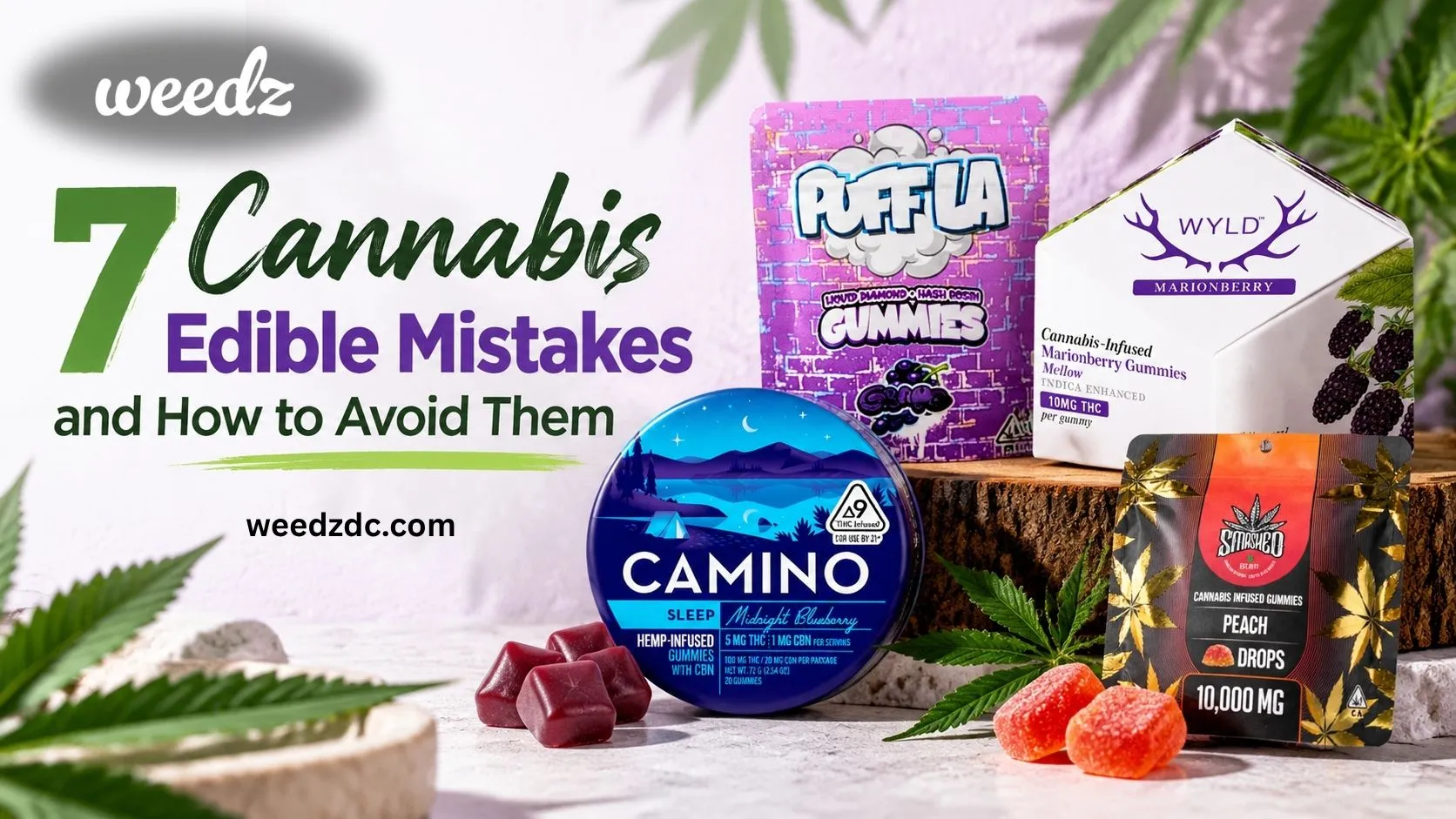


Quick Answer
The most common cannabis edible mistakes include taking another dose before the first one takes effect, misreading THC amounts, choosing an unfamiliar potency, mixing cannabis with alcohol or other substances, and storing edibles where others can access them. Edibles can take 30 minutes to 2 hours to produce noticeable effects and up to 4 hours to reach their full effect, making patience especially important.
TL;DR: The 7 Mistakes to Avoid
- Taking more because the first dose feels inactive.
- Confusing total THC with THC per serving.
- Starting with a product that is too potent for your experience.
- Mixing cannabis edibles with alcohol or other substances.
- Ignoring how food, medications, and individual differences can affect the experience.
- Treating every edible product as if it produces the same effects.
- Storing cannabis edibles carelessly.
Why Do Cannabis Edibles Feel Different?
Cannabis edibles are food or beverages containing cannabinoids such as THC. Unlike inhaled cannabis, edibles must pass through the digestive system before their effects become noticeable, which creates a significantly longer and less predictable onset.
The CDC reports that edible cannabis can take 30 minutes to 2 hours to produce intoxicating effects. The full effects can take even longer to develop.
That delay is responsible for one of the most common edible mistakes: assuming nothing is happening and consuming more.
For anyone exploring gummies, chocolates, baked goods, beverages, or other infused products, understanding the timing is just as important as understanding the THC amount.
1. Taking More Before the First Dose Takes Effect
This is one of the most common cannabis edible mistakes.
A person consumes an edible, waits 20 or 30 minutes, feels nothing, and assumes the product is not working. Another serving follows. Later, both servings begin taking effect at the same time.
Quick Answer
Do not judge an edible's effect too quickly. Edibles can take 30 minutes to 2 hours to begin producing noticeable effects, and full effects can take up to 4 hours. Taking additional THC before the first dose has fully developed can increase the likelihood of an uncomfortable experience.
How to avoid it
- Check the THC amount before consuming.
- Note the time you took the edible.
- Give the first serving adequate time to develop.
- Avoid making decisions based on the first 20–30 minutes.
- Keep track of how much THC you have consumed.
Health Canada specifically recommends a "start low, go slow" approach and notes that it can take up to four hours to feel the full effects of an edible.
2. Confusing Total THC With THC Per Serving
Another major mistake is reading the package incorrectly.
A package might contain multiple gummies, with each gummy containing a specific amount of THC. The total THC printed elsewhere on the package may represent the entire package rather than a single serving.
Quick Answer
Always distinguish between THC per serving and total THC in the package. For example, four pieces containing 2.5 mg THC each would contain 10 mg THC in total. Health Canada's labeling guidance specifically highlights this distinction.
Before consuming an edible, check:
- THC per piece
- THC per serving
- Total THC in the package
- Number of pieces
- CBD amount, if listed
- Serving size
This simple check can prevent accidental overconsumption.
Example
Imagine a package contains 10 gummies and lists 100 mg total THC.
That does not necessarily mean one gummy contains 100 mg.
If the THC is evenly distributed, each gummy would contain 10 mg THC.
The label should always be the starting point rather than assumptions based on package size or appearance.
3. Starting With Too Much THC
THC potency is another area where consumers can misjudge an edible.
A product that contains a small number of pieces can still contain a substantial amount of THC per piece. Similarly, two gummies that look almost identical can have very different cannabinoid concentrations.
Quick Answer
Higher THC amounts generally increase the likelihood of stronger impairment and unwanted effects. Health Canada recommends that new consumers consider edible products containing 2.5 mg THC or less, while emphasizing that individual responses vary.
The right approach is not to chase a specific number but to understand the product's potency and your own previous experience.
Factors that can influence the experience include:
- THC concentration
- Previous cannabis experience
- Individual tolerance
- Whether you have eaten recently
- Other substances being used
- Certain medications
- Individual metabolism
There is no universal edible dose that produces the same experience for everyone.
4. Mixing Edibles With Alcohol or Other Substances
Combining cannabis with alcohol or other substances can make the overall experience more difficult to predict.
Quick Answer
Using cannabis together with alcohol or other substances can increase impairment and may increase the risk of adverse effects. The CDC identifies combining cannabis with other substances as a factor that can increase impairment.
This is especially relevant with edibles because their effects can already be delayed and prolonged.
A better approach is to understand how an edible affects you on its own rather than introducing multiple variables at the same time.
If you take medications regularly, discussing cannabis use with a healthcare professional can also help identify potential interactions.
5. Ignoring the Difference Between Products
Not every cannabis edible is identical.
Gummies, chocolates, baked goods, beverages, and other infused products can differ in cannabinoid concentration, serving size, ingredients, and how quickly the individual experiences effects.
Searching for the best thc gummies for sleep may produce numerous products and opinions, but a product's suitability cannot be determined from a search ranking alone.
The same principle applies to searches for best cbd gummies for sleep. CBD and THC are different cannabinoids, and CBD is not intoxicating in the same way THC is.
What to compare instead
When evaluating an edible, look at:
- THC per serving
- CBD per serving
- Serving size
- Ingredient list
- Product consistency
- Recommended serving information
- Personal tolerance and previous experience
Avoid choosing a product solely because it has a popular flavor, attractive packaging, or a high cannabinoid number.
6. Assuming Every Gummy Will Feel the Same
Another common mistake is assuming that one gummy experience predicts every future experience.
It does not.
The effects of cannabis can vary based on THC concentration, frequency of use, previous experience, consumption method, and whether cannabis is combined with other substances.
Even the same person can have different experiences at different times.
Food intake, timing, individual metabolism, and other factors can influence the experience.
Expert Insight
The safest way to understand a new edible is to treat it as a new product rather than automatically applying your experience with another product.
For example, someone who has previously consumed a low-potency gummy should not assume that another gummy with a different THC concentration will produce an identical effect.
7. Storing Edibles Like Ordinary Food
Cannabis edibles can resemble everyday snacks, particularly gummies, chocolates, cookies, and other sweet products.
That creates an important storage concern.
Quick Answer
Cannabis edibles should be clearly identified and stored securely away from children and pets. The FDA has warned that THC-containing edible products can be mistaken for ordinary foods and that accidental ingestion can result in serious adverse events, particularly among children.
The FDA reported more than 10,000 single-substance exposure cases involving edible THC products between January 2021 and May 2022, with children and adolescents representing a substantial proportion of those cases.
Better storage habits
- Keep edibles in their original packaging when possible.
- Keep them clearly separated from ordinary snacks.
- Store them somewhere children cannot access.
- Keep them away from pets.
- Avoid leaving gummies or other infused foods on kitchen counters.
- Do not transfer them into unmarked food containers.
Good storage is part of responsible cannabis use.
What Happens If You Take Too Much of an Edible?
Taking too much THC can produce effects that are much stronger than expected.
The CDC lists possible signs of consuming too much cannabis, including extreme confusion, anxiety, paranoia, panic, increased heart rate, hallucinations, nausea, and vomiting.
What to do
If someone appears to have consumed too much cannabis:
- Stop consuming additional cannabis.
- Move to a calm and safe environment.
- Avoid alcohol or other substances.
- Do not drive or operate machinery.
- Monitor the person.
- Seek medical assistance when symptoms are severe or concerning.
For serious symptoms, emergency medical care should be sought.
Are Cannabis Gummies Better Than Other Edibles?
There is no universal "best" edible format.
Gummies are popular because they are portable, portioned, and easy to consume. However, the important factors are the cannabinoid concentration, serving size, ingredients, and how the individual responds.
Searches such as best cannabis infused gummies can be useful for discovering product categories, but popularity alone does not determine whether a product is appropriate for a particular consumer.
The same principle applies to searches for camino edibles or other named edible brands. A brand name does not tell you how an individual will respond to a particular cannabinoid concentration.
Always evaluate the actual product information rather than relying exclusively on a brand reputation.
What About Mushroom Gummies?
Cannabis edibles and mushroom gummies should not automatically be treated as interchangeable products.
Searches for best magic mushroom gummies can refer to products containing very different ingredients, including products marketed with psychedelic or functional-mushroom terminology.
Consumers should identify the actual ingredients and active compounds before assuming that a mushroom gummy produces effects similar to a THC edible.
The key lesson is simple: read the ingredient and cannabinoid information instead of judging a product by its name or marketing category.
A Simple Cannabis Edible Checklist
Before consuming an edible, run through this checklist:
Before Consumption
- I know the THC amount per serving.
- I know how many servings I am consuming.
- I have checked the total THC amount.
- I understand that effects can be delayed.
- I am not planning to take another serving too quickly.
- I understand how this product differs from products I have used before.
- I am avoiding combinations that could increase impairment.
- The product is stored securely after use.
This checklist turns complicated product information into a simple routine.
Did You Know?
Edibles can take substantially longer to produce noticeable effects than inhaled cannabis.
According to the CDC, edible effects may begin 30 minutes to 2 hours after consumption. Health Canada notes that full effects can take up to 4 hours, while effects may last considerably longer than those produced by inhaled cannabis.
That difference explains why patience is one of the most important principles when consuming cannabis edibles.
Key Takeaways
The biggest cannabis edible mistakes are usually not complicated. They come from misunderstanding timing, potency, serving sizes, product differences, or storage.
Remember these seven points:
- Wait for the first serving to take effect before considering more.
- Check THC per serving instead of looking only at total package THC.
- Start with a lower THC amount if you are inexperienced with edibles.
- Avoid combining cannabis with alcohol or other substances that can increase impairment.
- Do not assume different edible products will produce identical effects.
- Read the actual product information rather than relying on marketing claims.
- Store cannabis edibles securely and away from children and pets.
Conclusion
Cannabis edibles can be easy to consume, but their delayed onset makes them different from inhaled cannabis. The most useful habit is to slow down: understand the THC amount, check the serving size, allow sufficient time for effects to develop, and avoid making assumptions based on another product.
For consumers exploring cannabis products through Weedz DC, understanding the product before consuming it is just as important as choosing the product itself.
A thoughtful approach helps reduce avoidable mistakes and gives consumers a clearer understanding of what they are consuming.
Have you experienced one of these common edible mistakes? Share your experience or pass this guide along to someone who is new to cannabis edibles.
Frequently Asked Questions
1. How long do cannabis edibles take to work?
Cannabis edibles can begin producing noticeable effects within approximately 30 minutes to 2 hours. Full effects may take up to 4 hours. Because the onset is delayed, consuming additional THC too soon can increase the risk of taking more than intended. Individual response varies based on factors such as THC concentration, food intake, previous experience, and metabolism.
2. What is the biggest mistake people make with edibles?
Taking another serving too soon is one of the most common mistakes. Edibles can take much longer to produce noticeable effects than inhaled cannabis. Someone who assumes the first serving is ineffective after a short period may consume additional THC before the original dose has fully developed, potentially resulting in much stronger effects later.
3. How do I read the THC amount on an edible?
Look for both THC per serving and total THC in the package. These numbers are not necessarily the same. For example, four pieces containing 2.5 mg THC each would contain 10 mg THC in total. Checking the amount per individual serving helps prevent accidentally consuming more THC than intended.
4. Can I mix cannabis edibles with alcohol?
Combining cannabis with alcohol can increase impairment and make the overall experience less predictable. The CDC notes that using cannabis with other substances can increase impairment and potential harm. Avoiding combinations is a simpler way to understand how an edible affects you on its own.
5. Why do edibles feel stronger or last longer than expected?
Edibles are processed through the digestive system, so their effects develop more slowly than inhaled cannabis. THC consumed orally is metabolized differently, and the resulting effects can be delayed and prolonged. Food intake, THC concentration, individual metabolism, previous cannabis experience, and other substances can also influence the experience.
6. How should cannabis gummies be stored?
Cannabis gummies should be stored securely, clearly identified, and separated from ordinary food. Keep them away from children and pets. THC-containing foods can resemble familiar snacks, which increases the possibility of accidental ingestion. The FDA specifically recommends keeping cannabis-containing products out of children's reach.
7. What should I do if I accidentally consume too much THC?
Stop consuming additional cannabis and remain in a safe environment. Avoid driving, alcohol, and other substances. Strong effects can include anxiety, panic, confusion, paranoia, rapid heart rate, hallucinations, nausea, or vomiting. If symptoms are severe, unusual, or concerning, seek appropriate medical assistance.
About the Author
Weedz DC is a cannabis-focused editorial team dedicated to creating practical, product-focused educational content for consumers exploring cannabis products. The team combines experience in cannabis product research, consumer education, and digital publishing to explain complicated topics in clear, accessible language. Weedz DC content emphasizes product information, responsible consumer awareness, and practical guidance. Explore more educational resources from Weedz DC to learn about cannabis products, consumption methods, and what to consider before making a purchase.























Sign in to leave a comment.