

When sending documents from the UK to the United Arab Emirates (UAE), it is important to make sure they are properly authenticated before they can be used for official purposes. Whether you are moving to the UAE for employment, applying for a visa, continuing your education, getting married or expanding your business, you may need to complete the document legalisation process.
UAE legalisation is an important step in confirming that a UK-issued document is genuine and can be accepted by the relevant authorities in the UAE. The process usually involves document verification, an apostille from the UK Foreign, Commonwealth & Development Office (FCDO), and further authentication by the UAE Embassy, depending on the document and its intended use.
Although the process may seem complicated at first, understanding the requirements can make it much easier. Knowing which documents need authentication, how the process works and what mistakes to avoid can help prevent unnecessary delays.
Here are seven important things to know before starting the UAE legalisation process.
1. Understand What UAE Legalisation Means
Document legalisation is the process of verifying the authenticity of an official document so that it can be recognised in another country. When a document is issued in the UK but needs to be used in the UAE, the relevant authorities may require confirmation that its signature, seal or official certification is genuine.
UAE legalisation helps establish the authenticity of documents for use in different official situations. These may include employment applications, family visa applications, university admissions, business registrations and other administrative procedures.
For example, someone moving from the UK to Dubai for a new job may be asked to provide an attested degree certificate. Similarly, a person applying for a family visa may need to submit an authenticated marriage or birth certificate.
It is important to remember that legalisation confirms the authenticity of the document or the relevant signature and seal. It does not automatically confirm that the information written in the document is accurate or that the receiving authority will approve an application.
Understanding this distinction helps applicants prepare the correct paperwork before beginning the process.
2. Know Which Documents May Require Legalisation
Not every document requires the same authentication procedure. The requirements depend on the type of document and the reason it is being submitted in the UAE.
Some commonly requested documents include:
- Educational documents: Degree certificates, diplomas, academic transcripts and school certificates.
- Personal documents: Birth certificates, marriage certificates, death certificates and other civil records.
- Employment documents: Employment references, experience letters and professional qualifications.
- Business documents: Certificates of incorporation, commercial invoices, powers of attorney and company agreements.
- Legal documents: Affidavits, court documents, declarations and other legally certified paperwork.
For example, a UK graduate planning to work in Abu Dhabi may need to complete UAE legalisation for their degree certificate before submitting it to an employer or relevant authority.
Likewise, a company planning to establish business operations in the UAE may need to authenticate its corporate documents before presenting them to local authorities.
Before starting, check with the organisation requesting the document. An employer, university, government department or business authority may have specific requirements regarding the type of certification, translation or authentication needed.
3. Understand the Main Steps in the Legalisation Process

One of the most important things to understand is that document legalisation usually involves several stages. Completing them in the correct order can help avoid delays and unnecessary expenses.
For UK-issued documents intended for use in the UAE, the process may include the following steps:
Step 1: Document Preparation
The first step is to check whether the original document is suitable for legalisation. Some documents may need certification by a UK solicitor or notary public before they can be submitted for further authentication.
Step 2: Solicitor or Notary Certification
Depending on the document type, a solicitor or notary public may need to verify and certify the document. This is particularly relevant for certain private documents, copies and educational or business paperwork.
Step 3: FCDO Apostille
The document may then need an apostille from the UK Foreign, Commonwealth & Development Office. The apostille verifies the relevant signature, seal or stamp on the document.
Step 4: UAE Embassy Attestation
After the FCDO stage, the document may need to be submitted to the UAE Embassy in London for further authentication.
Step 5: Additional Requirements in the UAE
Depending on the document and its intended purpose, further requirements may apply after it reaches the UAE. These could include local authority procedures or an approved Arabic translation.
Following the correct sequence is essential. Before beginning UAE legalisation, applicants should confirm the latest requirements for their specific document and intended use.
4. Check the Specific Requirements for Different Documents
Another important point is that the requirements can vary depending on the document you want to authenticate. A process suitable for a degree certificate may not be exactly the same as the process required for a birth certificate or business agreement.
Here are a few examples:
Degree Certificates
People moving to the UAE for employment or higher education may need to get their degree certificates legalised. Educational documents may also require verification from the relevant educational authority or institution before proceeding.
Birth and Marriage Certificates
Birth and marriage certificates are commonly required for family visa applications, dependent sponsorship and other personal matters. These documents generally need to be submitted in their original form rather than as ordinary photocopies.
Business Documents
Companies dealing with UAE-based organisations may need to authenticate commercial documents such as incorporation certificates, memorandums of association, powers of attorney and business agreements.
Power of Attorney
A power of attorney may require signing in front of a UK solicitor or notary public before it can be submitted for further legalisation.
The UAE Embassy in London also has specific requirements for document submission. For example, laminated documents cannot be accepted, and documents must be apostilled separately rather than as a bundle.
Checking these requirements in advance can make UAE legalisation easier and help applicants avoid having their documents rejected.
Foreign Affairs Ministry+1
5. Processing Time Depends on the Document and Service
Processing time is another factor that applicants should consider before starting the legalisation process. Many people require their documents within a particular timeframe, especially when they have an upcoming employment start date, university admission deadline or visa appointment.
However, the time required can vary depending on several factors, including:
- The type of document being submitted.
- Whether solicitor or notary certification is required.
- The time taken by the FCDO to issue an apostille.
- UAE Embassy and Ministry of Foreign Affairs processing requirements.
- Courier collection and delivery arrangements.
- Additional verification or corrections, if necessary.
For example, a document that is already properly prepared may move through the process more smoothly than one requiring additional certification.
The UK FCDO provides different apostille services, including standard paper-based and electronic options for eligible documents. However, not every document qualifies for an e-Apostille. The recipient should confirm which format is acceptable before applying.
GOV.UK+1
It is also worth checking the latest UAE Embassy requirements. The UAE Embassy in London currently provides a digital attestation service for eligible UK-issued documents, with the process involving prior FCDO authentication and collection of the physical document by an approved service provider. The Embassy states that digital attestation is typically completed within 2–3 working days, although this should not be confused with the overall time required for document preparation, FCDO legalisation and delivery.
Foreign Affairs Ministry
If you have a deadline, it is better to begin UAE legalisation well in advance rather than waiting until the last minute.
6. Make Sure Your Documents Meet the Required Standards
Preparing your documents correctly is just as important as completing the authentication stages. Even a genuine document can face rejection if it does not meet the submission requirements.
Before sending your paperwork, keep the following points in mind:
Check the Original Document
Make sure you have the correct original document wherever required. For example, official personal documents such as birth, marriage and death certificates must be submitted in their original form to the UAE Embassy in London.
Avoid Laminated Documents
Laminated documents cannot be accepted for UAE Embassy legalisation. If your certificate is laminated, check with the issuing authority about obtaining an acceptable replacement before proceeding.
Check Signatures and Stamps
Ensure that the document contains the necessary signatures, seals or official stamps. If certification from a solicitor or notary is required, confirm that it has been completed correctly.
Check Document Details
Review names, dates, registration numbers and other information carefully. Any inconsistencies between documents may lead to additional questions from the receiving organisation.
Confirm Translation Requirements
Some UAE authorities may require documents to be translated into Arabic. The translation requirements depend on the document and its intended use. Check whether a certified or legally recognised translation is required before arranging one.
Taking these precautions can help reduce the chances of rejection and make the overall UAE legalisation process more straightforward.
Foreign Affairs Ministry+1
7. Choose a Reliable Document Legalisation Service
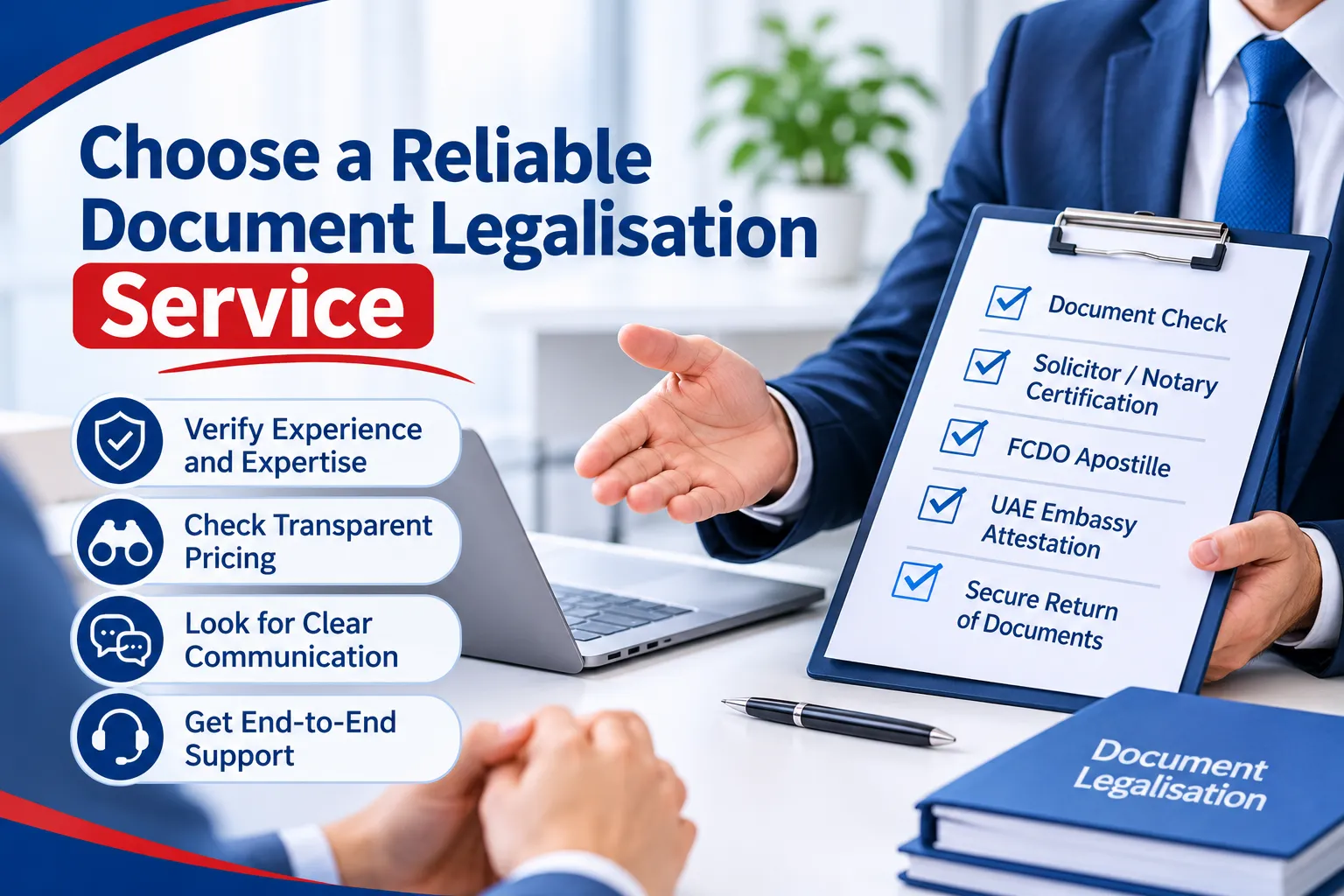
The final thing to consider is choosing a reliable service provider to help manage the process. Document authentication can involve several organisations, different submission requirements and multiple stages of verification.
For someone unfamiliar with the procedure, managing everything independently may become confusing, particularly when dealing with different document categories.
A professional legalisation service can help by:
- Checking documents before submission.
- Explaining the certification requirements.
- Arranging solicitor or notary certification where necessary.
- Assisting with the FCDO apostille process.
- Helping coordinate UAE Embassy attestation.
- Providing guidance on courier arrangements and document returns.
- Explaining any additional requirements for personal or commercial documents.
When choosing a provider, look for clear communication, transparent pricing and experience handling different types of UK documents.
It is also useful to ask whether the service provider can explain the complete procedure before accepting your documents. This helps you understand the stages involved, the expected processing time and any additional charges.
A reliable provider should also explain that the requirements can differ depending on whether you are submitting educational, personal, legal or commercial documents.
By choosing the right assistance, applicants can make UAE legalisation less stressful and reduce the risk of avoidable mistakes.
Why Planning Ahead Makes a Difference
Getting documents ready for international use requires attention to detail. A missing signature, incorrect certification or unsuitable document format can interrupt the process and create unnecessary delays.
Whether you are preparing a degree certificate for employment, a marriage certificate for family sponsorship or company paperwork for business purposes, understanding the legalisation requirements is essential.
The most important thing is to identify the correct procedure before submitting your documents. Always confirm the latest requirements with the organisation requesting the paperwork and the relevant UAE authorities.
A little preparation can make the process easier and help ensure that your documents are ready when you need them.
Get Professional Help with UAE Legalisation from Legalisation4you
Preparing documents for use in the UAE does not have to be complicated. With the right guidance, you can understand the requirements, prepare the correct paperwork and complete the necessary authentication stages with greater confidence.
Legalisation4you provides document legalisation and apostille services in the UK, helping individuals and businesses prepare their documents for international use. Whether you need assistance with educational certificates, personal documents, legal paperwork or commercial documents, getting professional guidance can help you understand the process.
If you are planning to work, study, relocate or conduct business in the UAE, make sure your documents are prepared correctly.
Visit to learn more about the available services and get assistance with your document legalisation requirements.
Frequently Asked Questions (FAQs)
1. What is UAE legalisation?
UAE legalisation is the process of authenticating a document issued in another country so that it can be recognised by the relevant authorities in the United Arab Emirates. For UK-issued documents, this generally involves FCDO authentication followed by the applicable UAE Embassy and Ministry of Foreign Affairs procedures.
2. Which documents commonly require UAE legalisation?
Common documents include degree certificates, birth certificates, marriage certificates, educational transcripts, powers of attorney, business agreements, certificates of incorporation and other official paperwork.
3. Is an FCDO apostille required for UAE legalisation?
Yes, UK-issued documents generally need to be authenticated by the FCDO before they can be submitted for UAE Embassy attestation. The exact procedure should be checked for the document concerned.
4. How long does UAE legalisation take?
Processing time depends on the document type, certification requirements, FCDO processing and UAE attestation arrangements. The UAE Embassy in London states that its digital attestation service typically takes 2–3 working days after the relevant application requirements are met. Additional preparation and delivery time may apply.
5. Can I submit photocopies for UAE legalisation?
Some documents may be accepted as true copies after the required certification and authentication. However, official personal documents such as birth, marriage and death certificates must be submitted in their original form to the UAE Embassy in London.
6. Do documents need to be translated into Arabic?
Some documents may require Arabic translation depending on their intended use and the requirements of the receiving authority. It is advisable to confirm the translation requirements before submitting your documents.
7. Can I get help with UAE legalisation in the UK?
Yes. You can contact a professional document legalisation provider such as Legalisation4you for guidance with document preparation, FCDO apostille and UAE Embassy attestation requirements.






















Sign in to leave a comment.