

Selecting a wireless System-on-Chip (SoC) is one of the most important decisions when developing an IoT product. The SoC can influence wireless performance, battery life, processing capability, hardware complexity, security, and development time.
With technologies such as Bluetooth Low Energy SoCs, Wi-Fi SoCs, Matter SoCs, Thread SoCs, Zigbee SoCs, UWB SoCs, and proprietary 2.4 GHz SoCs available, developers have many options. However, selecting a device based only on protocol support or headline specifications can create problems later.
Understanding some common selection mistakes can help engineering teams make better decisions.
1. Choosing the Protocol Before Understanding the Application
A common mistake is deciding that a product needs Bluetooth, Wi-Fi, or another technology before clearly defining what the product must accomplish.
A wireless gaming peripheral may require low latency and fast response, while an environmental sensor may prioritize long battery life. A smart-home device could require interoperability with multiple ecosystems, while an asset tracker may need both wireless communication and positioning capabilities.
The application requirements should therefore determine the connectivity strategy.
Before selecting an SoC, developers should understand expected data rates, communication range, latency, battery-life targets, network architecture, interfaces, and product use cases.
2. Looking Only at Processor Speed
A higher processor frequency can appear attractive when comparing wireless SoCs, but clock speed alone does not determine whether a device is suitable.
The processor needs enough performance to handle wireless protocol stacks, application firmware, security functions, sensor processing, and peripheral management.
Efficiency is equally important.
In battery-powered applications, a processor that completes a task efficiently and returns to a low-power state can sometimes be more valuable than simply selecting the highest available clock frequency.
Developers should evaluate processor performance in the context of their actual workloads.
3. Ignoring Real-World Power Consumption
Low-power specifications deserve careful analysis.
A datasheet may contain several current-consumption figures covering different operating conditions. Looking at only one value can create an unrealistic estimate of battery life.
A connected device may alternate between processing, transmitting, receiving, waiting, and sleeping throughout its operating cycle.
For products that remain inactive for long periods, sleep current can be particularly important. For products that communicate frequently, radio activity may have a much larger impact.
Developers should estimate power consumption based on the complete operating cycle of the final product.
4. Underestimating Memory Requirements
Flash and SRAM requirements often increase during development.
A prototype may initially require only a wireless stack and basic application firmware. Later versions may introduce security features, diagnostics, additional protocols, over-the-air updates, more sensors, or new product functionality.
If the selected SoC has very limited memory headroom, these changes can become difficult to implement.
Engineers should estimate both initial and future memory requirements rather than selecting a device that barely satisfies the first firmware version.
5. Forgetting About Peripheral Requirements
Wireless connectivity is only one part of most IoT products.
The SoC may need to communicate with displays, sensors, external memory, buttons, LEDs, microphones, audio devices, USB interfaces, or other components.
This can require GPIO, SPI, I²C, UART, ADC, PWM, USB, I²S, and other peripherals.
Developers should check not only whether the required interfaces are available but also whether enough instances and suitable pins exist for the final hardware architecture.
Discovering an interface limitation after PCB development has started can lead to unnecessary redesign work.
6. Treating Security as a Future Feature
Connected products can exchange information, receive firmware updates, communicate with mobile applications, and interact with cloud infrastructure.
Security should therefore be considered during initial architecture development.
Depending on the application, useful capabilities may include secure boot, cryptographic acceleration, protected key storage, device authentication, secure debugging, and secure firmware updates.
Security requirements vary between products, but choosing appropriate hardware capabilities early is generally easier than attempting to redesign the security architecture later.
7. Ignoring the Development Ecosystem
A wireless SoC with impressive specifications can still increase development effort if software tools and technical resources are limited.
Developers should evaluate the complete ecosystem surrounding the device.
Documentation, SDKs, evaluation kits, reference designs, example applications, debugging tools, wireless stacks, and technical support can all affect how quickly engineers move from evaluation to a working prototype.
RF design support can also be important because antenna implementation, PCB layout, component selection, and enclosure design can affect real-world wireless performance.
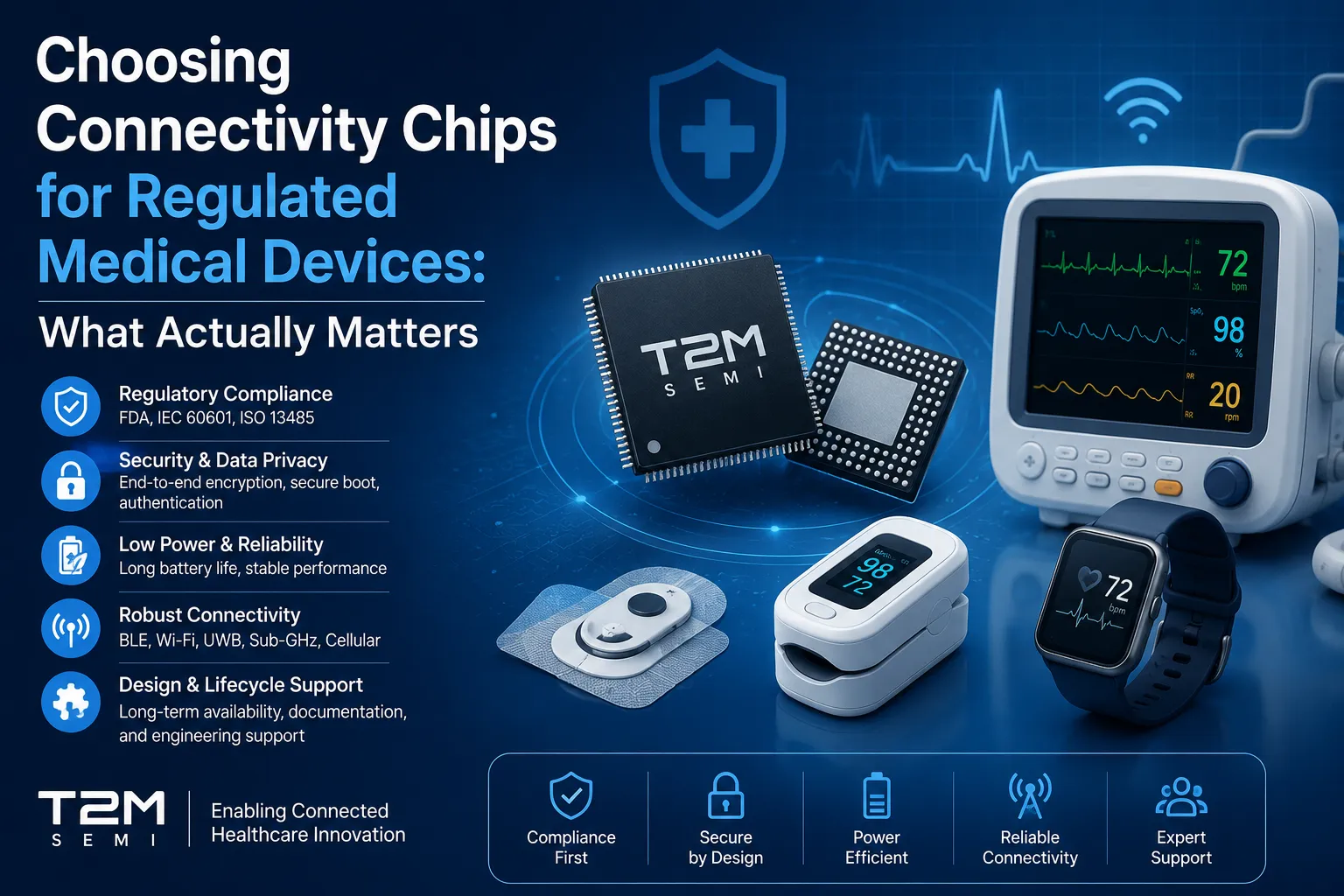
Companies such as T2M SEMI provide wireless semiconductor solutions covering Bluetooth LE, Wi-Fi, Matter, Thread, Zigbee, UWB, GNSS, and other connectivity technologies for connected-device applications.
Making a Better Wireless SoC Decision
Choosing a wireless SoC should be a system-level engineering decision rather than a comparison of individual specifications.
Connectivity, processor performance, memory, power consumption, interfaces, security, development tools, RF requirements, and future product plans all need to work together.
Starting with a detailed understanding of the application makes it easier to eliminate unsuitable platforms and focus on solutions that align with the actual product requirements.
The right SoC is not necessarily the device with the fastest processor, newest protocol, or lowest advertised power number. It is the platform that provides the appropriate balance of connectivity, performance, efficiency, scalability, and development support for the product being built.






















Sign in to leave a comment.