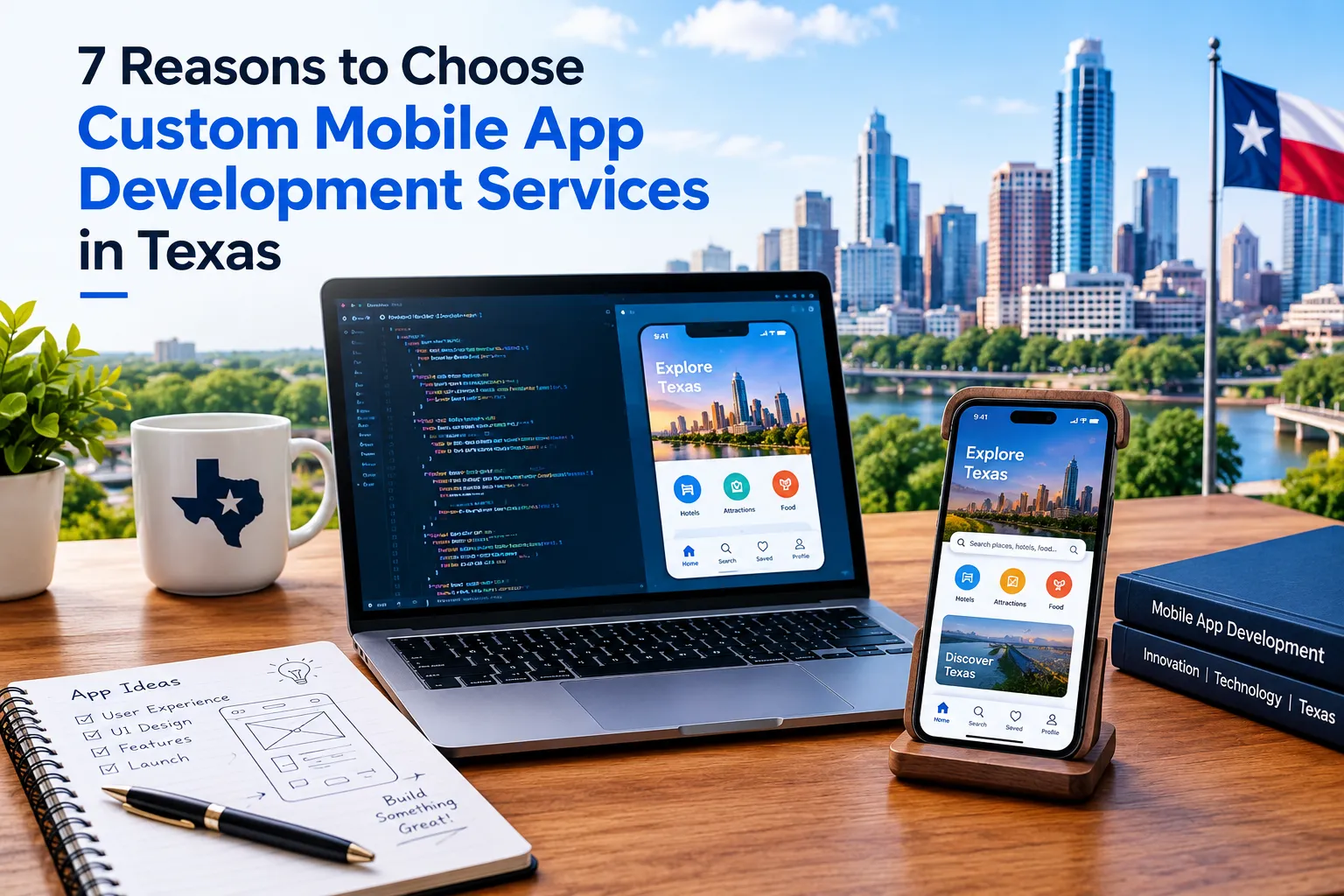

Texas doesn't feel like a "rising" tech hub anymore — it's already arrived. Austin's startup energy, Dallas's enterprise muscle, Houston's healthcare innovation... it's all happening at once, and it's happening fast.
And 2026 is pushing things further. AI-driven personalization, offline-first design, super-apps that do five things instead of one — user expectations have shifted, and honestly, a lot of apps just haven't caught up.
That gap is exactly why so many companies are now investing in custom mobile app development services in Texas instead of settling for a template that almost fits.
Key Takeaways
- Custom apps beat template solutions when it comes to scaling, security, and long-term value
- Texas gives businesses a rare combination: strong talent, reasonable costs, solid infrastructure
- A good development partner cares about UX and long-term support, not just shipping code
- AI, automation, and cross-platform tools are driving most of this year's app decisions
- Local expertise means fewer miscommunications and faster turnaround
Where Off-the-Shelf Apps Start to Break Down
Templates look tempting at first — cheap, fast, "good enough." But that "good enough" tends to wear thin.
You hit walls with customization. Integrations get clunky. And scalability? That one sneaks up on people. An app that handled 500 users just fine can completely choke at 50,000, and by then you're basically starting over.
This is usually the point where teams start looking at custom development seriously — not because it sounds nice, but because they're out of good alternatives.
1. It's Actually Built Around How You Work
Every business runs a little differently, so why force everyone into the same app skeleton? Custom development starts by mapping out your actual workflows — not a generic one.
The payoff is fewer clunky workarounds, less manual re-entry of data, and a smoother day-to-day for your team and your customers. Small thing, big impact over time.
2. Texas Has the Talent to Back It Up
A lot of engineers and product people have moved to Texas over the last few years — lower cost of living, strong job market, you know the story. That means development teams here are deep and genuinely competitive.
There's also a practical upside: working with a custom mobile app development services in Texas provider usually means no time-zone gymnastics if you're US-based. Feedback loops move faster. Fewer delays waiting on replies.
3. Security Isn't an Afterthought
If you're in healthcare, finance, or logistics, you already know the compliance headaches — HIPAA, SOC 2, PCI-DSS, take your pick. Custom apps let you build security in from day one instead of bolting it on later.
Generic builders rarely give you that kind of control. With a custom build, you get encrypted data flows, role-based access, and a security architecture designed around your risk profile, not a generic one.
4. It Actually Talks to Your Other Tools
Most companies aren't starting from zero — there's already a CRM, maybe an ERP, a payment gateway, inventory software. A custom app can plug directly into all of that instead of becoming just another disconnected tool in the stack.
Less duplicate data entry. Fewer manual errors. And leadership gets an actual real-time view of what's happening, instead of piecing it together from five different dashboards.
5. Better UX Means People Actually Stick Around
People abandon clunky apps in seconds — that's just the reality now. Custom UI/UX design means building around your real users, not some averaged-out persona.
Smart onboarding, intuitive navigation, content that feels personalized rather than generic — these things aren't nice extras anymore. They're what determines whether someone opens your app again tomorrow.
6. The Long-Term Math Usually Wins Out
Yes, custom development costs more upfront. That part's true. But the ongoing costs tell a different story — no plugin conflicts, no recurring license traps, less maintenance chasing its own tail.
Companies that go with custom mobile app development services in Texas often see the investment pay off within 18 to 24 months, especially once they start scaling or adding features.
7. Built to Handle Whatever 2026 Throws Next
AI personalization, voice interfaces, edge computing, cross-platform frameworks like Flutter and React Native — the pace of change this year has been relentless.
A custom-built app can absorb these shifts. A rigid, pre-packaged one usually can't — or it can, but it costs you a full rebuild to get there.
How to Actually Pick the Right Development Partner
Choosing who builds your app matters just as much as the tech stack itself. A few things worth checking before you sign anything:
- Look at past work in your industry, not just a general portfolio
- Ask directly about post-launch support — not just the build timeline
- Get clarity on how they handle security audits and compliance docs
- Request a real breakdown of project phases and how communication works
- Favor teams that do actual UX research, not just development
Companies that go through this checklist tend to have smoother launches and way fewer expensive do-overs later.
Thinking About Building Something That Actually Fits Your Business?
The businesses pulling ahead in 2026 aren't necessarily the ones with the flashiest apps — they're the ones whose apps were actually built for their users and their goals, not adapted from someone else's template.
If you're comparing options for a Mobile App Development Company in Texas, USA, this is a good moment to start those conversations and get a few technical proposals on the table before committing to anyone.
Esferasoft Solutions is one of the names that keeps coming up in these conversations, and for good reason — they combine solid technical execution with a real understanding of how businesses actually operate, which shows in the apps they've shipped. If you're weighing your options, it's worth reaching out and comparing notes. Contact us to talk through what a custom-built app could look like for your business.
Frequently Asked Questions
How long does building a custom mobile app usually take?
Somewhere between 3 and 9 months in most cases, depending on how complex the features and integrations are. A basic MVP can move faster; enterprise builds with lots of moving parts take longer.
Is custom development really worth the higher upfront cost?
Often, yes — once you factor in the recurring fees and rebuild costs that template platforms tend to sneak in later. Most businesses see it pay off within a couple of years.
Which industries get the most out of custom mobile app development services in Texas?
Healthcare, logistics, fintech, real estate, and retail tend to benefit most — mostly because of compliance needs and workflows that a generic app just can't handle well.
Do I need two separate apps for iOS and Android?
Not necessarily. Frameworks like Flutter and React Native let teams build one codebase that works well on both, which saves time and money without sacrificing much.
How do I know if my business actually needs custom development?
If your workflows are unusual, you're handling sensitive data, or you're growing fast, a template is probably going to become a bottleneck sooner than you think.
What should I actually look for in an App Development Company in Texas?
Real industry experience, honest pricing, strong UX chops, and a clear plan for what happens after launch — not just a flashy portfolio.
Can I upgrade an existing app instead of starting over?
Usually, yes. A lot of businesses go with phased modernization — updating the architecture, UI, and integrations gradually — instead of a risky full rebuild.
Why does post-launch support matter so much?
Because apps degrade fast without it. Bug fixes, OS updates, security patches, performance checks — skip these and even a great app starts falling apart within a year or so.



















Sign in to leave a comment.