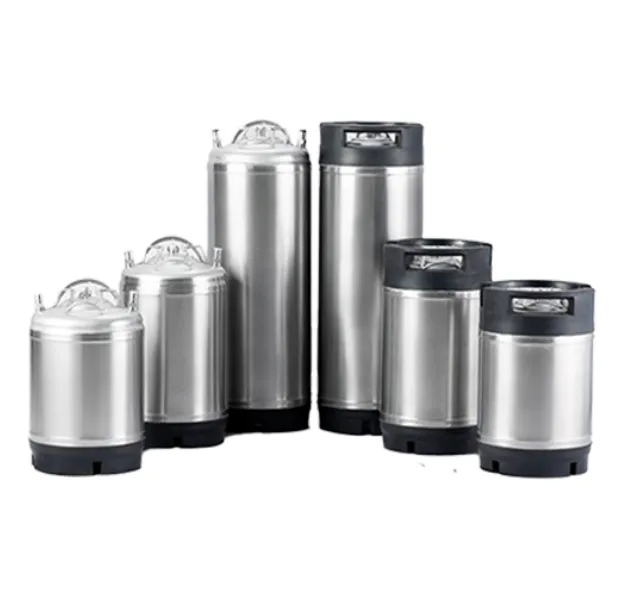

Beer kegs have long been the backbone of draught beer distribution, but not all kegs are built the same. From the brewery floor to the neighborhood pub, different keg types serve very different purposes — shaped by capacity needs, dispensing systems, regional standards, and the realities of storage space. Understanding these differences helps breweries, bars, and even home brewers choose the right vessel for their operation.
Sankey Kegs (D-System)
Sankey kegs, often called "D-system" kegs because of their D-shaped valve fitting, are the industry standard across much of North America. They're built with a single valve that handles both gas-in and beer-out functions, making them compatible with the vast majority of commercial draught systems.
Usage: Sankey kegs dominate commercial bars, restaurants, and large-scale breweries because they integrate seamlessly with standard coupler systems already installed at most venues.
Advantages: Their widespread compatibility means minimal equipment investment for new accounts. The single-valve design also simplifies cleaning and reduces points of potential contamination, while their robust stainless steel construction allows for hundreds of fill-and-empty cycles over a keg's lifespan.
Cornelius (Corny) Kegs
Originally designed for the soda industry, Cornelius kegs have become a favorite among home brewers and small craft operations. They use two separate posts — one for gas, one for liquid — rather than a single combined valve.
Usage: Corny kegs are common in home brewing setups, small taprooms, and for dispensing cold brew coffee, kombucha, or nitro beverages, thanks to their smaller, more manageable size (typically around 5 gallons).
Advantages: Their compact footprint fits easily into standard refrigerators, and the dual-post design makes disassembly for cleaning straightforward. They're also widely available secondhand, making them a cost-effective entry point for smaller-scale operations.
Euro Kegs
As the name suggests, Euro kegs are built to meet European dimensional and connection standards. They typically feature a cylindrical stainless steel body mounted on a sturdy base, often with double-walled construction for added insulation.
Usage: These kegs are the go-to choice for beer, wine, cider, and kombucha producers exporting or distributing across European markets, where connection standards differ from US Sankey systems.
Advantages: Beyond regulatory compliance, Euro kegs offer excellent temperature retention thanks to their insulated walls, along with efficient cleaning and filling systems suited to high-volume commercial use.
Slim (Quarter Barrel) Kegs
Slim kegs are a space-conscious solution, engineered with a narrow diameter that allows them to fit through tight doorways, onto crowded shelving, or into compact cooler spaces where a full-size keg simply won't fit.
Usage: Bars with limited back-of-house space, food trucks, and venues serving multiple beer varieties on rotation often favor slim kegs so they can stock a wider variety without sacrificing storage efficiency.
Advantages: Their narrow, often vertically-oriented shape blocks light effectively, making them well-suited to porters, stouts, and other dark or light-sensitive brews. They're also easier to maneuver by hand and can be packed more densely into refrigerated spaces than standard round kegs.
Half Barrel Kegs
The half barrel is the workhorse of commercial draught systems, typically holding around 15.5 gallons — enough to pour roughly 124 pints. Its dimensions are standardized enough to allow stacking and efficient warehouse storage.
Usage: High-traffic bars, taprooms, and flagship beer lines rely on half barrels to keep consistent, high-demand brews like IPAs, lagers, and amber ales flowing without frequent changeovers.
Advantages: The large capacity reduces the frequency of keg changes during peak service hours, and integrated handles make transport safer for staff. The scale also improves cost-efficiency per pint compared to smaller formats.
Sixth Barrel Kegs
Sitting between the slim keg and half barrel in size, sixth barrel kegs offer a middle-ground capacity — useful for breweries wanting to test limited releases or seasonal batches without committing to full-barrel volumes.
Usage: Craft breweries frequently use sixth barrels for experimental or small-batch beers, since the reduced volume limits financial risk if a new recipe doesn't sell as expected.
Why Stainless Steel Matters Across All Keg Types
Regardless of size or connection system, stainless steel construction underpins the advantages of modern kegs. It resists corrosion, withstands high internal pressures, and doesn't impart metallic flavors into the beverage — unlike some alternative materials. Critically, stainless steel kegs are reusable across hundreds of cycles, making them both more economical over time and significantly more sustainable than single-use packaging like bottles and cans.
Choosing the Right Keg
Ultimately, the "best" keg type depends on the specific use case: a home brewer prioritizing easy cleaning will lean toward Corny kegs, a European distributor needs Euro-standard fittings, and a busy commercial taproom will rely on half barrels for volume. By matching keg type to actual operational needs, breweries and bars can optimize storage space, reduce costs, and preserve the quality of every pour.

























Sign in to leave a comment.