

Some writers leave a place behind when they move away. Others carry it with them.
Cathie Beck belongs to the second group. Indiana remains woven into the stories she tells, even when the subject reaches far beyond its streets and neighborhoods. Her writing often returns to memory, family, friendship, class, and the strange ways people become who they are.
That makes an Indiana memoir by Cathie Beck interesting for more than its setting. Indiana becomes part of the emotional landscape. It gives her memories a particular shape and texture.
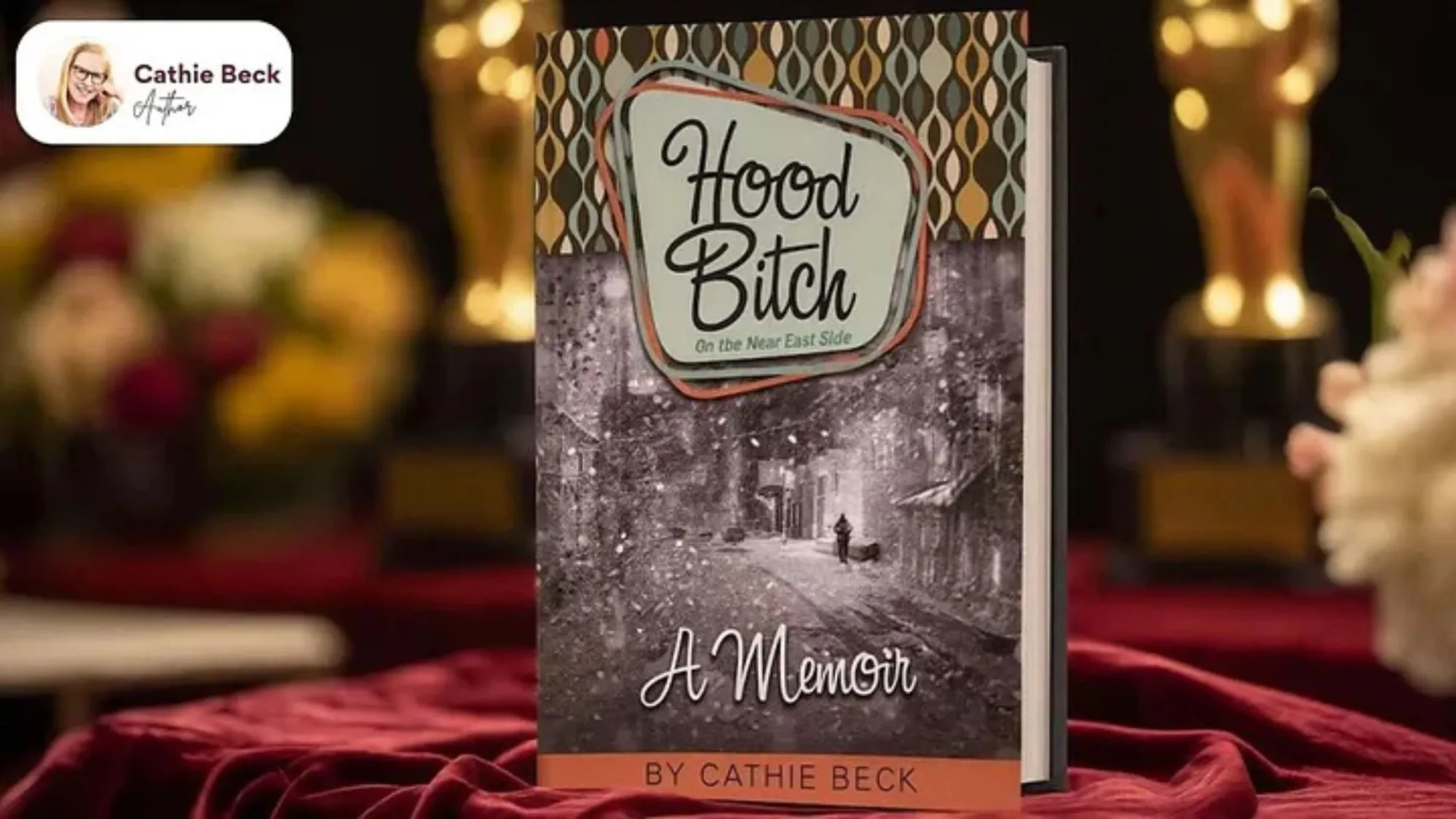
There is also something else worth watching. Beck's literary work continues to develop beyond the books already known to readers. Her next memoir, Hoodbitch: On the Near Eastside, turns toward Indianapolis and a childhood marked by movement and uncertainty.
Taken together, these works offer a useful look at a writer's continuing relationship with place. They also show how old memories can keep producing new material.
Indiana Has Never Been Just a Setting
Place matters greatly in memoir. A street can bring back an entire childhood. A neighborhood can hold memories of people who are no longer there. Even an ordinary house can become loaded with meaning years later.
That quality is especially important in Hoodbitch: On the Near Eastside. The memoir looks back at Beck's early years in Indianapolis during the 1960s and 1970s. She moved twelve times before turning seventeen.
That kind of childhood creates its own geography.
Home does not necessarily mean one address. It can mean a series of temporary places, each carrying different people and circumstances. Moving so often can make a young person unusually observant. It can also teach resourcefulness long before adulthood.
Those experiences give the forthcoming memoir its raw foundation.
Yet the book is not simply an account of changing houses. It examines class, instability, longing, and survival through a young person's eyes. That distinction matters.
A strong memoir does not simply tell readers what happened. It asks what those events meant.
Beck's Indianapolis is therefore more than a backdrop. It becomes part of the story's pressure. The city helps establish the social world surrounding the young narrator.
That is one reason place-based memoir can feel so immediate. Readers may not know the streets themselves. Still, they recognize the feelings attached to them.
The Past Keeps Finding New Forms
Writers rarely move through their careers in a straight line. One book may begin with a friendship. Another may reach back into childhood. A third may come from questions that have quietly followed the writer for decades.
Beck's published work demonstrates that movement.
Cheap Cabernet: A Friendship grew from the loss of a close friend. The book eventually became a widely recognized work of narrative nonfiction. Its foundation was deeply personal, but its subject reached beyond one relationship.
Friendship, grief, illness, and memory are experiences many readers recognize. The important part is how those experiences are shaped into a narrative.
That same instinct appears in Hoodbitch. The material changes, but the underlying interest remains familiar. Beck looks closely at people and circumstances that leave lasting marks. Her background as a journalist adds another layer to that approach.
Journalists are trained to notice details. They listen for what people say and what they leave unsaid. They watch how ordinary events reveal larger truths.
Memoir asks for some of those same instincts. The writer has to look backward without pretending to have understood everything at the time.
That can create a fascinating tension. The child remembers one thing. The adult writer sees something else. The distance between those two perspectives can become the heart of a memoir.
That seems particularly relevant to Hoodbitch. A childhood spent moving through different homes could be remembered simply as instability. A mature writer can look again and find questions about class, identity, ambition, and survival.
Memory changes when we revisit it.
Sometimes, the things that seemed small become enormous. Other times, an event once thought to define everything becomes only one part of a much larger story.
That process keeps memoir from becoming simple autobiography.
Literary News Is Also About What Comes Next
The phrase "literary updates from Cathie Beck" might sound like a straightforward publishing note. There is more to it than that.
For an established writer, literary news can reveal where the work is heading. A new memoir can reopen an old place. A new project can reshape how readers view earlier books. Recognition can bring older work back into conversation.
That makes Hoodbitch especially interesting. The memoir turns toward material that predates Cheap Cabernet. Yet it arrives after Beck has already established herself through journalism and narrative nonfiction.
The result is not simply another book. It is another part of the larger picture.
The forthcoming memoir has also received strong attention from people familiar with publishing and literary writing. Its early praise suggests that its voice has made an impression before reaching its wider readership.
That matters because memoir depends heavily on voice. Facts alone cannot carry a personal narrative. Readers need a reason to stay with the narrator through difficult memories. They need language that feels alive rather than carefully polished into distance.
A raw story can therefore become powerful when the writing gives it shape. This is particularly true for stories about difficult childhoods. Writers can easily fall into either nostalgia or explanation. The strongest work often avoids both.
It allows contradictions to remain. A childhood can be painful and funny. A neighborhood can feel dangerous and beloved. Survival can involve both strength and vulnerability.
Those contradictions are part of real life. They are also what make memoirs worth reading.
A Writer's Relationship With Place
Indiana's importance in Cathie Beck's work is not simply geographical. It represents an earlier life and a collection of experiences that continued to matter. Indianapolis provides the physical landscape, but memory supplies the deeper map.
That map can change with time. The child moving from home to home could not know how those experiences would eventually become material. The adult writer can return to them with questions that were impossible to ask then.
That is perhaps one of the most interesting things about memoir. The past does not remain fixed. Every return can reveal something different.
Beck's writing career has already moved through friendship, grief, journalism, publishing, and personal history. Hoodbitch adds another significant piece to that body of work.
It also brings readers back to Indiana. Not the Indiana of postcards or simple nostalgia. This is a more complicated place. It is shaped by class, family circumstances, movement, and the determination to keep going.
That complexity gives the upcoming memoir its particular promise. For readers interested in narrative nonfiction, the larger story may be just as compelling. A writer looks backward, finds unfinished questions, and gives them a new form.
Sometimes literary news is not really about what has happened. It is about what an old story is becoming now. And in Cathie Beck's case, Indiana still has plenty left to say.






















Sign in to leave a comment.