
You open the utility closet to grab something and notice a small puddle under the water heater. Or maybe you spot a ring of moisture on the floor around the base that wasn't there last week. Your first instinct is probably panic — and your second is probably to wonder if you can just ignore it for a while. The honest answer is: it depends entirely on where the water is coming from. Some water heater leaks are minor and manageable. Others are the kind that can flood a utility room in hours. According to the Insurance Information Institute, water damage is one of the most common and costly homeowner insurance claims in the US, averaging over $11,000 per incident. Before you assume the worst — or dismiss something you shouldn't — call an expert plumber in Plano and get a straight answer on what you're actually dealing with.
Why Is My Water Heater Leaking?
A leaking water heater doesn't mean the unit is automatically done. But it does mean something needs attention — and which something determines whether you're looking at a $20 fix or a full replacement.
Water heaters have multiple components, and leaks can originate from several different spots. The location of the leak tells you almost everything about severity. A drip from the top of the unit is almost always less urgent than water pooling steadily under the tank. A weeping pressure relief valve is different from a seeping tank body. Knowing the difference is what separates a calm, planned repair from an emergency response.
This post walks through each leak source, what it means, and what to do — in plain terms, not plumber jargon.

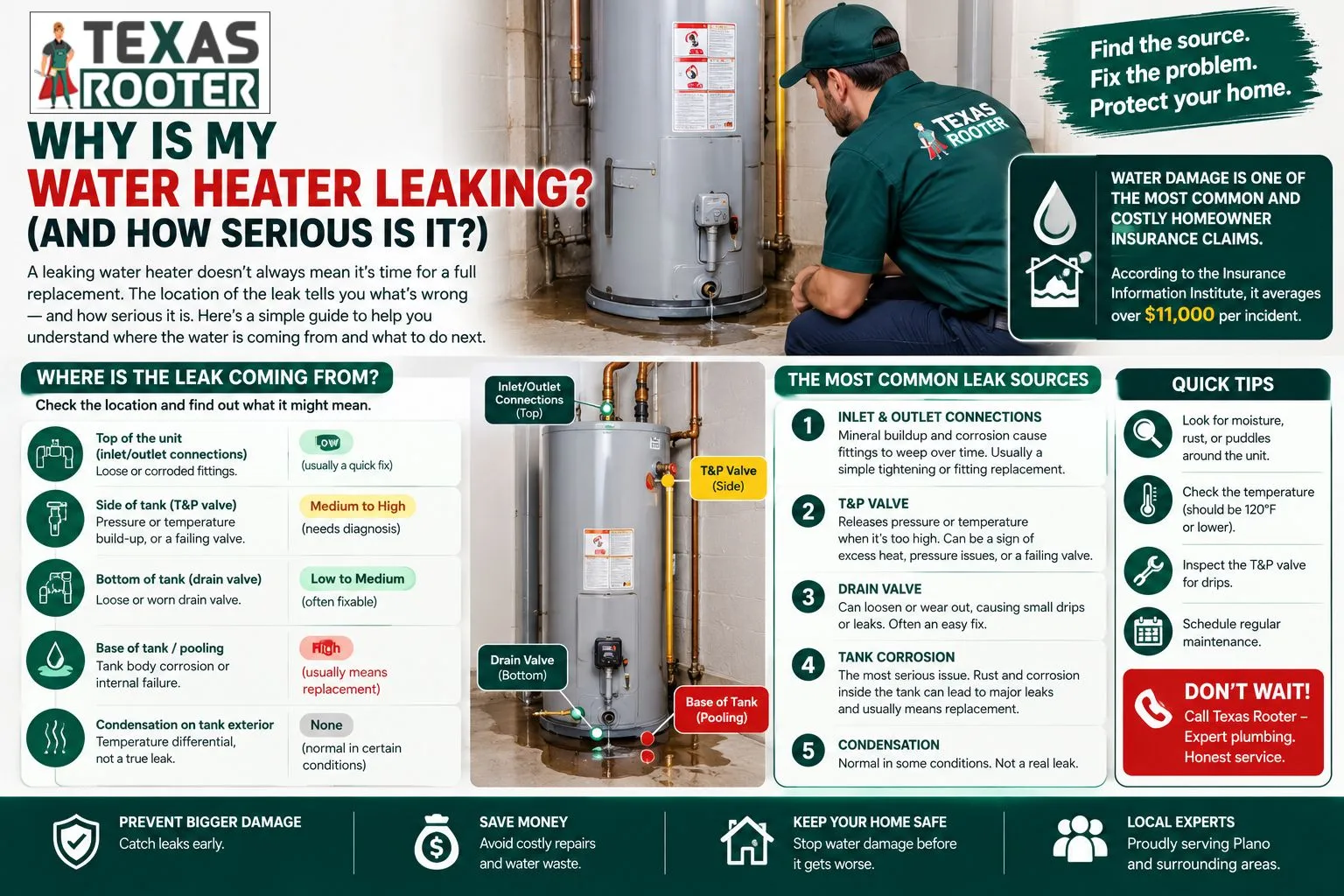
Quick Reference: Where Is the Water Coming From?
Before anything else, find the source. Dry the area around the water heater with a towel, wait 10–15 minutes, and watch where moisture reappears. This is the single most important step — and the one most homeowners skip because they're already stressed.
Use this as your starting guide:
| Leak Location | Likely Cause | Urgency Level |
|---|---|---|
| Top of the unit (inlet/outlet fittings) | Loose or corroded pipe connections | Low — often a quick fix |
| Side of tank (T&P valve) | Pressure relief valve activating or failing | Medium to High — needs diagnosis |
| Bottom of tank (drain valve) | Loose or worn drain valve | Low to Medium — often fixable |
| Base of tank / pooling under unit | Tank body corrosion or internal failure | High — usually means replacement |
| Condensation on tank exterior | Temperature differential, not a true leak | None — normal in certain conditions |
Let's go through each one.
1: The Inlet and Outlet Connections at the Top
The pipes that bring cold water in and carry hot water out connect to fittings at the top of your water heater. Over time — and especially in areas with hard water like Plano and the broader DFW metroplex — these connections develop mineral deposits, the threads corrode, and the fittings start to weep.
You'll usually see this as white or greenish residue around the connection point, sometimes with a slow drip running down the side of the unit.
Urgency: Low. This is typically a tightening or a fitting replacement — a plumber can handle it in under an hour. Left alone, the corrosion progresses and what's a $100 repair today becomes a bigger job later. But it's not an emergency.
What doesn't work: Wrapping it in tape or applying sealant around a corroded fitting. That's a temporary mask on a problem that continues beneath the surface.
2: The Temperature and Pressure Relief Valve
This is the one that confuses people the most — and gets mishandled more than any other water heater component.
The T&P valve is a safety device. It's designed to release water when pressure or temperature inside the tank exceeds safe limits. It's the safety valve on a pressure cooker — it opens when something inside reaches a dangerous level, lets pressure escape, and closes again.
If your T&P valve is dripping occasionally, that can mean one of two things:
Option A: The valve is doing its job — pressure or temperature inside the tank briefly exceeds the threshold, and the valve releases a small amount of water. This might happen if your water heater temperature is set too high (above 120°F) or if there's a thermal expansion issue in a closed plumbing system.
Option B: The valve itself is faulty — it's stuck partially open and releasing water it shouldn't be. T&P valves wear out over time, and once a valve starts dripping on its own, it typically doesn't reseal properly.
Urgency: Medium to High. A functioning T&P valve that occasionally releases is a sign the system needs adjustment, not an immediate crisis — but it needs attention soon. A failed valve that can no longer open when it should is genuinely dangerous. A water heater without a working pressure relief valve can, in extreme cases, build pressure until the tank fails catastrophically.
The fix: Have a plumber test the valve — they can manually lift the lever briefly to check whether it seats properly when released. If it drips afterward, it needs replacement. T&P valve replacement is a straightforward job, but pulling one from a pressurized hot water tank isn't something to wing on your own.
One thing to never do: Cap or plug the T&P valve discharge pipe because it's dripping. I've seen this done. It eliminates the drip by eliminating the safety mechanism. Don't do it.
3: The Drain Valve at the Bottom of the Tank
Every water heater has a drain valve near the base — it looks like a hose bib or a plastic spigot. It's used to flush sediment from the tank, and in most homes, it gets touched maybe once every few years.
Drain valves leak for a couple of reasons: the valve wasn't closed fully after the last time someone flushed the tank, the valve seat has worn and no longer seals properly, or the plastic housing has cracked from age.
Urgency: Low to Medium. A slow drip from the drain valve is manageable — a plumber can often replace it without draining the full tank. Left for months, it keeps dripping, keeps creating moisture on your utility room floor, and accelerates rust formation on the floor and surrounding materials.
Quick check: Try tightening the valve clockwise by hand. If the drip stops, it was just loose. If it doesn't stop, or if you feel the valve is already as tight as it goes, the valve seat is worn and needs replacement.
4: Condensation on the Tank Exterior
This one isn't actually a leak — but it looks like one, especially in certain conditions.
When a water heater sits in a cool utility space or garage, and the tank is full of hot water, the exterior surface can develop condensation — just like a cold glass of water sweats on a warm day, but in reverse. The cool ambient air hits the warm tank surface and moisture forms.
This is most common in early mornings, after the first hot shower of the day, or when a new tank is being brought up to temperature for the first time.
Urgency: None. If the moisture appears on the tank surface itself, wipes off cleanly, and isn't pooling underneath the unit, it's condensation. Watch it for a day or two. If it dries completely when the ambient temperature equalizes, that's your answer.
How to tell the difference: Condensation appears on the outside of the tank and evaporates. A real leak produces water that drips down and collects underneath. If you're seeing a persistent puddle that doesn't fully dry, it's not condensation.
5: Water Pooling Under or Around the Base of the Tank
This is the one that actually warrants concern. Water collecting steadily at the base of the unit — not from a fitting above, not from the drain valve, but appearing to come from the tank body itself — usually means the tank is corroding from the inside out.
Here's what happens: water heater tanks develop sediment buildup at the bottom over years of use. In North Texas, where hard water is a consistent issue, that buildup is accelerated by high mineral content. The sediment layer creates hot spots on the tank floor where the water can't circulate freely, and over time, those hot spots cause the metal to deteriorate.
Once the tank itself is leaking, the unit is done. You cannot patch a corroding water heater tank. There is no repair that addresses an internal tank failure. The unit needs to be replaced.
Urgency: High. A small seep from the tank body today can become a significant flood within days or weeks. The corrosion that's letting water escape is not slowing down — it's progressing. This is not a "watch it for a few weeks" situation.
What to do immediately:
- Turn the water heater to pilot mode or vacation mode to stop heating
- Shut off the cold water supply line to the unit (the valve on the pipe feeding the top of the tank)
- Call a plumber to confirm the source and arrange replacement
- Do not turn it back on
If the tank is older than 10 years — and in Plano, many homes still have units running at 12–15 years — replacement was probably coming soon anyway. Hard water shortens the lifespan below what the manufacturer's rating assumes.
How to Tell a Minor Drip From a Real Emergency
Here's the honest breakdown in plain terms:
Minor — handle within a few days:
- Moisture at the inlet/outlet connections at the top
- Dripping drain valve that tightens by hand
- Condensation that evaporates and doesn't pool
Needs a plumber soon — within a week:
- T&P valve dripping regularly (even if occasional)
- Drain valve dripping that doesn't stop when tightened
- Corrosion or white residue forming at any fitting
Call today — do not wait:
- Water pooling at the base of the tank with no fitting source above
- T&P valve running continuously
- Rust-colored water from hot taps
- Any smell of burning or melting near the unit
- Unit is over 12 years old AND showing any moisture
The last category is not a "let's monitor it" situation. A failed water heater tank in a utility closet or garage can release 30–80 gallons of water faster than most people can respond. That's a flooded room, warped flooring, and potentially a mold situation that takes weeks to remediate.
Step-by-Step: What to Do When You Find a Leak
Step 1 — Dry the area and find the source. Wipe everything dry. Come back in 15 minutes and watch where moisture reappears. Don't skip this — knowing the source changes everything.
Step 2 — Check the fittings at the top first. Look at the inlet and outlet connections. Any dripping, white residue, or corrosion? If yes, that's your likely source.
Step 3 — Check the T&P valve discharge pipe. The T&P valve has a pipe that runs down to near the floor or to a drain. Is there water coming out of that pipe? Is the valve body itself wet?
Step 4 — Check the drain valve at the base. Is it fully closed? Any dripping around the valve body?
Step 5 — Look at the tank surface and the floor underneath. Moisture on the tank exterior that wipes off? Probably condensation. Water actually collecting under the unit with no fitting source? The tank is failing.
Step 6 — Act on what you find. Minor fitting issue — schedule a plumber visit. T&P valve concern — call soon. Water under the tank — shut off supply and call today.
What About Water Heater Age? Does It Change the Calculation?
Yes — significantly.
A 4-year-old water heater with a dripping inlet fitting is a simple repair. The same dripping inlet fitting on a 13-year-old unit with known hard water history is a different conversation. That unit is approaching or past its practical lifespan, and spending money repairing components on a tank that's likely to develop other issues within a year or two often doesn't make financial sense.
Most plumbers will tell you: if the unit is under 8 years old and the leak is from a fitting or valve — fix it. If it's over 10–12 years old and showing any signs of internal corrosion — plan for replacement, not repair. The repair buys you a few more months at best.
In North Texas especially, hard water is hard on water heaters. The mineral content accelerates corrosion and sediment buildup beyond what standard lifespan estimates account for. A unit rated for 12 years in soft water conditions may be functionally done at 9 or 10 years here.
Don't Let a Small Drip Turn Into a Big Problem
The homeowners who end up with the worst situations are almost never the ones who caught a leak early. They're the ones who noticed moisture, figured it wasn't urgent, and let weeks pass before doing anything.
A minor fitting drip stays minor if you address it. Left long enough, it corrodes the fitting, creates moisture damage on the surrounding structure, and eventually accelerates failure of the tank itself.
Texas Rooter serves homeowners throughout Plano and the DFW area with water heater inspection, repair, and replacement — as well as full plumbing diagnostics, leak detection, and drain service. If you've found moisture around your water heater and aren't sure what you're looking at, a plumber in Plano can give you a straight answer without overselling the fix.
Key Takeaways
- Where the leak comes from determines how urgent it is — location is everything with water heater leaks
- Inlet/outlet fitting drips are usually low urgency and fixable without major work
- T&P valve dripping needs prompt attention — a failed safety valve is a safety issue, not just a plumbing issue
- Never cap or plug the T&P discharge pipe — it exists for a reason, and blocking it is dangerous
- Condensation on the tank exterior is not a leak — watch it for a day and see if it evaporates
- Water pooling under the tank with no fitting source means the tank body is failing — shut off supply and call today
- Units over 10–12 years old in hard water areas like Plano are often better replaced than repaired when leaks appear
- Hard water in North Texas shortens water heater lifespan below manufacturer ratings — factor that into your timeline




























Sign in to leave a comment.