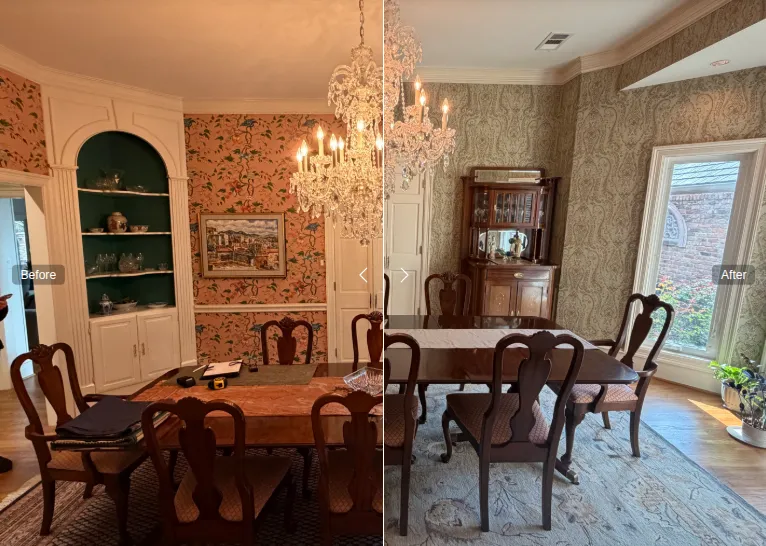

An accent wall is one of the lowest-commitment ways to bring bold pattern or texture into a room - one wall, not four, which makes it a natural entry point for anyone hesitant about wallpaper. But choosing the wrong wall, or the wrong approach to installing it, can leave the room feeling off rather than intentional.
Not Every Wall Is a Good Candidate
The instinct is often to pick whichever wall has the most open space, but that's not actually the right criteria. A good accent wall is usually:
- The first wall you see entering the room : the one your eye naturally lands on
- A wall without too many interruptions : heavy interruption from windows, doors, or built-ins makes pattern alignment harder and can visually fragment the effect
- Behind a focal piece of furniture : a bed headboard, a sofa, a dining table - since this naturally anchors the wall as the room's visual center
Walls that get chosen simply because they're "the blank one" often end up feeling random rather than deliberate, especially once the wallpaper goes up and the room's actual focal point turns out to be somewhere else entirely.
Common Mistake: Ignoring the Room's Existing Focal Point
If a room already has a natural focal point a fireplace, a large window with a view, a piece of statement furniture - putting the accent wall somewhere else can create visual competition. The eye doesn't know where to land first, and the room ends up feeling busier rather than more intentional.
The strongest accent walls work with the room's existing focal point, not against it.
Common Mistake: Choosing Pattern Scale Without Considering Room Size
A bold, large-scale pattern that looks stunning in a photo can overwhelm a smaller room in person. As a general guideline:
- Smaller rooms tend to do better with tighter, smaller-scale repeats or textured, low-contrast wallcoverings
- Larger rooms with higher ceilings can support bigger, more dramatic patterns without feeling crowded
This is one of the more common reasons homeowners end up disappointed with an otherwise well-installed accent wall - the material itself wasn't matched to the room's actual scale.
Common Mistake: Underestimating Pattern Alignment
Even on a single wall, pattern alignment matters more than people expect. If the wall has any interruptions - an outlet, a light switch, a doorway - the pattern needs to be planned so it doesn't awkwardly break right at those points.
This requires measuring and dry-fitting before any adhesive goes on, mapping out where the pattern will land relative to the wall's specific features. Skipping this step is one of the most common reasons a single accent wall ends up looking slightly off even when the material itself is beautiful.
Common Mistake: Rushing the Prep Because It's Just One Wall
Because an accent wall is a smaller project than a full room, it's tempting to treat wall prep as less important. But a single, highly visible wall actually has less room to hide imperfections than four walls with a repeating pattern do - there's nowhere else in the room for the eye to go, so any bump, seam, or misalignment stands out more, not less.
Getting the Most Out of a Single Wall
An accent wall succeeds when the wall, the room's proportions, and the pattern scale all work together - not when it's simply the most convenient blank surface. Taking the time to choose the right wall, account for the room's existing focal point, and plan pattern alignment before installation begins is what separates an accent wall that feels intentional from one that feels like an afterthought.
Rebirth Paperhanging, an accent wall wallpaper installer serving Dallas-Fort Worth, walks through exactly this kind of assessment before recommending a wall or material - treating a single accent wall with the same planning rigor as a full-room project, since a smaller surface area doesn't mean smaller stakes for getting it right.



























Sign in to leave a comment.