Acne Scar Treatment in Dubai: Which Treatment Gives the Best Results?


Acne has a way of outlasting itself. The breakouts clear, the oil settles, the skin finally calms down, and what remains is a set of reminders: small pits, uneven texture, red or brown marks that refuse to fade, and the quiet habit of angling your face away from bright light. For many people in Dubai, acne scars become a bigger source of self-consciousness than the acne itself ever was, and the search for a fix usually begins with one practical question: which treatment actually gives the best results?
The honest answer is more nuanced than any single product or procedure name. There is no one treatment that is best for every scar. The right choice depends on what kind of scar you have, how deep it sits, how old it is, what your skin tone is, and whether your acne is fully under control. What does exist is a well-established set of clinical options that, when matched correctly to the individual, can improve scarring significantly. And what consistently produces the strongest outcomes is rarely a single procedure. It is a combination, sequenced and calibrated by a dermatologist who has assessed your skin properly.
This guide explains how acne scars form, how to identify your scar type, which treatments work for which kind of scarring, and how to choose a laser clinic in Dubai that can deliver the combination of technology and clinical judgment that real improvement requires. Everything here reflects how we approach scar removal treatment in Dubai at Premium Cosmetic Laser Center.
Why Acne Scars Form and Why They Do Not Simply Fade
Acne scars develop as a result of inflammation that causes permanent changes in the skin's structure. When a breakout becomes deeply inflamed, the body's repair response can go wrong in one of two directions. If too little collagen is produced while the lesion heals, the skin sinks and leaves a depression. If too much collagen is produced, the tissue builds up and leaves a raised area. In both cases, the architecture of the dermis has been permanently altered, which is why creams, serums, and home remedies cannot reverse it.
This is the reason most dermatologists describe scar treatment as a structural problem rather than a surface problem. Products can brighten a mark or smooth the top layer of skin, but a depressed scar is a hole in the collagen scaffolding beneath the surface. Fixing it requires a treatment that reaches the dermis and stimulates the skin to rebuild what was lost, or one that fills or releases the depression directly.
It also explains why time alone helps only a little. Small, superficial marks often fade on their own. Indented or raised scars generally do not, and waiting years rarely improves them. The earlier a scar is assessed and treated, the more responsive it tends to be, particularly while the skin still has strong regenerative capacity.
Step One Is Knowing Your Scar Type
Choosing the right treatment starts with identifying what you are actually treating. Acne scarring is not one condition. It falls into three broad categories, and each responds best to a different approach.
Atrophic scars are the most common and appear as indentations or pits in the skin, usually caused by acne inflammation destroying collagen. They are further described by shape. Icepick scars are narrow, deep, and sharply defined. Boxcar scars are wider with steep, defined edges. Rolling scars have a gentle, wave-like appearance caused by fibrous bands that tether the skin to deeper tissue.
Hypertrophic scars are raised, thickened areas of tissue that develop at the site of a previous injury. They are less common with acne than atrophic scarring but occur, particularly on the jawline, chest, and back.
Discoloration is often mistaken for scarring but is technically a pigment issue. It shows up as persistent redness, known as post-inflammatory erythema, or as brown marks, known as post-inflammatory hyperpigmentation, that remain after the original lesion has healed. It is extremely common in medium to deeper skin tones, and it frequently coexists with textural scarring.
Many patients have a mix of all three. A thorough consultation at a qualified laser clinic in Dubai should identify the proportions, because the treatment plan for a face dominated by boxcar scars is genuinely different from one dominated by lingering brown marks.
Treat the Acne First
One principle matters more than any specific scar procedure: the acne itself needs to be controlled before scar treatment begins. If you have a tendency to develop acne scars, new breakouts will simply create new scars, undoing the work being done on the old ones. For this reason, a dermatologist will first treat the acne and bring it under control, and only then focus on the scarring.
This is why the starting point for many patients is a proper acne treatment Dubai program rather than an immediate scar procedure. Active acne, ongoing inflammation, and unstable skin all compromise results and raise the risk of complications from procedures that wound the skin deliberately in order to stimulate repair.
There is also an important medication consideration. Some studies suggest that treating acne scars while taking isotretinoin can make scarring worse. Dermatologists commonly ask patients to wait at least six months after stopping isotretinoin before undergoing certain scar procedures, with the exact interval depending on the treatment recommended. If you are currently taking or have recently taken isotretinoin, disclose this at your first consultation so your treatment can be sequenced safely.
The Main Treatment Options and What Each One Does Best
Because no single treatment is best for every scar, it helps to understand what each option actually does and where it fits.
Fractional Laser Resurfacing
Fractional laser treatment is one of the most effective and most widely recommended approaches for atrophic acne scars. It works by delivering laser energy in a pattern of microscopic treatment zones surrounded by untreated tissue. The controlled injury stimulates new collagen and elastin production within the dermis, gradually raising depressed scars and refining overall texture, while the untreated tissue between the zones allows faster healing than fully ablative methods.
At Premium Cosmetic Laser Center, fractional resurfacing is delivered through our Fraxel Dual platform. As a form of laser treatment in Dubai, it is particularly useful for boxcar and rolling scars, for general textural unevenness, and for improving the quality of the skin surrounding the scars. Results develop progressively as new collagen forms over the weeks and months after each session.
Laser Toning for Marks and Pigmentation
When the main concern is discoloration rather than depth, a different laser approach is more appropriate. Laser toning uses controlled energy to break up excess pigment and calm persistent redness without aggressively wounding the skin. It is well suited to the brown and red marks that remain after acne clears, and it can be used alongside resurfacing for patients who have both texture and color concerns. Our Lutronic Spectra platform is used for this kind of toning, helping to fade stubborn dark spots and improve overall evenness.
Radiofrequency Microneedling
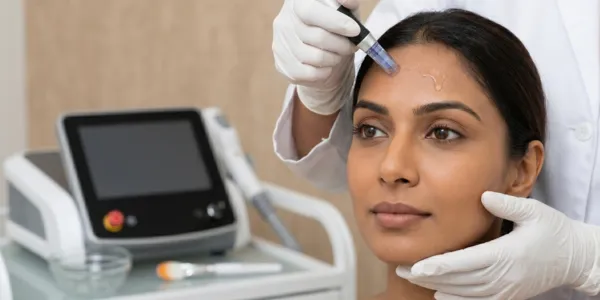
Radiofrequency microneedling combines fine needles with radiofrequency energy delivered into the dermis. The needles create controlled micro-channels while the RF energy heats the deeper tissue, stimulating collagen remodeling at a depth that surface treatments cannot reach. It is a strong option for atrophic scars and for patients who want meaningful improvement with a manageable recovery. Our Secret RF treatment falls into this category and is frequently combined with other modalities in a scar protocol.
Chemical Peels and Microdermabrasion
Chemical peels and microdermabrasion are ablative procedures that remove or regenerate the top layer of skin. Microdermabrasion is generally less invasive than a chemical peel. These treatments are most useful for superficial texture, mild marks, and overall brightening, and they are often used as supporting treatments within a broader plan rather than as the primary solution for deeper indented scars.
PRP and Collagen-Stimulating Support
Platelet-rich plasma, prepared from a small sample of your own blood, can be combined with microneedling to deliver concentrated growth factors into the skin. This supports the healing response and collagen production, and many patients choose it as an enhancement to a microneedling or RF-based protocol, particularly when they want a regenerative, biologically driven approach.
Dermal Fillers for Depressed Scars
Injections of dermal filler can be used to fill the depression left by a scar and minimize its appearance. Fillers are particularly useful for certain rolling and broad atrophic scars where an immediate lift is desirable, and they are often used alongside collagen-stimulating treatments that improve the skin over a longer timeline.
Surgery for Severe Scarring
For very wide, long, or otherwise prominent scars, surgical approaches exist. However, surgery can create new scars and is usually appropriate only in specific cases. Most patients with acne scarring achieve their goals through the non-surgical options above.
Comparing the Options at a Glance
Scar or Concern Commonly Recommended Approach What It Targets Boxcar scars Fractional laser, RF microneedling Collagen rebuilding at depth Rolling scars Fractional laser, RF microneedling, fillers Texture, tethering, volume Icepick scars Combination protocols tailored by assessment Deep, narrow depressions Raised (hypertrophic) scars Individually assessed targeted treatment Excess tissue build-up Red or brown marks Laser toning, chemical peels Pigment and redness Overall texture and dullness Peels, PRP, microneedling Surface quality and glow
So Which Treatment Gives the Best Results?
If a single answer is required, it is this: the best results come from the right combination for your specific scar profile, delivered in a sensible sequence by an experienced dermatologist. A patient with mostly boxcar scars and some brown marks, for example, might begin with a series of fractional laser sessions for structural improvement, add laser toning to address the pigmentation, and use PRP or RF microneedling to reinforce collagen production between sessions. A patient with mainly rolling scars might combine fractional treatment with filler for immediate lift and RF microneedling for ongoing remodeling.
Although complete scar removal is not possible, most acne scars can be significantly improved in appearance through one or more of these techniques. Setting that expectation honestly at the outset is part of good care. Improvement, not erasure, is the realistic and achievable goal, and for many patients the difference is substantial enough to change how they feel about their skin every day.
Skin Tone and Climate: Why Dubai Needs Extra Care
Dubai's population spans the full range of skin tones, and this directly affects which scar treatments are safe and how they should be calibrated. Darker skin tones carry a higher risk of post-inflammatory hyperpigmentation after any procedure that wounds or heats the skin. This does not make scar treatment off-limits for medium to deeper skin. It means the wavelength, energy settings, and treatment intervals must be chosen carefully, sometimes starting conservatively and building up, so that the treatment improves the scars without creating new pigmentation.
The climate adds a second layer. Year-round intense UV exposure can darken healing skin and undermine results, which makes strict sun protection essential after any scar procedure. A good dermatologist in Dubai will give specific, climate-appropriate aftercare guidance rather than generic advice, including daily broad-spectrum sunscreen, avoiding direct sun during the healing window, and timing procedures to fit your lifestyle and sun exposure.
Why a Full-Service Laser Clinic Matters for Scar Care
Acne scar improvement is rarely a one-device job, which is why the breadth of a clinic's technology and expertise matters as much as any individual treatment. A clinic with multiple laser platforms can match the right tool to each concern, resurfacing for texture, toning for marks, and radiofrequency for deeper remodeling, instead of forcing every patient into the same protocol.
That breadth tends to show up across a clinic's whole service range. The same expertise in matching technology to skin tone that underpins safe scar work also underpins a well-run Dubai laser hair removal treatment program, where wavelength selection and cooling are critical across the full spectrum of skin types. There is also a direct, practical link between the two. Ingrown hairs and razor bumps, especially in people who shave frequently, can become inflamed and leave their own marks and scars over time. Permanent hair reduction through a properly delivered Dubai laser hair removal treatment removes the cause of that recurring inflammation, which is one reason patients prone to scarring sometimes address both concerns at the same clinic.
What to Expect During Treatment
Most patients experience only mild discomfort during scar procedures. At our clinic, topical numbing creams are applied beforehand and cooling systems are used during laser and microneedling sessions to keep treatment comfortable.
The number of sessions depends on the type, age, and severity of the scarring. Many patients see results within three to five sessions, while some require up to six to reach their optimal outcome. Sessions are typically spaced several weeks apart to allow the skin to regenerate properly between treatments, because collagen remodeling continues for weeks after each session and rushing the interval offers no benefit.
Downtime varies by treatment. Laser toning and many peels involve little to none. Fractional resurfacing and RF microneedling typically involve a few days of redness and mild swelling that settle quickly. Your dermatologist will explain the specifics for your plan so you can schedule around your calendar.
How to Choose the Right Laser Clinic in Dubai for Scar Treatment
Whichever treatment you are considering, the quality of the clinic and practitioner determines the outcome as much as the technology does. Ask whether the clinic is licensed by the Dubai Health Authority and whether the practitioners performing treatment are individually licensed. Ask whether a dermatologist will personally assess your scars and skin type before recommending anything. Ask what laser and RF platforms are available, so your plan is built around your scars rather than around the one device the clinic happens to own. Ask how treatment is adjusted for your skin tone, and what the aftercare protocol looks like in Dubai's climate. And ask for a clear explanation of expected results, because any clinic promising complete scar erasure is not being honest with you.
Why Premium Cosmetic Laser Center for Acne Scar Care
At Premium Cosmetic Laser Center, scar care begins with a proper consultation where our dermatologists identify your scar types, assess your skin tone, review your medical history, and determine whether your acne is controlled enough to begin. From there, we build a personalized plan that draws on our range of laser, radiofrequency, peel, PRP, and filler options, sequenced to deliver the best achievable improvement with the lowest risk for your skin.
Our approach to acne treatment Dubai and scar care is built on the same principle that guides everything we do: treat the cause first, match the technology to the individual, and be honest about what is realistic. If your acne scars have been affecting your confidence, we would welcome the chance to assess your skin and show you what a properly planned treatment can do.
Frequently Asked Questions
1. Which acne scar treatment gives the best results in Dubai? There is no single best treatment for every patient. The best results come from matching the treatment to your scar type and skin tone, and most often from a combination, such as fractional laser for structural improvement, laser toning for marks, and RF microneedling or PRP to reinforce collagen. A dermatologist's assessment determines the right combination for you.
2. Can acne scars be removed completely? Complete removal is not possible, but most acne scars can be significantly improved in appearance through one or more cosmetic techniques. Realistic expectations focus on visible improvement in depth, texture, and discoloration rather than total erasure.
3. Do I need to clear my acne before starting scar treatment? Yes. Dermatologists first treat the acne and bring it under control, because ongoing breakouts can create new scars and compromise results. Starting with an effective acne treatment Dubai plan gives scar procedures the stable foundation they need.
4. I took isotretinoin. When can I start scar treatment? Some studies suggest treating scars while taking isotretinoin can worsen scarring, so dermatologists often ask patients to wait at least six months after stopping it. The exact wait depends on the treatment recommended, so always tell your dermatologist about current or past use.
5. How many sessions will I need and how far apart are they? Many patients see results within three to five sessions, and some need up to six for optimal outcomes. Sessions are usually spaced several weeks apart so the skin can regenerate between treatments.
6. Is scar removal treatment painful, and is it safe for darker skin? Most patients feel only mild discomfort, as topical numbing and cooling are used during laser and microneedling sessions. Treatment is possible across skin tones when parameters are chosen carefully by an experienced practitioner, because darker skin has a higher risk of post-inflammatory pigmentation if settings are not calibrated correctly.
Final Thoughts
The question of which acne scar treatment gives the best results has a clear and reassuring answer once you understand it: the best treatment is the one matched to your scars, your skin tone, and your acne status, and the strongest outcomes usually come from combining complementary approaches under the guidance of an experienced dermatologist. Acne scars are structural, which is why products alone rarely change them, but modern laser, radiofrequency, and regenerative treatments can improve them meaningfully.
If you are ready to stop applying short-term solutions to a long-term problem, the first step is a proper assessment. Book a consultation at Premium Cosmetic Laser Center and let our team design a plan built around your skin.
Ready to find out what the right treatment plan could do for your skin? Book your acne scar consultation at Premium Cosmetic Laser Center today.




Sign in to leave a comment.