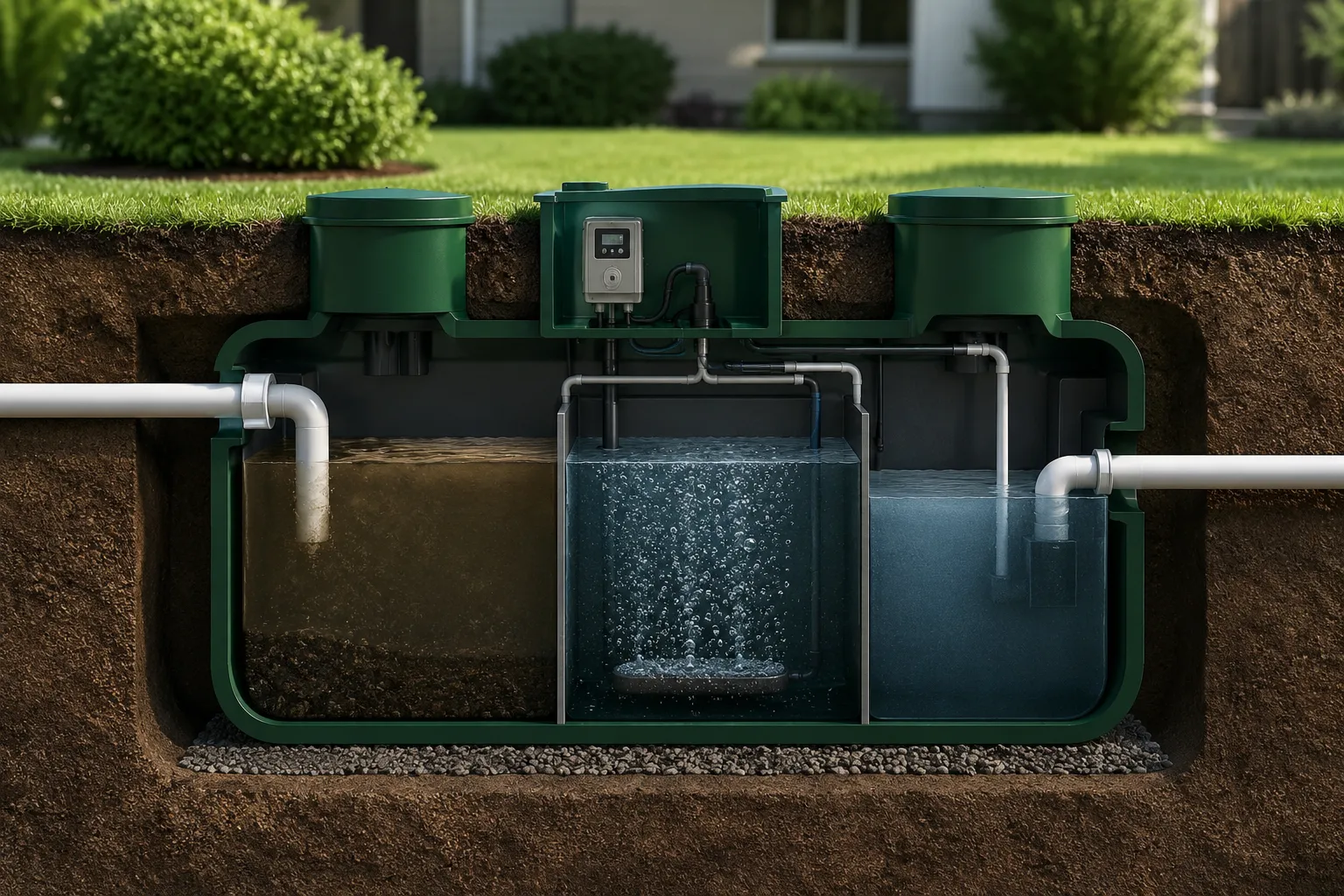

Not every septic system in Central Florida gets the option of a conventional tank and drain field anymore. Across a growing number of parcels near the region's spring systems and other sensitive waterways, state and local rules now require an aerobic treatment unit, or ATU, capable of removing significantly more nitrogen than a standard system before wastewater ever reaches the drain field. For homeowners building new, replacing a failed system, or simply trying to understand why a neighbor's project looks different from what used to be standard, knowing why these rules exist and how ATUs actually work makes the permitting process far less confusing.
Did you know? Under Florida's Enhanced Nutrient-Reducing Onsite Sewage Treatment and Disposal Systems program, an approved ATU or comparable advanced system must cut total nitrogen by at least 50% before the drainfield stage, or at least 65% when measured across the tank and drainfield combined, compared to a conventional system. These enhanced systems are now mandatory for new septic installations on lots of one acre or less within designated Basin Management Action Plan areas surrounding Florida's Outstanding Springs. Source: Florida Department of Environmental Protection, "Permitting of Enhanced Nutrient Reducing Onsite Sewage Treatment and Disposal Systems," floridadep.gov.
What Makes an ATU Different From a Standard Septic System
A conventional septic system relies on gravity and naturally occurring anaerobic bacteria to break down solids in the tank before the liquid effluent moves out to the drain field for final filtration through the soil. An ATU nitrogen-reducing septic system works differently. It actively pumps oxygen into the treatment chamber, which supports aerobic bacteria that break down waste more thoroughly and, critically, convert nitrogen compounds into forms that can be more effectively removed before the effluent ever leaves the unit. Some ATU designs add a secondary treatment stage, and disinfection is often built in as well, producing effluent that's cleaner than what a standard tank sends to the drain field. This added treatment comes at a cost. ATUs have moving mechanical parts, including blowers and sometimes pumps, that a conventional gravity system doesn't need, which means they require more frequent maintenance and typically an annual service contract to keep the unit operating within the parameters the state requires.
Why Florida Is Pushing These Systems Near Springs
Florida is home to more than a thousand documented springs fed by the Floridan Aquifer, and many have shown rising nitrogen levels over recent decades, a trend closely tied to nutrient sources including agricultural runoff, fertilizer use, and aging or undersized septic systems in the surrounding springshed. Excess nitrogen feeds algae blooms that damage the ecological health of a spring system and can eventually degrade the water quality relied on by nearby residents. In response, the Florida Legislature identified a set of Outstanding Florida Springs requiring dedicated restoration plans, known as Basin Management Action Plans, that specifically target onsite sewage systems as one of several nitrogen sources needing remediation. Where a BMAP is in effect, new septic installations on small lots are generally required to use an enhanced nutrient-reducing system rather than a conventional one, and in some areas, existing systems are also being phased toward upgrade requirements as funding and infrastructure allow. Homeowners in these zones sometimes qualify for state assistance through septic upgrade incentive programs designed to offset the added cost of compliant equipment.
When an ATU Is Required Versus When It's a Choice
Beyond the BMAP-driven mandates, ATUs also show up in a handful of other scenarios that aren't strictly about spring protection. Some counties require ATUs county-wide or in specific zoning districts regardless of proximity to a spring. A property with limited or challenging soil conditions may use an ATU to earn a reduction in required drain field size, since the enhanced treatment lowers the burden placed on the soil for final filtration. ATUs are also commonly paired with drip irrigation systems, which distribute treated effluent more evenly across a smaller footprint than a traditional trench-style drain field. Homeowners evaluating a septic tank installation on a tight or oddly shaped lot may find that an ATU-based design opens up options that wouldn't otherwise be permittable with a conventional system, even outside a mandated BMAP zone.
What Ongoing ATU Ownership Actually Involves
Owning an ATU is a different commitment than owning a conventional septic system, and homeowners moving into a home with one, or installing one for the first time, should understand what that means going forward. Florida generally requires a maintenance contract with a certified provider, along with periodic sampling and reporting to confirm the unit continues to meet its nitrogen-reduction performance standard. Alarms on ATUs typically signal blower failure, unusual water levels, or other mechanical issues that need prompt septic repair attention, since these systems don't have the same passive fallback that a gravity-fed conventional system does. Skipping scheduled maintenance doesn't just risk a mechanical failure, it can put a homeowner out of compliance with the permit conditions tied to the property, which becomes a real issue during a future sale if the system's maintenance records don't hold up to scrutiny.
Key Takeaways
- Florida's ENR-OSTDS rules require nitrogen reduction of at least 50% at the drainfield stage, or 65% overall, for qualifying systems in designated BMAP areas.
- ATUs use active aeration and aerobic bacteria to treat wastewater more thoroughly than a conventional gravity-fed septic tank.
- The mandate exists primarily to protect Florida's spring systems, where excess nitrogen from septic and other sources fuels damaging algae growth.
- ATUs are sometimes chosen voluntarily outside mandated zones to reduce drain field size requirements or work around difficult soil conditions.
- Ongoing ATU ownership requires a maintenance contract and regular monitoring, not a one-time installation and forget approach.
Homeowners unsure whether their property falls inside a BMAP zone, or whether an existing system already meets current nitrogen-reduction standards, are better served checking before starting a project than assuming a conventional system will pass permitting. A1 Septic works with both conventional and ATU systems across Central Florida, and browsing the full range of septic services offered is a reasonable starting point for homeowners who aren't yet sure which category their project falls into. Determining which requirements apply to a specific parcel is easiest before design work begins, not after a permit application has already been submitted.
























Sign in to leave a comment.