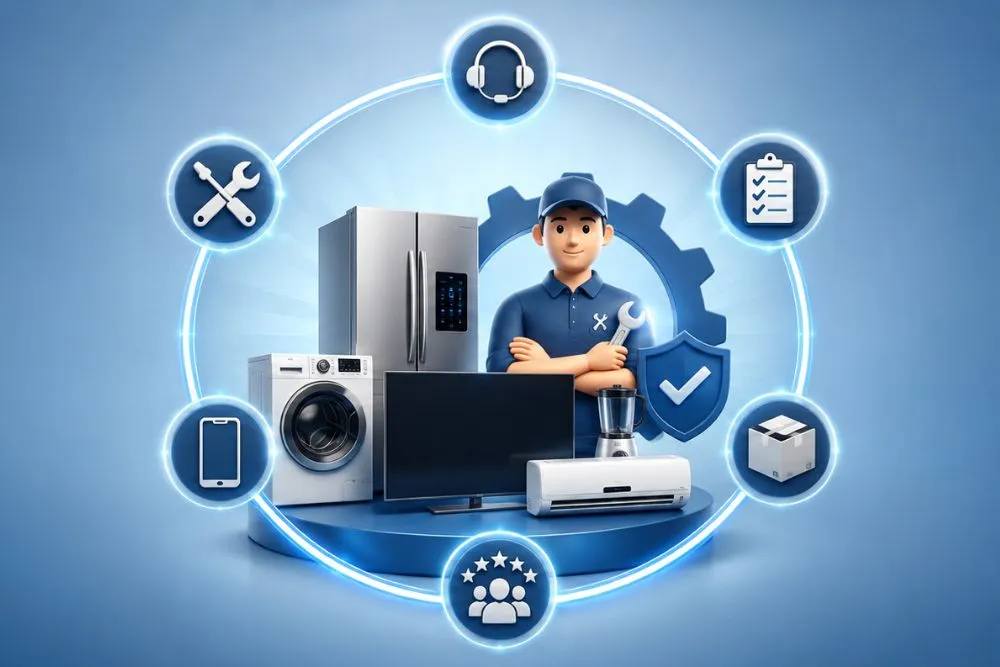

After-sales service management for consumer durables is the coordinated handling of installation, product demonstrations, warranty registration, and repairs once a product is sold. For FMEG and consumer durables brands, this coordination shapes repeat purchases, dealer confidence, and brand reputation, which makes it a revenue function rather than only a support cost.
Note: This article separates published research from practical recommendations for teams managing multi-tier distribution and field operations. It does not present automotive service data as an FMEG benchmark.
“Focus on the interactions that are important to customers.”
For a consumer-durable brand, the sale does not end when the invoice is generated. It continues through installation, product demonstration, warranty registration, repair, replacement, and follow-up.
This is why after-sales service management software is becoming a priority for FMEG brands. The goal is not only to close service requests. The goal is to connect sales, distribution, field teams, service partners, and customer feedback in one operating loop.
Key takeaways
- After-sales service is part of the revenue journey, not only a support function.
- FMEG brands should connect sales, installation, warranty, and service-partner data.
- Installation turnaround and first-time-fix rate reveal commercial as well as operational health.
- Service insights can improve dealer confidence, product decisions, and repeat
Why after-sales service affects sales
A customer may buy a fan, light, switch, appliance, or home electrical product through a dealer. The brand may count that transaction as complete. The customer may not.
If installation is delayed, the product creates a poor first impression. If a demonstration never happens, key features may go unused. If a warranty claim disappears between a dealer and a service partner, trust declines.
These issues affect revenue in four ways:
- Customers become less likely to repurchase.
- Dealers become less confident when recommending the brand.
- Electricians and contractors may specify competing products.
Research published in the Journal of Retailing and Consumer Services identifies after-sales service as an important predictor of customer satisfaction and retention. The study also shows that service quality elements do not affect every customer in the same way. Brands must therefore measure service performance instead of relying on assumptions.
Note: The study analyses automotive data. Its conclusion supports the service-quality logic, not an FMEG benchmark.
The after-sales gap in consumer durables
Many FMEG companies have strong systems for orders, inventory, and distribution. Yet service activity often remains fragmented across dealers, coordinators, technicians, and authorised partners.
Common problems include:
- Installation requests recorded in spreadsheets or chat messages.
- Product demos scheduled without checking field availability.
- Warranty claims managed without reliable serial-number data.
- Service partners assigned without clear territory or skill rules.
The result is a disconnected experience with hidden costs from missed appointments, repeat travel, poor parts planning, and escalations.
Four workflows that require better coordination
1. Installation and activation
Installation is often the first real interaction after purchase. A reliable process should capture the product, location, customer preference, service window, assigned partner, and completion evidence.
It should also handle rescheduling. A missed appointment should trigger an alert, not another unanswered phone call.
2. Product demonstrations
Demos matter when a product has safety requirements, multiple settings, or features that are not obvious. They are especially important for appliances and smart electrical products.
A structured workflow can assign the right person, schedule the visit, record customer questions, and confirm completion. This reduces avoidable complaints caused by incorrect usage.
3. Warranty registration and claims
Warranty management requires more than storing an invoice. It needs a reliable connection between the customer, product model, serial number, purchase date, warranty terms, claim status, and resolution.
This helps teams confirm coverage, identify duplicate claims, find the responsible partner, and choose the right resolution. It also reduces disputes.
4. Authorised service partner management
Service partners represent the brand in the customer’s home or workplace. Their performance directly affects brand perception.
Brands should monitor assignment time, appointment adherence, first-time-fix rate, repeat visits, customer feedback, and claim ageing. These measures help identify whether the problem is product quality, diagnosis, parts availability, routing, or partner execution.
What good after-sales service management looks like
The best operating model creates one connected record for each service event. That record should include the customer or outlet, product, serial number, invoice, warranty, location, request type, assigned partner, visit history, and closure evidence.
A modern field workflow should support:
- Request capture from customers, dealers, sales teams, and service desks.
- Rules-based assignment by territory, skill, availability, and priority.
- Mobile checklists for installation, demo, repair, and replacement visits.
- Offline access for technicians working in low-connectivity markets.
- Photos, signatures, parts used, and completion notes.
- Alerts for ageing claims and missed service-level agreements.
- Dashboards for sales, service, operations, and leadership.
Connect these tasks with distribution management and channel visibility.
Why the logic differs across FMCG, FMEG, and building materials
The need for coordination exists across sectors, but the service journey is not identical.
FMCG and CPG
FMCG products usually have high transaction frequency and lower service complexity. The focus is often on complaint capture, replacement handling, distributor claims, and consumer feedback.
A small improvement in complaint classification can reveal packaging, stock, or route-level issues. It can also prevent repeated complaints from the same outlet.
FMEG and consumer durables
FMEG products create more post-purchase dependency. Installation, demonstration, repair, spare parts, and warranty status can all shape future demand.
The brand must connect channel sales data with service outcomes. Repeated complaints around a strong dealer may signal a training, product-information, or partner issue.
The existing discussion of FMEG multi-channel distribution is useful for understanding dealer, electrician, and modern-trade complexity. After-sales coordination adds the missing post-purchase layer.
Building materials
Building materials often involve projects, contractors, architects, applicators, and sub-dealers. Service may include site visits, technical guidance, and replacement requests.
The longer sales cycle means a missed follow-up can affect an entire project. Field visibility must cover stakeholders, sites, tasks, and commitments.
KPIs that connect service to revenue
Service teams should not report only on tickets closed. They should measure the commercial effect of service quality.
Important indicators include:
- Installation turnaround time: Time from request to completed installation.
- Demo completion rate: Percentage of scheduled demonstrations completed.
- First-time-fix rate: Cases resolved during the first visit.
- Warranty claim ageing: Time taken to close valid claims.
- Repeat-visit rate: Cases requiring additional visits.
- Partner SLA adherence: Percentage of visits completed within the agreed window.
- Complaint rate by SKU and region: Evidence of product or execution hotspots.
- Repeat purchase after service: A useful indicator of trust and retention.
Practical recommendations for implementation
Start with the highest-friction workflows. Do not digitise every process at once.
- Map the full journey from sale to service closure.
- Create a common product, customer, serial-number, and warranty record.
- Standardise request types and closure codes.
- Define ownership for every handoff and set service-level rules.
- Give field teams mobile tools that work in low-connectivity areas.
- Connect service data with sales reviews and use complaint patterns to improve training, routing, product information, and inventory planning.
For organisations modernising field operations, sales force automation capabilities can provide the execution layer. Sales and service data must inform each other.
Frequently asked questions
What is after-sales service management for consumer durables?
It is the coordinated process of managing installation, demos, warranty claims, repairs, replacements, service partners, and customer follow-up after a product is sold.
What does after-sales service management software do?
It helps teams capture requests, assign work, schedule visits, track warranty status, monitor service-level agreements, document field activity, and analyse outcomes.
How does warranty tracking help FMEG brands?
It connects the claim to the product, serial number, invoice, warranty terms, service partner, and resolution. This reduces avoidable disputes and improves claim visibility.
Which metric should brands improve first?
Start with installation turnaround time and first-time-fix rate. They often expose process, partner, routing, and product-information problems quickly.
Is after-sales service only a service department responsibility?
No. Sales, distribution, service, finance, product, and leadership teams all need relevant parts of the same information. Shared visibility prevents repeated handoffs and weak accountability.
Conclusion
For FMCG, FMEG, and building-materials companies, after-sales service protects the value of every sale. When installation, demos, warranty handling, and partner coordination are connected to sales data, service becomes a source of retention, insight, and channel confidence.
References
- Beaujean, M., Davidson, J., & Madge, S. (2006). The ‘moment of truth’ in customer service. McKinsey Quarterly. mckinsey.com/capabilities/people-and-organizational-performance/our-insights/the-moment-of-truth-in-customer-service
- Shokouhyar, S., Shokoohyar, S., & Safari, S. (2020). Research on the influence of after-sales service quality factors on customer satisfaction. Journal of Retailing and Consumer Services, 56. doi.org/10.1016/j.jretconser.2020.102139


























Sign in to leave a comment.