Agency vs Freelancer vs In-House: Who Builds Your Mobile App?

Sooner or later every founder with an app idea reaches the same fork. Do you hire a freelancer, build your own team or go to a mobile app development company? Everyone you ask has a strong opinion, and most of those opinions come from whichever route worked for them once.
There is no universal answer, but there is usually an obvious one once you look at your budget, your timeline and who will own the product in two years. This post compares the three routes honestly, including the cases where an app development agency is the wrong call.
The short version
If your scope is clear and you want to launch within a few months, an agency usually gets you there fastest. If you have one small, well-defined task, a freelancer is cheaper and quicker. If the app is the business and you will be building on it for years, you will eventually want your own team.
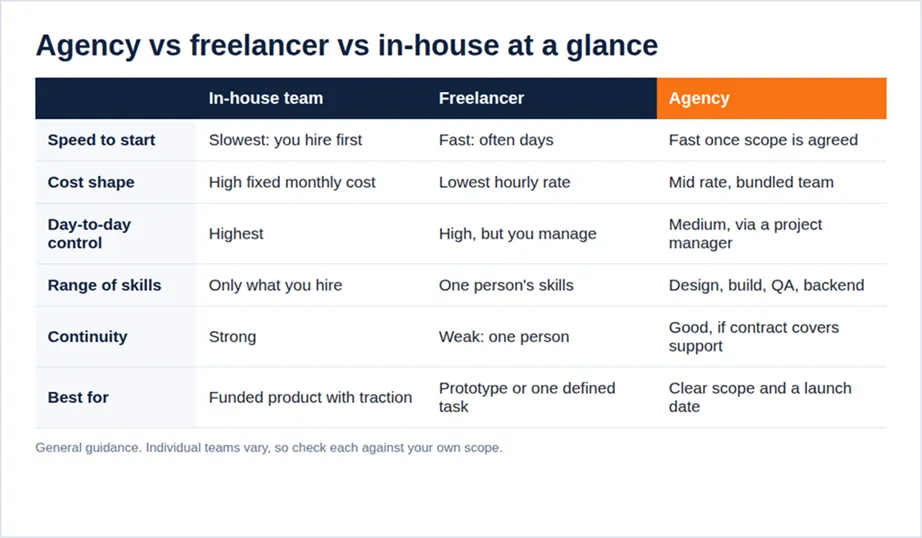
Most companies end up using more than one route over time. The table below shows how the three compare on the things founders ask about first.
In-house: control, and the bill that comes with it
Salary is the smallest part of the cost. Recruiting takes time, equipment and tools add up, and someone has to manage the team. One developer cannot cover design, backend, testing and release, so a single hire rarely makes a product.
Platform choice matters here too. Android and iOS need different skills, and if you pick a cross-platform framework you are hiring for that. Our comparison of Flutter vs React Native is worth reading before you write a job description, because the framework decides who you can hire.
Hiring mobile app developers also takes longer than most founders plan for, and a wrong hire costs you months. An in-house team makes sense when you are funded, you have proof people want the product and you have a technical leader who can run the work. Before that, it is an expensive guess.
Freelancers: great for a defined slice of work
A good freelancer is fast, affordable and easy to start with. They suit a prototype, a single feature or a fix. An Android app development task such as adding a payment SDK is a fair fit, and so is a small internal tool where android application development is the whole brief and nobody else needs to be coordinated.
The risks are structural. One person is your whole team. If they get sick, take a full-time job or go quiet, the project stops. You also become the project manager, and if you hire separate freelancers for design, backend and mobile, you become the integrator too.
If you go this way, write the contract carefully. Our notes on hiring a React Native developer on contract cover code ownership, handover and what to check before the first payment.
Agency: a full team, and a price to match
An agency gives you a project manager, designers, developers and testers under one contract. That is the main appeal. You get mobile app development services from idea to store release without hiring anyone, and the same company can usually handle the backend and wider application development services too.
The trade-offs are real. The hourly cost is higher than a freelancer. You have less day-to-day control, so you need to be clear about scope up front. Quality varies a lot between agencies, which is why the vetting step matters more than the choice of model.
Agencies are strongest on custom mobile app development, where the work needs several skills at once and a deadline attached. They are weaker on tiny tasks, where setup and process cost more than the job itself.
The middle path: a dedicated team
There is a fourth option that sits between the three. A dedicated team from a development company works as an extension of yours. You direct the work and they handle hiring, payroll and equipment.
It suits startups that need to hire mobile app developers quickly without building an HR function first. It also suits companies that have a product owner but not enough engineers. Our guide to IT staff augmentation explains how it works and what to ask for.
What the cost really looks like
Founders compare hourly rates and stop there. The number that matters is the cost of getting a working, tested app into the store and keeping it alive afterwards.
A freelancer has the lowest rate, but add the hours you spend managing the work, the rework when separate pieces do not fit together and the risk of starting over if they leave. An in-house team has the highest fixed cost. Salaries run every month whether or not the roadmap is full, and you pay for recruiting before you see any code. An agency sits in the middle on rate and often comes out ahead on total cost for a first version, because planning, design and testing are already built into the price.
None of this is a rule. A solo developer on a well-scoped job can beat any agency on price. When you compare, put the same lines next to each option: design, development, testing, project management, launch and three months of fixes. Whoever leaves a line blank is the one who will bill you for it later.
Five questions that settle it
- How clear is your scope?
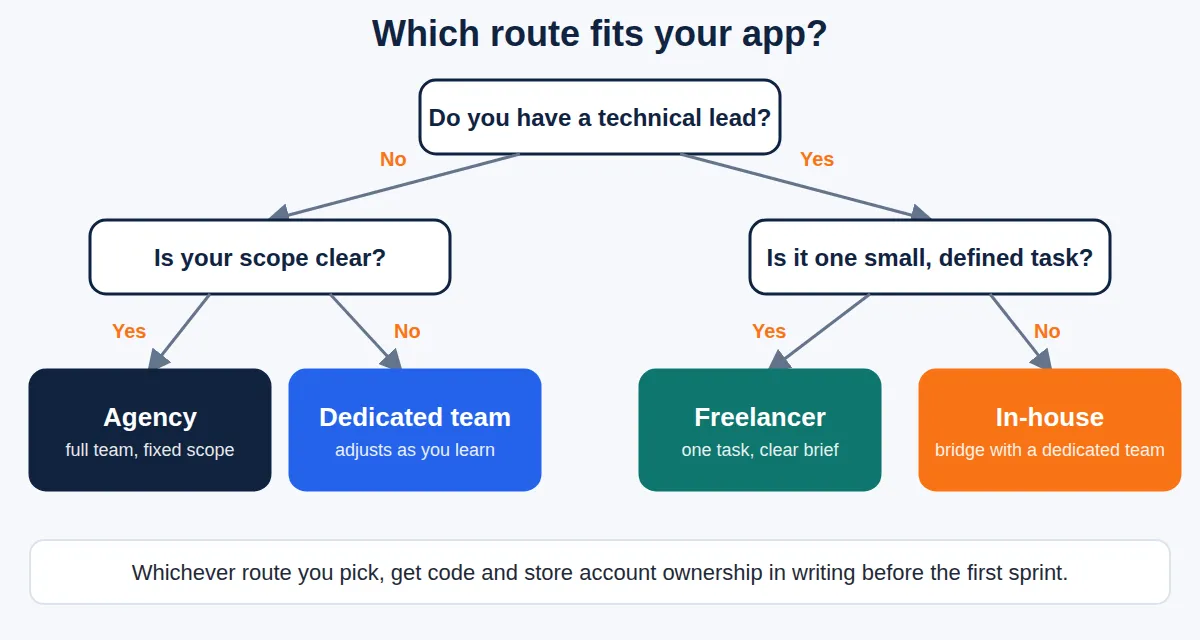
A clear scope favors an agency or a freelancer. A fuzzy one favors a dedicated team that can adjust as you learn.
- How long is your runway?
A short runway rules out slow hiring.
- Who will manage the work?
If nobody on your side has built software before, a freelancer alone is risky.
- Will the app change often after launch?
Frequent change points toward a team you keep, whether in-house or dedicated.
- Do you have a technical lead?
If yes, you can manage freelancers or a dedicated team. If not, an agency fills that gap.
Mistakes we see most often
Mobile application development rarely goes wrong because of the code itself. It goes wrong because of decisions like these:
- Hiring a freelancer to build the whole product with no technical lead
- Building an in-house team before the idea is validated
- Choosing an agency on price alone
- Skipping the code ownership conversation until the final invoice
If you are still deciding whether to build at all, our walkthrough of building your own app is a good place to start.
How DianApps works with founders
At DianApps, we work with founders on fixed-price projects, dedicated teams and hourly engagements, depending on how settled the scope is. We build for Android, iOS, Flutter and React Native, and a project usually starts with a discovery call where we go through your brief and tell you plainly what we think.
If you are looking for a partner for custom mobile app development, we can scope it with you and show you how similar products were built. And if a freelancer or a small in-house hire is the better call for your stage, we will say that too.
Which one should you pick
Early idea with no budget: start with a freelancer or a no-code test. Clear scope and a launch date: an agency. A funded product with traction: build your team, ideally with a dedicated team to bridge the gap while you hire. Whatever you choose, get ownership of the code in writing before the first sprint starts.



Sign in to leave a comment.