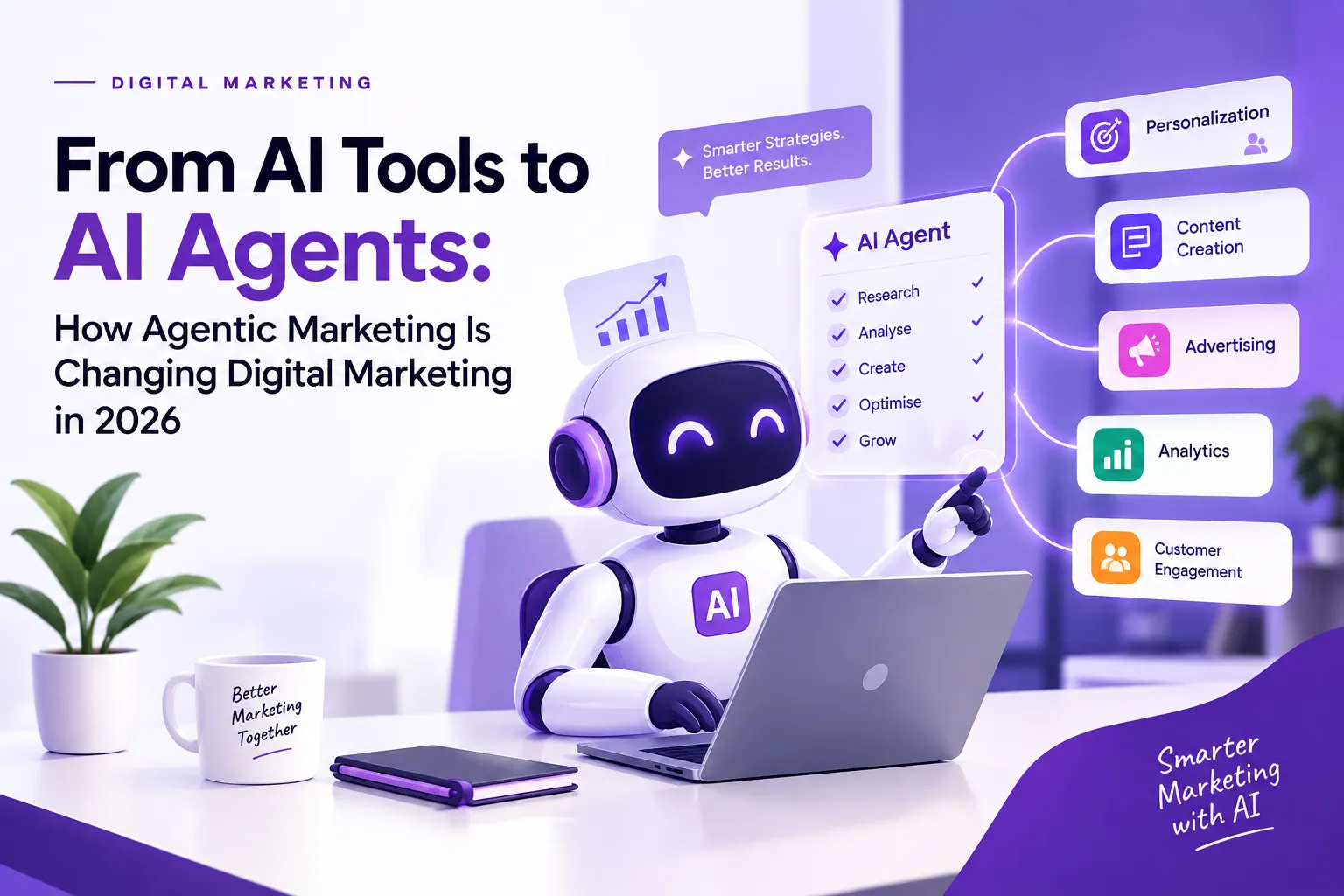

Digital marketing has always changed with technology.
A few years ago, marketers were learning how to use social media platforms, automation tools, analytics dashboards, and advertising platforms more effectively. Then generative AI changed the way marketers approached content, research, design, and everyday tasks.
Now, another shift is taking place.
The conversation is moving from AI tools that help marketers to AI agents that can perform multi-step marketing tasks.
Instead of simply asking an AI tool to write a caption or suggest keywords, marketers can increasingly use AI-powered systems to research information, analyse customer behaviour, organise data, create variations, recommend actions, and support campaign workflows.
This emerging approach is often described as agentic AI or agentic marketing.
It does not mean that human marketers are disappearing. In fact, the opposite may be more important: as AI handles more repetitive work, human judgement, creativity, strategy, and decision-making become more valuable.
What Is Agentic Marketing?
Agentic marketing refers to using AI systems that can work through a series of tasks toward a particular marketing objective instead of performing only one isolated instruction.
A traditional AI tool might answer:
“Give me five ideas for a social media post.”
An AI agent could potentially work through a broader workflow:
Research the audience → analyse previous content → identify opportunities → create content ideas → prepare variations → review performance data → suggest the next action.
The important difference is not simply that the AI can generate text.
The difference is the workflow.
An AI agent is designed to work toward an objective by handling multiple connected steps, often using information from different sources or tools.
This is one reason AI agents are becoming an important topic in the marketing industry. Current marketing trend reports increasingly highlight AI-powered personalisation, automation, conversational experiences, and AI agents as areas to watch in 2026.
Why Is This Becoming Important Now?
Digital marketing has become complicated.
A single campaign may involve:
- Audience research
- Content creation
- Search optimisation
- Social media
- Email marketing
- Paid advertising
- Analytics
- Customer relationship management
- Testing and optimisation
A marketer may spend hours moving information between different platforms.
AI agents have the potential to connect some of these activities.
For example, imagine an online store wants to promote a new product.
Instead of manually checking customer data, researching competitors, creating content ideas, preparing different ad variations, and analysing campaign performance separately, an AI-powered workflow could assist with several of these tasks.
The marketer still sets the objective, provides rules, reviews important decisions, and monitors the results.
The technology simply helps reduce repetitive work.
AI Agents Are Different From Simple Automation
Automation is not new.
Marketers have been using automated emails, scheduled social media posts, lead notifications, and workflow systems for years.
So what makes AI agents different?
Traditional automation generally follows predefined rules.
For example:
If a customer submits a form → send an email.
An AI-powered system can potentially deal with more flexible situations.
For example:
Analyse the customer's interaction → determine what information may be useful → select an appropriate response → personalise the communication → recommend the next action.
This does not mean AI can safely make every marketing decision without supervision. It means AI systems are becoming more capable of handling complex workflows rather than simply following one fixed instruction.
That distinction is important for marketers who want to use AI responsibly.
Personalisation Is Becoming More Intelligent
People do not all respond to the same message.
A first-time website visitor may need basic information. Someone who has already compared several products may need more detailed information. An existing customer may be interested in something completely different.
Personalisation attempts to reflect these differences.
AI can help marketers analyse large amounts of behavioural information and identify patterns that may be difficult to notice manually.
For example, an AI system might help identify that:
- New visitors prefer educational content.
- Returning visitors interact more with product comparisons.
- Existing customers respond better to loyalty offers.
- Certain audiences engage more with video than long-form articles.
The marketer can then use these insights to create more relevant experiences.
The goal should not be personalisation simply because technology makes it possible.
The goal should be relevance.
If personalisation becomes excessive or feels intrusive, it can have the opposite effect.
AI Agents and Content Marketing
Content creation is one of the areas where AI has already had a major impact.
But creating more content is not necessarily the answer.
The internet already contains enormous amounts of repetitive information. Google continues to emphasise people-first content and warns against producing content primarily to manipulate search rankings.
This creates an interesting role for AI agents.
Instead of using AI simply to produce hundreds of articles, marketers can use AI to support the research and planning process.
An AI-assisted content workflow might include:
- Identifying common customer questions.
- Grouping related topics.
- Reviewing existing website content.
- Finding information gaps.
- Suggesting content formats.
- Creating an initial outline.
- Preparing a draft for human editing.
- Checking consistency and factual details.
- Analysing performance after publication.
The human writer remains important because good content requires context, judgement, experience, originality, and understanding of the audience.
AI can speed up parts of the process, but speed alone does not create valuable content.
Search Is Also Becoming More AI-Driven
Search is another major area being transformed by AI.
Google has introduced AI-powered search experiences and continues to expand how people interact with Search. Its current guidance states that traditional SEO best practices remain relevant because generative AI features are connected to Google's existing Search systems.
This means marketers should not assume that the arrival of AI makes SEO irrelevant.
Instead, the search experience is becoming broader.
People may discover information through traditional search results, AI-generated answers, social platforms, videos, communities, product experiences, and conversational interfaces.
For marketers, this means the basic goal remains similar:
Be useful, be relevant, and make reliable information easy to understand.
The places where people discover that information are simply becoming more diverse.
AI Agents and Paid Advertising
Paid advertising is also moving toward greater automation.
Modern advertising platforms already use machine learning to help with bidding, audience signals, placements, creative variations, and campaign optimisation.
Google has also announced new AI-powered advertising experiences and conversational approaches within Search.
The next stage is likely to involve more systems helping marketers manage complex campaign decisions.
For example, instead of manually creating every variation, a marketer may provide:
- Campaign objective
- Target audience
- Budget
- Brand guidelines
- Product information
- Creative assets
- Business restrictions
AI can then help generate and evaluate multiple possibilities.
But there is an important limitation.
Marketing is not simply mathematics.
A campaign can have excellent numbers and still damage a brand if its message is insensitive, misleading, or inconsistent.
That is why human review remains important.
The Human Marketer Is Still Important
Whenever a new technology becomes popular, one question appears:
“Will AI replace marketers?”
The more realistic answer is that AI is likely to change the work marketers do.
Routine production tasks may become faster.
Research may become easier.
Data analysis may become more accessible.
Content variations may be produced more quickly.
But strategy still requires understanding people.
A marketer needs to ask:
- What does the customer actually need?
- What problem are we solving?
- Is this message appropriate?
- Does this campaign fit the brand?
- Are we communicating honestly?
- What should we do with the data?
- Which result actually matters to the business?
AI can support these decisions, but responsibility still belongs to people.
Recent industry reporting also reflects this shift: as AI automates more production work, agencies and marketers are being pushed toward strategy, creativity, consumer insight, and brand stewardship.
The Importance of Good Data
AI systems are only as useful as the information they receive.
Imagine a company has different product prices on different platforms, outdated descriptions on its website, inconsistent customer information, and old campaign data.
An AI system may produce an impressive-looking recommendation based on unreliable information.
The problem is not necessarily the AI.
The problem is the data.
This makes data quality increasingly important in AI-driven marketing.
Businesses should pay attention to:
- Accurate product information
- Updated customer data
- Consistent brand information
- Correct analytics
- Clear campaign objectives
- Reliable performance measurements
Before asking AI to make smarter decisions, businesses need to make sure the information available to it is trustworthy.
Privacy and Responsible AI
More data and more automation also create responsibility.
Marketers need to think carefully about how customer information is collected, stored, analysed, and used.
Not every piece of customer data should automatically be used for personalisation.
Customers should not feel that a brand knows too much about them.
Responsible AI marketing means considering:
Transparency + Privacy + Accuracy + Human Oversight
Businesses should also review AI-generated content before publishing it, particularly when the content contains statistics, product claims, legal information, financial information, or other sensitive details.
AI can make mistakes.
A professional marketing process should have a way to detect and correct those mistakes.
What Skills Will Marketers Need?
As AI takes over more repetitive tasks, marketers may need to strengthen skills that technology cannot easily replace.
Strategic Thinking
Knowing what to do is more valuable than simply knowing which tool to open.
Creative Thinking
Original campaign concepts, storytelling, positioning, and emotional communication still require strong human input.
Data Interpretation
Marketers need to understand what the numbers actually mean instead of blindly following dashboards.
Customer Understanding
Technology can identify patterns, but marketers still need to understand human motivations and concerns.
AI Literacy
Marketers do not necessarily need to become programmers. However, understanding how AI systems work, what they can do, and where they can fail is becoming increasingly useful.
Critical Thinking
AI can produce confident answers that are incorrect. Marketers need to question information, verify important claims, and make informed decisions.
A Practical Example
Consider a small online clothing business.
The business wants to increase sales of a new collection.
A traditional marketing process might involve separate activities:
- Researching customers
- Writing product descriptions
- Creating social posts
- Preparing email campaigns
- Running advertisements
- Checking analytics
An AI-assisted workflow could help organise these activities.
The system could analyse existing information, identify customer segments, suggest content ideas, prepare draft variations, and summarise campaign performance.
But the business owner or marketing team would still decide:
What should the brand stand for?
Which customers should be prioritised?
Which message feels authentic?
What offers are appropriate?
Which recommendations should actually be implemented?
This is the future of AI-assisted marketing in a practical sense—not simply pressing a button and allowing AI to run everything.
How Small Businesses Can Prepare
You do not need a huge marketing department to start preparing for this shift.
Small businesses can begin with simple steps.
1. Identify Repetitive Tasks
Look for activities that take time but do not require much strategic thinking.
2. Organise Your Data
Make sure website, product, customer, and campaign information is accurate and consistent.
3. Create Clear Brand Guidelines
Define your tone, messaging, visual identity, target audience, and communication rules.
4. Use AI as an Assistant
Start with research, brainstorming, summaries, reporting, and content drafts rather than handing over every important decision.
5. Review Everything Important
Human review should remain part of the process.
6. Measure Business Outcomes
Do not measure success only by the amount of content produced or the number of AI tasks completed.
Look at meaningful outcomes such as qualified leads, sales, retention, engagement, and customer satisfaction.
What Comes Next?
The most interesting part of AI in digital marketing is that the technology is still evolving.
Google is already moving toward more agentic experiences in Search, while marketers across the industry are exploring AI agents for research, personalisation, content workflows, advertising, and customer engagement.
This could eventually create marketing workflows where different AI systems work together.
One system could analyse customer behaviour.
Another could help with content.
Another could assist with advertising.
Another could monitor performance.
Humans could then supervise the overall strategy.
That future may sound advanced, but many pieces of it are already appearing in today's marketing platforms.
Final Thoughts
Digital marketing is entering a stage where AI is moving beyond simple content generation and automation.
The rise of AI agents could change how marketers research, create, personalise, advertise, analyse, and communicate.
But the biggest opportunity is not simply doing more work faster.
It is using technology to spend more time on the work that matters most.
Strategy, creativity, customer understanding, trust, and good judgement will remain valuable—even as the tools become smarter.
The marketers who benefit most from AI may not be those who use the most tools. They may be the ones who understand when to use AI, when not to use it, and how to combine it with strong human thinking.
In 2026, the question is no longer simply “Can AI do this task?”
A better question is:
“How can AI help us do this better while keeping the human value that makes marketing meaningful?”























Sign in to leave a comment.