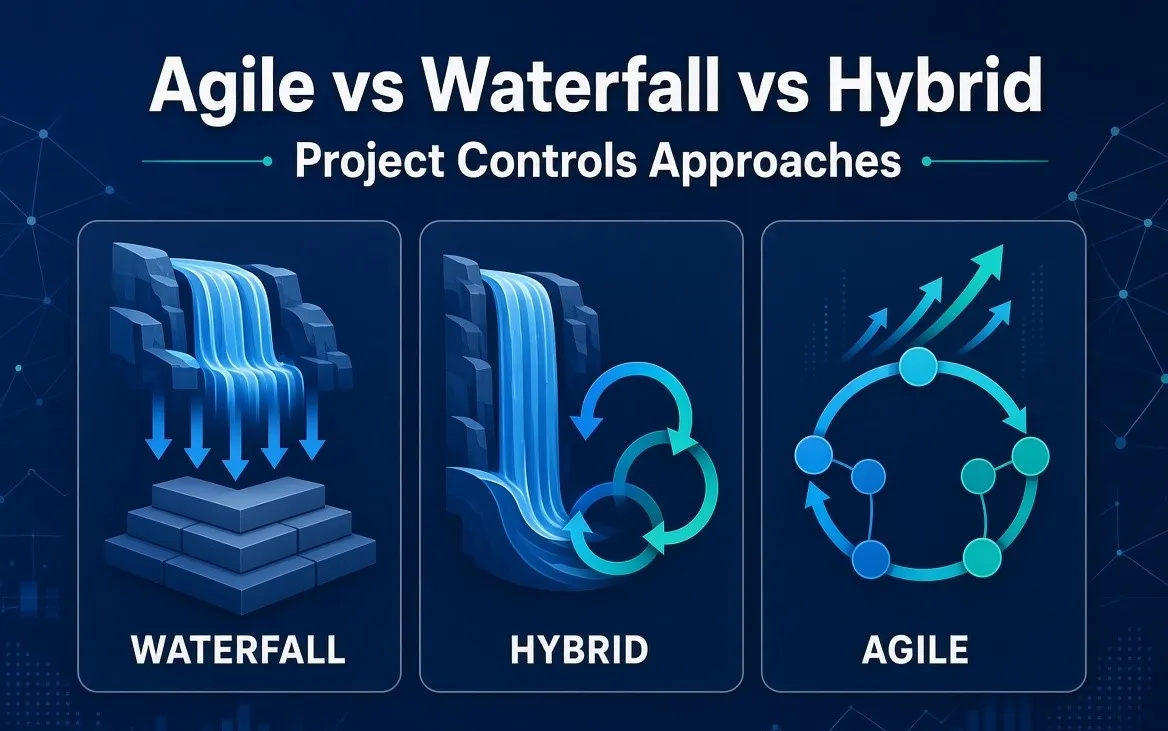


Choosing the right project delivery approach affects how teams plan, schedule, control costs, manage risks, and respond to change. Project Controls Institute (PCI) views project controls as a broader discipline that must work with the way a project is actually delivered. Waterfall suits projects with relatively stable requirements, Agile supports frequent feedback and changing priorities, while Hybrid combines practices from both when the project needs a tailored approach.
What Are Agile, Waterfall, and Hybrid Approaches?
Before comparing the three approaches, it helps to understand what each one means.
1. Waterfall or Predictive Approach
Waterfall is commonly associated with a predictive approach. The team defines as much of the scope, sequence, schedule, and budget as practical before execution begins.
Work generally progresses through planned phases or activities, with changes managed through a formal process.
This approach can be useful when:
- Requirements are well understood.
- The sequence of work is relatively predictable.
- Changes can be expensive.
- Regulatory or contractual requirements are significant.
- Detailed planning and documentation are important.
Construction, infrastructure, engineering, manufacturing, and other projects with defined requirements can often benefit from predictive planning. However, the suitability depends on the specific project rather than its industry alone.
2. Agile Approach
Agile is an adaptive approach that emphasizes shorter delivery cycles, feedback, collaboration, and the ability to respond to changing requirements.
Instead of trying to define every detail at the beginning, teams work in smaller increments and use feedback to improve the product or solution.
Agile principles emphasize early and continuous delivery of value, responding to change, collaboration, and regular reflection and improvement.
Agile can be particularly useful when:
- Requirements are likely to change.
- Customer feedback is important.
- The solution is still being developed or discovered.
- Teams need frequent feedback.
- Work can be delivered incrementally.
3. Hybrid Approach
A Hybrid approach combines predictive and adaptive practices based on the needs of the project.
It does not simply mean using random Agile and Waterfall techniques together. A good Hybrid approach is deliberately designed around the project's scope, uncertainty, stakeholders, governance requirements, and delivery environment. PMI describes Hybrid as a combination of predictive and adaptive ways of working tailored to project characteristics.
For example, a project could use:
- A predictive master schedule for major milestones.
- A defined project budget and cost baseline.
- Agile iterations for software development.
- Sprint reviews for stakeholder feedback.
- Traditional risk and change controls.
- Regular Agile retrospectives for continuous improvement.
Agile vs Waterfall vs Hybrid: Key Differences
The simplest way to understand the three approaches is to look at how they handle planning, change, delivery, and control.
Waterfall: Planning is generally more detailed upfront, and work follows an established sequence.
Agile: Planning is continuous and refined as the team learns more. Work is delivered in smaller increments.
Hybrid: High-level planning may follow a predictive structure while selected parts of the project use iterative or Agile practices.
The important point is that all three approaches involve planning. The difference is mainly in how much planning happens upfront, how frequently plans are revisited, and how the team responds to change.
Which Approach Is Better for Project Controls?
There is no universal winner.
The right approach depends on the project's characteristics.
1. Waterfall Project Controls
In a predictive environment, project controls often focus heavily on:
- Baseline development
- Work breakdown structures
- Detailed project scheduling
- Cost estimation and control
- Progress measurement
- Earned value analysis
- Change control
- Risk registers
- Forecasting
- Variance analysis
Because the baseline is established in greater detail, project controls teams can compare actual performance against planned scope, schedule, and cost.
This can provide strong visibility when project requirements and execution sequences are relatively stable.
2. Agile Project Controls
Agile environments require a different emphasis.
Instead of relying only on a long-term detailed schedule, teams may monitor:
- Backlog progress
- Iteration or sprint completion
- Release progress
- Throughput
- Work in progress
- Quality indicators
- Customer feedback
- Product or business outcomes
- Team capacity
The controls process becomes more focused on short feedback cycles and adapting plans as information changes.
This does not mean that cost, schedule, risk, and performance controls disappear. Instead, they need to be tailored to the Agile delivery environment.
3. Hybrid Project Controls
Hybrid environments require project controls professionals to connect the two systems.
For example, a major infrastructure project may have a fixed overall budget, contractual milestones, procurement schedule, and regulatory requirements. At the same time, a digital component within that project may be developed using Agile iterations.
The project controls framework therefore needs to connect:
Strategic milestones → detailed planning → iterative delivery → progress measurement → cost and schedule reporting
This is one reason Hybrid project management requires more than simply combining individual techniques. PMI notes that effective Hybrid work requires understanding when and how to blend predictive and adaptive approaches.
Also Read: WBS vs Project Schedule: Understanding the Difference
When Should You Use Waterfall?
Waterfall can be a strong choice when the project has relatively stable requirements and a predictable sequence of activities.
It may be suitable when:
- Scope is clearly defined.
- Engineering or construction activities have strong dependencies.
- Procurement has long lead times.
- Regulatory approvals must happen in a specific sequence.
- Changes are expensive.
- Contractual milestones are important.
- Stakeholders require detailed baseline reporting.
For example, a large infrastructure project may require detailed planning for engineering, procurement, construction, commissioning, and handover.
That does not mean every part of the project must remain strictly predictive. Some components may still benefit from iterative techniques.
When Should You Use Agile?
Agile can be useful when the team needs to learn, test, adapt, and deliver value frequently.
It may be appropriate when:
- Requirements are uncertain.
- Customer feedback can change priorities.
- The solution is being developed incrementally.
- Innovation is important.
- The team can deliver usable increments.
- Short feedback cycles provide value.
Software development and digital transformation projects are common examples, although Agile practices can be applied in other environments where the work supports iterative delivery.
When Should You Use a Hybrid Approach?
Hybrid can make sense when different parts of the same project have different levels of certainty.
Consider a major digital transformation project.
The organization may have a fixed budget, executive milestones, governance requirements, and an overall delivery target. However, the development team may not know exactly which product features will provide the greatest value until users test early versions.
A Hybrid model can provide:
- Predictive governance at the program or project level.
- Agile development at the team level.
- High-level schedule control.
- Iterative product development.
- Formal cost and risk management.
- Frequent stakeholder feedback.
This type of tailoring is increasingly relevant because organizations often use more than one delivery approach rather than treating Agile and predictive methods as mutually exclusive. PMI research has also reported increasing use of Hybrid approaches.
Agile, Waterfall, or Hybrid: Which Is Best?
The answer depends on the project.
1. Choose Waterfall when: requirements are stable, dependencies are predictable, detailed upfront planning is valuable, and change needs formal control.
2. Choose Agile when: requirements are evolving, frequent feedback is important, and the team can deliver work incrementally.
3. Choose Hybrid when: the project contains both predictable and uncertain work and needs structured governance alongside iterative delivery.
There is no rule that says an organization must use the same approach for every project. The better question is:
Which approach gives this project the right balance of predictability, adaptability, governance, and value delivery?
How Project Controls Change Across the Three Approaches
The fundamentals of project controls remain important, but their application changes.
1. Planning
Waterfall: Detailed planning and baseline development are usually emphasized upfront.
Agile: Planning is continuous and refined through iterations.
Hybrid: High-level planning may be predictive while selected work packages are planned iteratively.
2. Cost Control
Waterfall: Budget baselines, commitments, actual costs, forecasts, and variances can be tracked against a detailed baseline.
Agile: Cost may be connected to team capacity, iterations, releases, and prioritized work.
Hybrid: The overall project budget can remain predictive while Agile teams manage delivery at a more detailed level.
3. Schedule Control
Waterfall: Critical paths, milestones, dependencies, and baseline schedules are central.
Agile: Teams often focus on iteration cadence, backlog flow, releases, and delivery trends.
Hybrid: A high-level integrated schedule can connect predictive milestones with iterative delivery cycles.
4. Risk Management
Waterfall: Risks can be identified and monitored through structured risk registers and planned mitigation actions.
Agile: Frequent feedback and short delivery cycles can help teams identify and respond to emerging issues quickly.
Hybrid: Formal risk governance can operate alongside continuous team-level risk identification.
What Does This Mean for Project Controls Professionals?
Modern project controls professionals need more than scheduling and cost-control skills.
They increasingly need to understand different delivery approaches and know how controls should be adapted to each environment.
Relevant skills include:
- Project planning
- Project scheduling
- Cost control
- Risk management
- Progress measurement
- Forecasting
- Change management
- Data analysis
- Stakeholder communication
- Agile and predictive delivery concepts
- Digital project controls
- AI applications in project controls
For professionals pursuing a project controls certification, understanding these approaches can help connect technical controls knowledge with the wider project delivery environment.
The Role of AI in Modern Project Controls
AI is also changing how project controls teams work.
AI for project controls can potentially support:
- Project forecasting
- Schedule analysis
- Cost trend analysis
- Risk identification
- Project reporting
- Progress analysis
- Data-quality checks
- Scenario analysis
For example, AI could help analyze historical schedule and cost data to identify patterns that deserve attention.
However, AI-generated recommendations should be reviewed by experienced professionals. Project controls decisions depend on the quality of the underlying data, project context, assumptions, contracts, and governance requirements.
PCI can be relevant for professionals who want to develop their understanding of modern project controls while also considering how AI and digital tools are changing planning, cost, scheduling, risk, and project reporting.
A Simple Framework for Choosing the Right Approach
Before selecting Agile, Waterfall, or Hybrid, ask these questions:
1. How stable are the requirements?
Stable requirements generally support more predictive planning. Frequently changing requirements may favor Agile or Hybrid.
2. How expensive are changes?
If late changes are highly expensive, stronger upfront planning may be useful.
3. How quickly can value be delivered?
If useful deliverables can be produced incrementally, Agile practices may provide advantages.
4. How complex are the dependencies?
Projects with extensive engineering, procurement, or construction dependencies may need stronger predictive controls.
5. How much governance is required?
Regulated or contract-heavy environments may require formal baselines and controls.
6. Are different parts of the project different?
If yes, a Hybrid approach may provide a practical solution.
Final Thoughts
Agile, Waterfall, and Hybrid are not competing labels where one approach is always better than the others. They are different ways of organizing and delivering project work. The strongest project controls methodology is the one that matches the project's uncertainty, dependencies, governance needs, cost and schedule requirements, and ability to respond to change. Project Controls Institute (PCI) can help professionals build a broader understanding of project controls and prepare for a project environment where predictive, Agile, Hybrid, and AI-enabled practices increasingly work together.
FAQs
Q1. What is the difference between Agile and Waterfall?
Waterfall is generally predictive, with more detailed planning and sequencing established upfront. Agile is adaptive, using shorter cycles, frequent feedback, and the ability to respond to changing requirements.
Q2. Is Hybrid better than Agile or Waterfall?
Not automatically. Hybrid is useful when a project contains both predictable and uncertain work. The best approach depends on the project's requirements, risks, stakeholders, dependencies, and delivery environment.
Q3. Is Waterfall still used in project controls?
Yes. Predictive approaches remain useful for projects with stable requirements, significant dependencies, contractual milestones, and detailed planning needs.
Q4. Can Agile projects have project controls?
Yes. Agile projects still need planning, cost awareness, risk management, progress measurement, and performance reporting. The controls are simply tailored to the Agile delivery model.
Q5. What is Hybrid project controls?
Hybrid project controls connect predictive and adaptive control practices. For example, a project may use a high-level baseline schedule and budget while allowing individual teams to deliver work through Agile iterations.
Q6. Which approach is best for construction projects?
Many construction and infrastructure projects have characteristics that favor predictive planning, but the correct choice depends on the specific work. Some construction projects can benefit from Hybrid practices where certain components require iterative development or frequent feedback.
Q7. How does AI support project controls?
AI can support activities such as forecasting, schedule analysis, cost analysis, risk identification, and project reporting. Human review remains important because AI output depends on the quality and context of project data.
Q8. Should project controls professionals learn Agile?
Understanding Agile, predictive, and Hybrid approaches can help project controls professionals work effectively across different project environments. Modern project work increasingly requires the ability to tailor controls to the delivery approach rather than applying one fixed method.
























Sign in to leave a comment.