AI Agent Development Services: A Complete Guide for Businesses
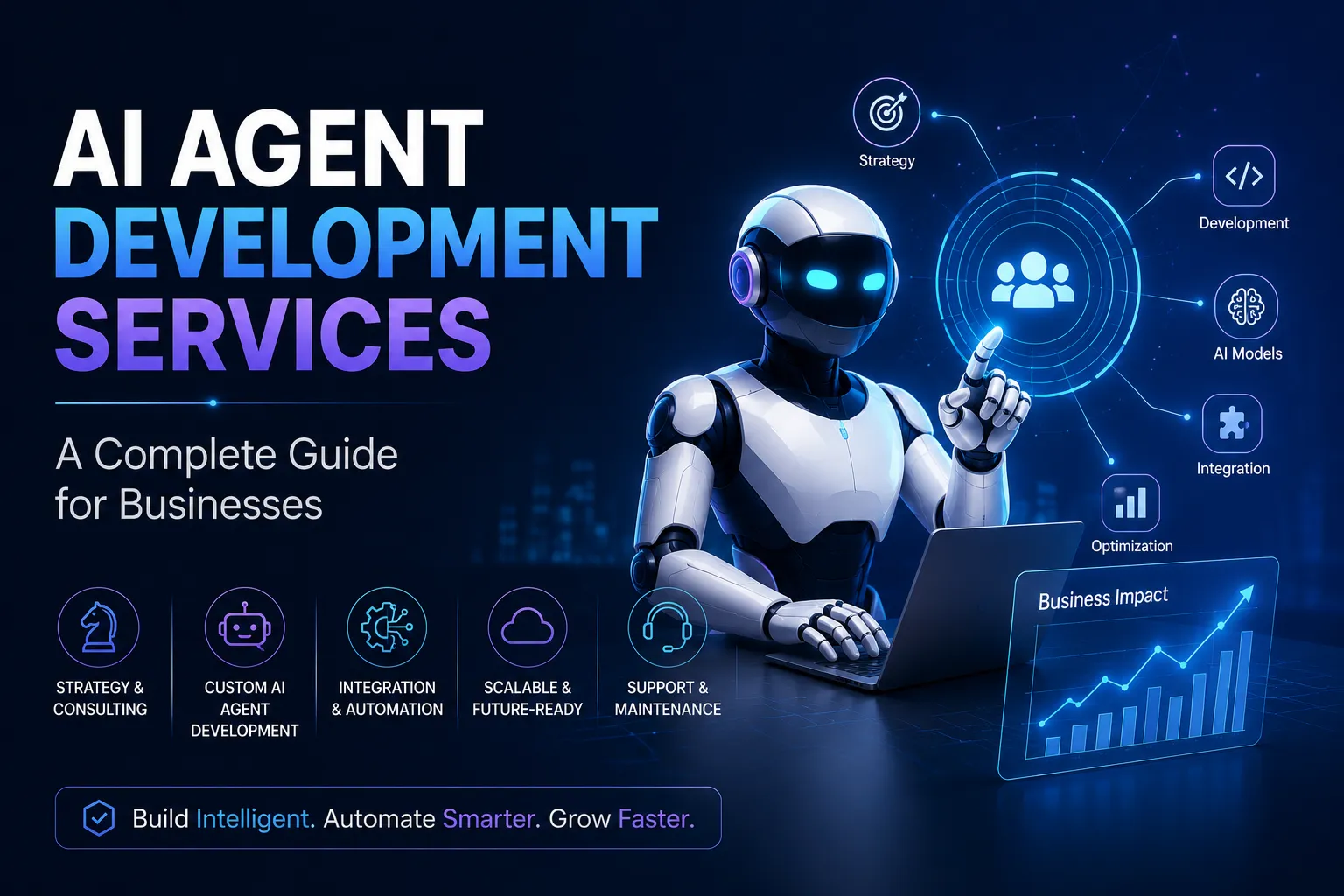
Businesses are entering a new phase of AI adoption where the focus is shifting from experimenting with generative AI to building systems that can perform meaningful work. Instead of using AI only to generate text, summarize information, or answer questions, organizations can now create software agents designed around specific business objectives.
This is where AI agent development services come into play. These services involve planning, engineering, integrating, testing, and deploying AI-powered agents that can become part of an organization's existing digital ecosystem.
Whether the goal is to automate customer interactions, assist employees, streamline back-office operations, or coordinate tasks across multiple applications, an AI agent can be designed around the organization's particular requirements.
What Are AI Agent Development Services?
AI agent development services encompass the complete process of creating an AI-powered agent for a particular business purpose.
Rather than treating an AI agent as a standalone chatbot, development teams design it as a functional software component that can work with business data, applications, APIs, and predefined processes.
Depending on the use case, development may include:
- AI model integration
- Agent workflow design
- Knowledge-base connectivity
- API integration
- Tool configuration
- Memory implementation
- Business-rule integration
- Authentication and authorization
- Evaluation and testing
- Deployment and monitoring
For example, an insurance company could develop an agent that reviews incoming claims documents, extracts relevant information, checks policy details, identifies missing documentation, and sends the case to the appropriate processing queue.
The value comes from connecting AI capabilities to a specific operational outcome.
What Can Businesses Build With AI Agents?
The versatility of agent technology means businesses aren't limited to one particular type of application.
Some common possibilities include:
Customer Support Agents
These agents can assist customers with product questions, account-related requests, order information, troubleshooting, and service inquiries.
Rather than providing generic responses, the agent can retrieve information from approved company sources and tailor the interaction according to the customer's situation.
Sales Assistants
Sales-focused agents can research prospects, summarize account activity, prepare meeting briefs, identify potential opportunities, and maintain CRM information.
This allows sales professionals to spend less time preparing data and more time engaging with prospects.
Internal Knowledge Agents
Large organizations often have valuable information scattered across documents, intranets, databases, and internal platforms.
An internal knowledge agent can provide employees with a single conversational interface for finding approved information without requiring them to search multiple locations manually.
Finance Agents
Financial teams can use agents to support invoice reviews, expense processing, reporting, document analysis, and reconciliation-related workflows.
Operations Agents
Operational agents can monitor business activities, identify exceptions, route tasks, and notify relevant teams when action is required.
These examples illustrate why AI agent solutions can be adapted to very different business environments.
Core Components of an AI Agent
A production-ready agent typically consists of several interconnected components.
AI Model
The model provides the reasoning and language capabilities required to interpret requests and generate appropriate outputs.
Instructions
The agent needs clearly defined responsibilities and operating rules. These establish what it should accomplish and how it should behave.
Knowledge Layer
Business-specific information can be supplied through databases, documents, APIs, knowledge repositories, or retrieval systems.
This helps the agent work with current organizational information instead of relying solely on its underlying model.
Tools
Tools allow an agent to perform actions beyond generating a response.
These could include searching a database, creating a CRM record, checking inventory, sending an approved notification, or triggering another application workflow.
Memory
Depending on the application, the agent may need to retain relevant information from previous interactions or tasks.
Orchestration
The orchestration layer manages the sequence of activities performed by the agent and determines how different tools or specialized agents are used.
Security Controls
Access permissions, authentication, authorization, logging, and approval mechanisms help keep agent activity within defined boundaries.
The combination of these components determines how effectively an agent can operate in a real business environment.
Custom AI Agent Development for Unique Requirements
Every organization has its own processes, technology stack, terminology, and operational priorities. Generic AI assistants may not be sufficient when an agent needs to work with proprietary systems or specialized workflows.
Custom AI agent development allows businesses to create agents specifically around those requirements.
A custom AI agent could be connected to an organization's:
- CRM
- ERP
- HR platform
- Customer-support system
- Inventory database
- Payment infrastructure
- Internal APIs
- Business intelligence platform
- Document management system
Consider a property management company that receives maintenance requests from tenants. A custom agent could categorize each request, check the tenant's property information, determine the urgency, identify an appropriate service provider, create a work order, and notify the tenant.
The workflow is built around that organization's processes rather than forcing the business to adapt to a generic AI product.
Enterprise AI Agents
Large companies often have significantly more complex AI requirements.
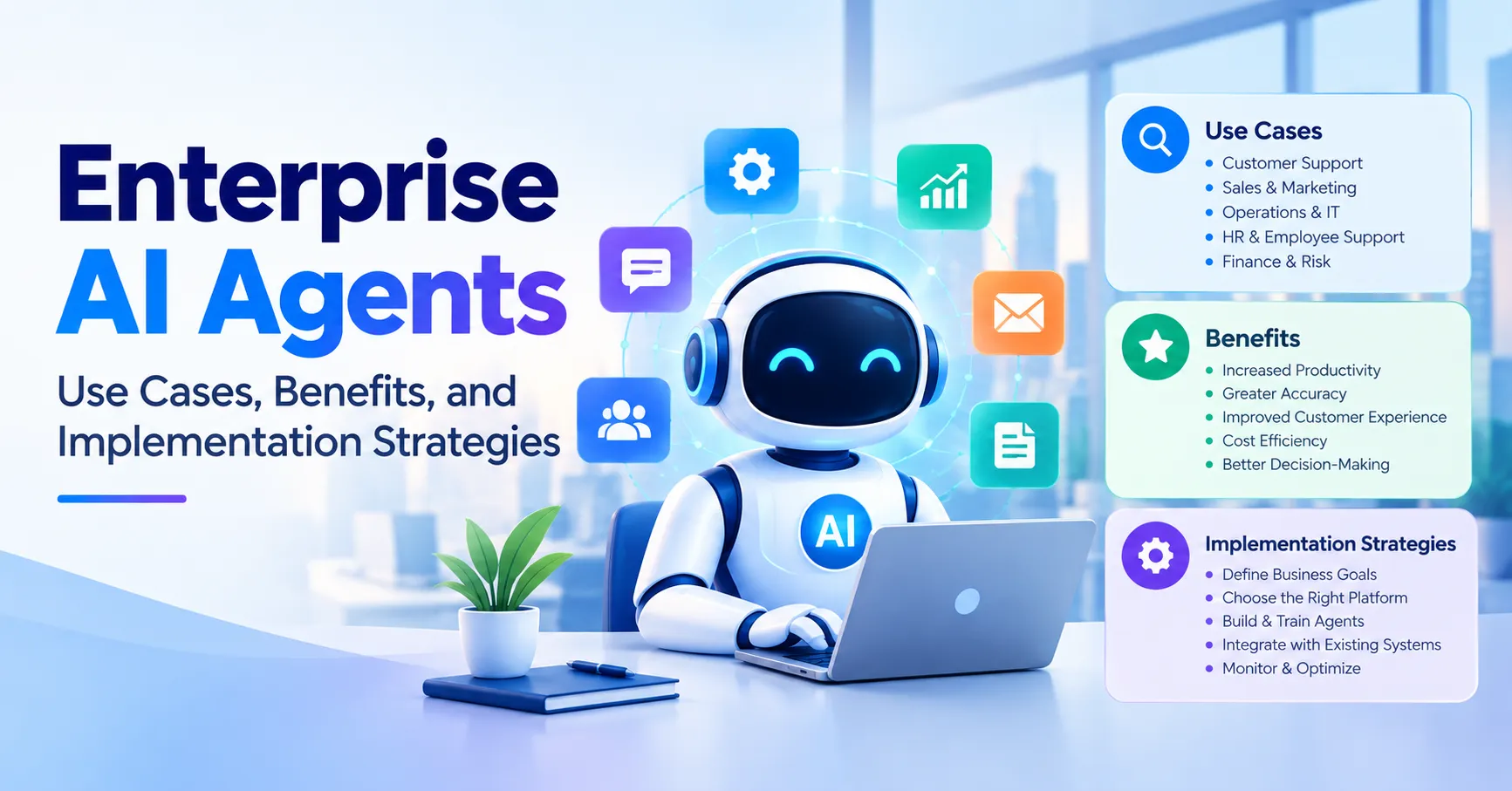
Enterprise AI agents may need to operate across departments, applications, data environments, and user groups while following organizational policies.
An enterprise deployment may involve several specialized agents working together. For example, a retail organization could have separate agents responsible for customer assistance, inventory intelligence, order processing, and supplier communication.
Enterprise implementations also require careful consideration of:
- Role-based access
- Data governance
- Security policies
- Compliance
- System availability
- Performance
- Auditability
- Agent lifecycle management
As the number of deployed agents increases, organizations also need centralized visibility into their agents, integrations, permissions, and performance.
AI Agent Development Lifecycle
A successful project usually starts with the business requirement rather than the technology.
1. Business Discovery
The first stage is understanding the existing process, its bottlenecks, stakeholders, inputs, outputs, and desired outcomes.
2. Use-Case Selection
Not every process needs an AI agent. The strongest candidates typically involve knowledge-intensive work, variable inputs, repeated decisions, or coordination across systems.
3. Solution Design
The development team determines the required agent capabilities, data sources, integrations, tools, workflows, and approval points.
4. Prototype Development
A limited version of the agent can be created to validate whether it can perform the intended task effectively.
5. Integration
Once the concept is validated, the agent can be connected with production applications, APIs, databases, and business systems.
6. Evaluation
The system should be tested using representative business scenarios to assess accuracy, reliability, response quality, and workflow completion.
7. Production Deployment
After validation, the agent can be introduced into the production environment, typically with appropriate monitoring and safeguards.
8. Continuous Optimization
Performance data, user feedback, failures, and changing business requirements can be used to improve the agent over time.
This lifecycle helps organizations avoid making a large investment before proving that the proposed solution can deliver practical value.
AI Agent Solutions Across Business Functions
Organizations can apply AI agents to many different areas depending on their objectives.
| Business Function | Potential AI Agent Use |
| Customer Service | Request handling and support assistance |
| Sales | Lead research and CRM assistance |
| Finance | Invoice and document workflows |
| HR | Employee information and onboarding support |
| Healthcare | Administrative assistance and information retrieval |
| E-commerce | Shopping assistance and order support |
| Logistics | Exception handling and operational coordination |
| Marketing | Research and campaign intelligence |
| IT | Internal support and incident assistance |
The most appropriate implementation depends on the complexity of the process, available data, required integrations, and acceptable level of automation.
Why AI Agent Consulting Matters Before Development
Jumping directly into development can lead to an expensive solution that doesn't address the most valuable business problem.
AI agent consulting can help organizations determine where agent technology makes sense before engineering begins.
A consulting engagement can cover:
- Business process assessment
- AI opportunity identification
- Technical feasibility
- Data readiness
- Integration requirements
- Security considerations
- Agent architecture
- Implementation roadmap
- Success metrics
For example, instead of developing an autonomous agent for an entire department, an organization may discover that automating one high-volume workflow provides a faster and more measurable return.
Starting small also gives teams an opportunity to understand how employees interact with AI before expanding the technology across the organization.
Challenges Businesses Should Consider
AI agent projects also come with practical challenges.
Data Quality
An agent cannot consistently produce useful outcomes when the information available to it is incomplete, outdated, or poorly structured.
Integration Complexity
Connecting an agent with legacy applications, proprietary software, and multiple APIs can require substantial engineering effort.
Security
Agents need carefully controlled permissions, especially when they can access confidential information or perform actions within business systems.
Reliability
AI-generated decisions can vary depending on context. Testing and evaluation are therefore essential before agents are trusted with important workflows.
Cost
Model usage, infrastructure, integrations, monitoring, and ongoing optimization all contribute to the total cost of ownership.
A successful implementation needs to balance AI capability with business value, operational risk, and long-term maintainability.
How to Choose an AI Agent Development Company
Choosing an AI agent development company should involve more than reviewing its ability to build an AI chatbot.
Businesses should evaluate whether the development partner has experience with:
- Agent architecture
- Generative AI and LLM technologies
- Custom software engineering
- Enterprise integrations
- API development
- Data and knowledge systems
- Security implementation
- AI evaluation
- Production deployment
It's equally important to examine the partner's approach to business discovery.
A capable development team should first understand what the business wants to achieve, then determine how AI can support that objective.
Ask potential partners about their development methodology, integration capabilities, security practices, testing process, post-launch monitoring, and ability to scale the solution as requirements evolve.
Conclusion
AI agents are becoming a practical technology for organizations looking to modernize knowledge-intensive and operational workflows. With the right architecture and implementation strategy, they can connect AI capabilities with business applications and help employees complete complex work more efficiently.
The role of AI agent development services extends from initial strategy and architecture through custom development, integrations, deployment, and ongoing optimization.
For organizations with specialized processes, custom AI agent development can create solutions tailored to their data, systems, and workflows. Larger organizations can use enterprise AI agents to support multiple departments and coordinate capabilities across their technology environment.
However, the strongest implementations begin with a clearly defined business problem. By combining AI agent consulting, thoughtful solution design, reliable integrations, and continuous evaluation, businesses can turn AI agents from experimental technology into useful components of their digital operations.




Sign in to leave a comment.