
What Are AI Governance and Compliance?
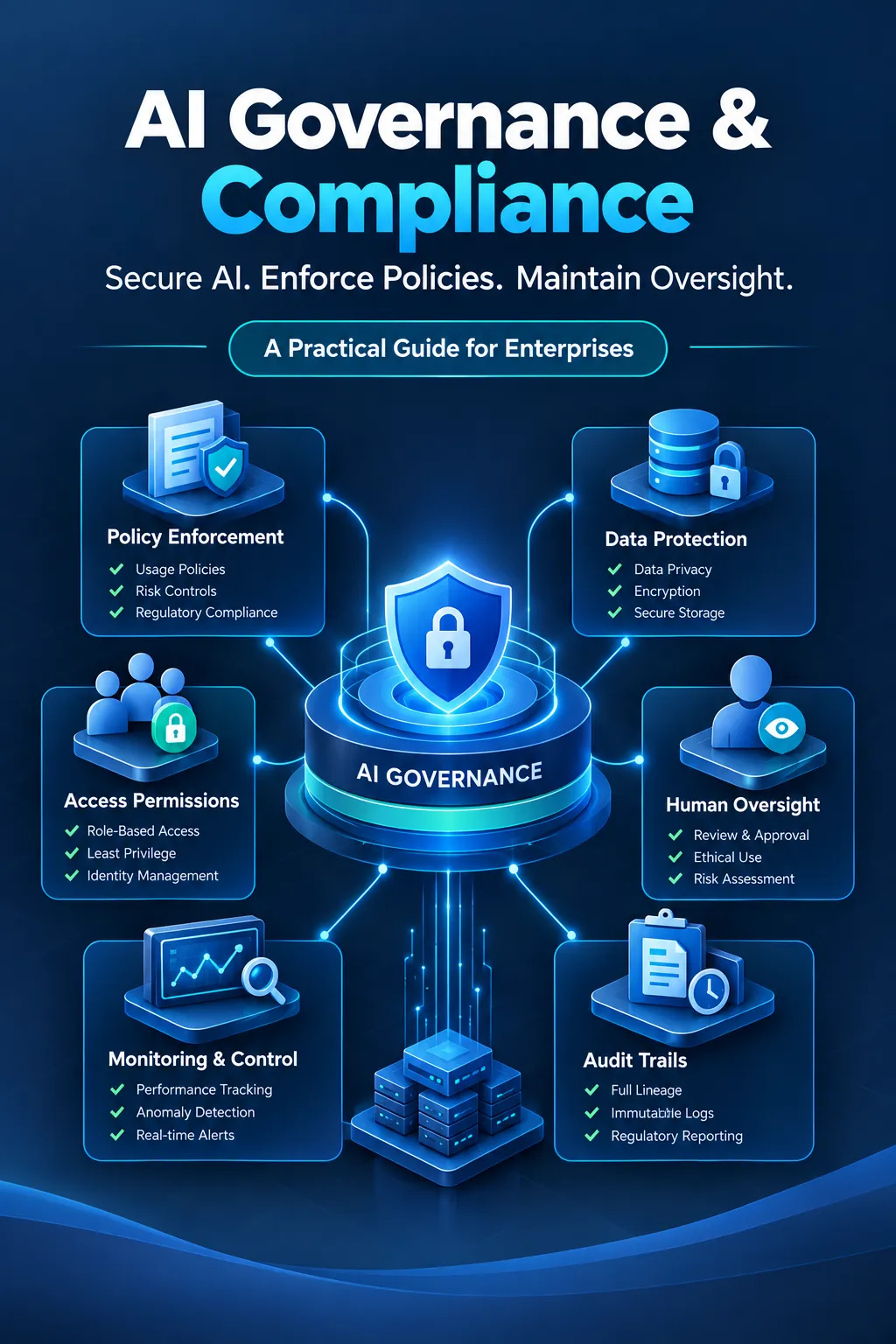
AI governance and compliance are the policies, responsibilities, technical controls, and review processes that help organizations develop, deploy, and use artificial intelligence responsibly. They establish who can approve AI systems, what data and tools those systems may access, how risks are assessed, and how decisions and actions are monitored.
For enterprises, governance becomes especially important when AI systems use internal business data, connect to enterprise applications, or operate as agents capable of completing multi-step tasks. Effective oversight requires more than technical safeguards: organizations also need accountable risk owners, documented procedures, human review where appropriate, and a clear understanding of applicable legal obligations.
Enterprise AI governance combines organizational accountability with technical enforcement. An AI governance platform for enterprises can support this work through policy controls, access restrictions, monitoring, and audit records. However, using a platform does not automatically make an organization compliant. Compliance depends on the relevant laws, the organization’s implementation, and how its AI systems are actually used.
Why Enterprise AI Introduces New Oversight Requirements
Traditional software generally follows defined application logic and permissions. AI systems introduce additional considerations because their outputs may be probabilistic, context-sensitive, or influenced by user instructions and retrieved information. When an AI system can call tools or perform actions, the oversight challenge becomes more significant.
Common enterprise scenarios include:
- An AI assistant retrieving confidential information from internal documents.
- An AI agent interacting with customer relationship management or ticketing systems.
- An automated workflow preparing a report, recommending an action, and submitting it for approval.
- Multiple AI agents coordinating tasks across business applications.
These scenarios create risks involving data exposure, excessive permissions, inaccurate outputs, unauthorized actions, and incomplete records of how a decision was reached.
A system that can answer a question presents a different risk profile from one that can modify a customer record, initiate a financial workflow, or access sensitive company data. Governance should therefore reflect each system’s capabilities, operating environment, intended purpose, and potential impact.
Organizations also need to distinguish between technical reliability and regulatory compliance. Testing a model for accuracy does not replace privacy reviews, access controls, legal assessments, or appropriate human oversight.
Risk Identification, Ownership, and Accountability
Effective AI governance for enterprises begins with knowing which AI systems are in use, what they do, and who is accountable for their outcomes.
Create an AI system inventory
Maintain an inventory of approved AI applications, models, agents, workflows, and relevant third-party services. For each system, document its business purpose, data sources, connected tools, user groups, deployment environment, and level of autonomy.
This inventory helps organizations identify systems that may have been introduced by individual teams without sufficient central review. It also provides a starting point for prioritizing assessments.
Assess risk according to use
Not every AI application requires the same level of control. An internal tool that summarizes public information may require fewer safeguards than an agent that accesses employee records or initiates consequential business actions.
Risk assessments should consider:
- Data sensitivity: What confidential, personal, regulated, or commercially sensitive information can the system access?
- Action capability: Can it only generate recommendations, or can it execute actions?
- Potential impact: What could happen if the output is inaccurate, manipulated, or used inappropriately?
- Human involvement: Who reviews consequential decisions or actions?
- Dependencies: Which models, vendors, tools, and data sources affect the system?
Assessments should be repeated when a system’s purpose, permissions, model, data access, or autonomy changes materially.
Assign clear accountability
Enterprise AI governance should define responsibilities across business, technical, security, privacy, legal, and compliance teams. A practical responsibility model might include:
- Business owner: Accountable for the use case, business outcomes, and acceptable operational risk.
- Technical owner: Responsible for system design, testing, access configuration, and maintenance.
- Security and privacy teams: Assess threats, data handling, access risks, and safeguards.
- Legal and compliance teams: Determine which obligations apply and advise on required controls and evidence.
- Approvers and reviewers: Evaluate higher-impact uses and oversee actions that require human judgment.
A governance committee can coordinate decisions, but accountability should remain explicit at the system and use-case level. Responsibility should not be assigned vaguely to “the AI team” or assumed to belong entirely to the platform provider.
Policy Enforcement, Permissions, Monitoring, and Audit Records
Organizational policies define what is permitted. Technical controls help make those rules enforceable within the AI environment. Both are necessary because a written policy alone cannot prevent an agent from calling an over-permissioned tool.
Translate policies into enforceable controls
Define clear rules for the actions AI systems may perform, the data they can access, and the circumstances in which they must stop or request approval. Depending on the use case, controls may include:
- Identity and access management: Apply role-based or attribute-based permissions to users, agents, tools, and data sources.
- Least-privilege access: Grant only the access necessary for a defined task, and review it as the task or system changes.
- Action restrictions: Separate read-only activities from changes, transactions, external communications, or other consequential actions.
- Approval gates: Require human authorization for sensitive or high-impact operations.
- Policy validation: Check requested actions against permissions and rules before execution, rather than relying only on instructions in a prompt.
- Environment separation: Use appropriate development, testing, and production controls to reduce the chance that experiments affect live systems.
Controls should apply to the actual execution path. For example, telling an AI agent not to modify a customer record is weaker than technically preventing unauthorized write operations through the connected tool or application.
Monitor behavior and preserve audit records
Monitoring should help teams understand what an AI system attempted, which tools it called, what permissions were evaluated, whether an action was approved, and what outcome followed. Where relevant and lawful, records can include model and configuration versions, policy decisions, timestamps, and references to the data or systems involved.
Audit records should be useful for investigations without unnecessarily exposing sensitive prompts, personal data, credentials, or confidential business information. Define retention periods, access restrictions, and protection against unauthorized changes to logs.
Monitoring should also look for unexpected behavior, repeated policy denials, unusual access patterns, changes in task scope, and failures that may indicate misuse or a configuration problem. Alerts need clear ownership and escalation procedures; collecting telemetry without reviewing it does not provide effective oversight.
The NIST AI Risk Management Framework offers a useful reference for organizing ongoing AI risk work through its Govern, Map, Measure, and Manage functions. It is a risk-management framework, not a legal certification or a substitute for applicable obligations.
AIRC+1
Data Governance, Human Oversight, and Incident Response
AI governance must account for the information systems use as well as the actions they perform.
Govern data access and usage
Organizations should identify the sources an AI system can retrieve from, classify the sensitivity of that information, and determine whether access is appropriate for each user and workflow. Data controls should cover collection, retrieval, processing, sharing, retention, and deletion where applicable.
Key practices include:
- Enforcing source-system permissions when retrieving enterprise information.
- Limiting the context supplied to a model to what is needed for the task.
- Reviewing whether data is accurate, relevant, current, and suitable for its intended use.
- Defining how personal and confidential information may be processed by models and third-party providers.
- Testing for unauthorized disclosure, prompt injection, and attempts to retrieve information outside the user’s permissions.
Retrieval from an approved source does not automatically make every use of its contents appropriate. Organizations still need to consider the purpose of processing, data sensitivity, and the permissions applicable to the workflow.
Make human oversight meaningful
Human oversight should be proportionate to risk. A low-impact drafting task may need only routine review, while an action affecting financial transactions, employment, customer rights, or critical operations may require explicit approval or independent review.
Reviewers need enough information, time, authority, and training to challenge an AI recommendation. An approval button is not meaningful oversight if the reviewer cannot understand the proposed action or reverse it when necessary.
Prepare for incidents
Create an incident-response process for AI-related events, including unauthorized data access, unsafe actions, unexpected behavior, compromised credentials, or repeated policy failures. The process should identify who can suspend an agent, revoke access, disable a tool, preserve evidence, notify relevant stakeholders, and authorize recovery.
After an incident, review its cause, affected systems and data, and the effectiveness of existing controls. Update policies, tests, permissions, and monitoring based on the findings. Legal, contractual, and regulatory notification requirements should be assessed by the responsible teams according to the specific circumstances.
Understanding Legal and Regulatory Obligations
AI governance and compliance should be informed by the laws and standards relevant to the organization, the people affected, the industry, and the location in which the system is developed or used.
For example, the EU Artificial Intelligence Act establishes a risk-based legal framework with requirements that vary according to the AI system, its intended use, and the roles of the parties involved. For covered high-risk systems, the regulation addresses areas such as risk management, data governance, record-keeping, and human oversight. It should not be interpreted as imposing identical obligations on every AI use case.
In India, the Digital Personal Data Protection Act, 2023 is relevant to the processing of digital personal data within its scope. Its commencement is phased through government notification, so organizations should check the provisions and commencement dates applicable to their activities rather than assuming that every provision became effective at once.
These examples are not an exhaustive compliance checklist. Organizations should confirm their specific obligations with qualified legal and compliance advisers and review current official materials before deployment or significant changes. A governance framework can help organize evidence and controls, but it does not by itself establish legal compliance.
How to Evaluate an AI Governance Platform for Enterprises
An AI governance platform for enterprises should help organizations translate governance requirements into practical controls across models, agents, tools, and business workflows. The right solution depends on the organization’s architecture, risk profile, and operational needs.
When evaluating options, consider the following capabilities.
| Evaluation area | What to look for |
| Policy enforcement | Controls that evaluate requests and actions against defined policies before execution |
| Identity and permissions | Granular access controls for agents, users, tools, and enterprise data |
| Observability | Visibility into AI interactions, tool calls, policy decisions, and execution outcomes |
| Auditability | Records that support investigation, review, and internal accountability |
| Human oversight | Approval workflows and escalation paths for sensitive actions |
| Integration | Compatibility with the organization’s models, applications, identity systems, and deployment architecture |
| Security and data handling | Clear data flows, retention practices, access boundaries, and deployment options |
| Operational management | Policy updates, testing, incident handling, and ongoing review |
A platform should complement existing security, privacy, identity, and compliance processes rather than replace them. During evaluation, test realistic workflows, including denied actions, permission changes, unexpected inputs, and attempted access to restricted data.
The Role of THQ.digital and Ritvam
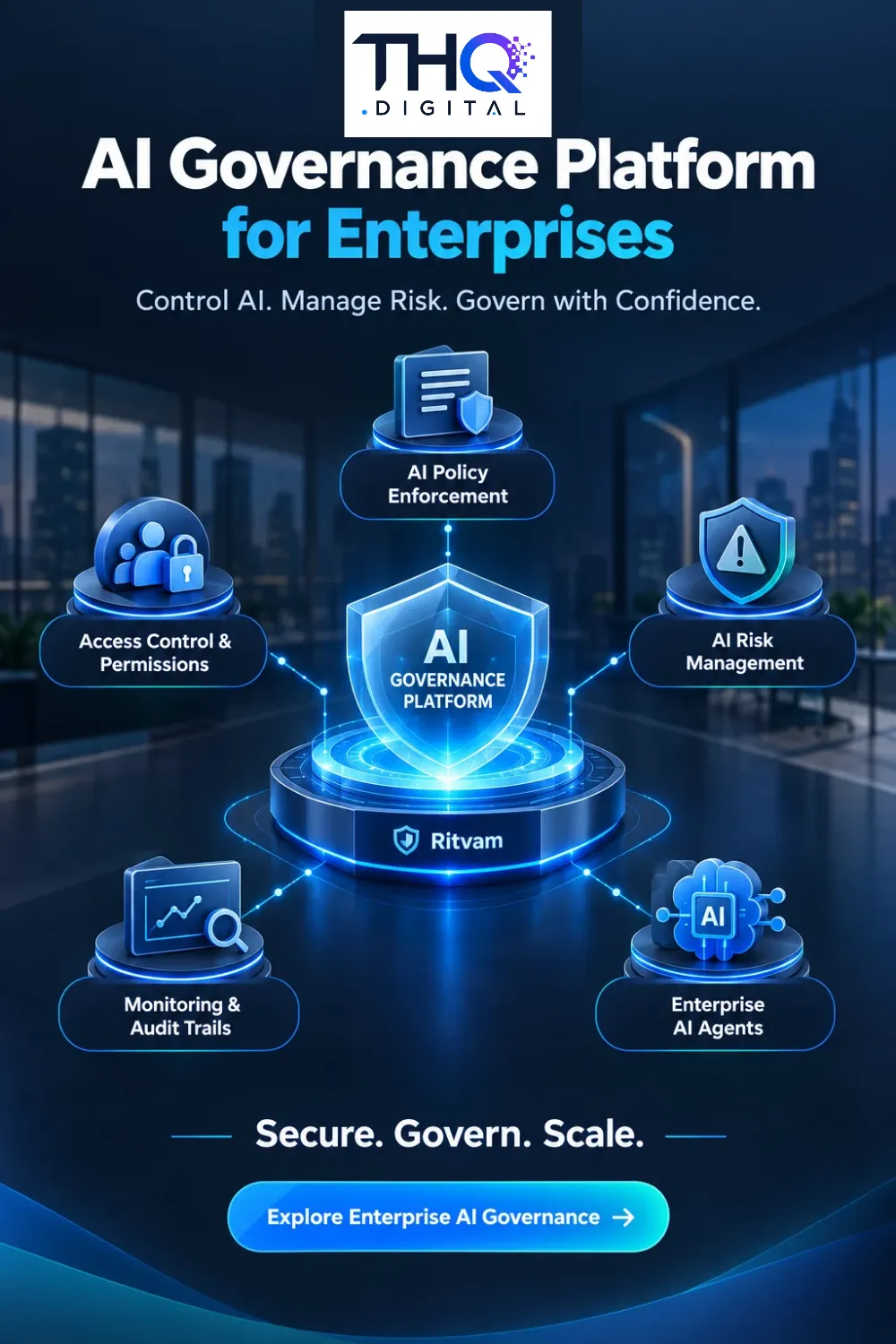
THQ.digital addresses enterprise AI governance through a control-plane approach. Within this architecture, Ritvam serves as the governance and observability layer, supporting the implementation of policies and oversight across AI workflows.
The architectural goal is to make governance more operational: define what AI systems are permitted to do, apply relevant controls to their interactions, and improve visibility into their behavior. This is particularly relevant when agents interact with internal data or invoke tools to complete multi-step tasks.
Organizations should still validate the controls, integrations, deployment requirements, and audit capabilities needed for their own environments. Ritvam or any other governance technology should be evaluated as one part of a wider accountability and compliance program—not as an automatic guarantee of compliance, certification, or risk elimination.
A Practical Implementation Roadmap
Organizations can build enterprise AI governance incrementally instead of attempting to govern every use case through one large initiative.
- Inventory AI systems: Identify models, agents, applications, data sources, connected tools, and business owners.
- Classify risk: Assess data sensitivity, potential impact, autonomy, and consequences of incorrect or unauthorized actions.
- Define governance policies: Establish acceptable-use rules, approval thresholds, access requirements, and prohibited activities.
- Assign accountability: Name the business, technical, security, privacy, and compliance owners responsible for each system.
- Implement technical controls: Configure permissions, action restrictions, approval gates, monitoring, and logging.
- Test before deployment: Evaluate normal use, unexpected inputs, restricted-data access, policy violations, and failure scenarios.
- Monitor and improve: Review incidents, alerts, policy decisions, system changes, and emerging risks on a defined schedule.
Begin with a bounded use case that has a clear owner and measurable acceptance criteria. Use the results to refine policies and technical controls before expanding to more sensitive workflows.
Conclusion: Build Governance Into Enterprise AI Operations
AI governance and compliance require a coordinated approach to risk ownership, data management, technical enforcement, human oversight, and continuous monitoring. As organizations adopt AI agents that access internal information and execute multi-step workflows, governance needs to extend beyond model outputs to the permissions and actions surrounding them.
A structured governance process, supported by appropriate technical controls and clear accountability, can help enterprises adopt AI with greater visibility and control. THQ.digital’s governance approach, including Ritvam, is relevant for organizations assessing how to operationalize oversight across enterprise AI workflows.
Explore how THQ.digital approaches enterprise AI governance and evaluate how a governance control plane could fit your organization’s AI architecture.
Frequently Asked Questions
Q1. What is the difference between AI governance and AI compliance?
AI governance is the broader system of policies, accountability, risk management, and controls that guides how an organization uses AI. AI compliance focuses on meeting applicable legal, regulatory, contractual, and internal requirements. Governance can support compliance, but it does not automatically establish it.
Q2. Why do enterprises need AI governance?
Enterprises need AI governance to manage risks associated with inaccurate outputs, sensitive data, excessive permissions, unauthorized actions, and limited visibility into AI behavior. It helps define responsibilities and establish consistent oversight as AI becomes part of business operations.
Q3. How can organizations govern AI agents that execute actions?
Organizations can use least-privilege permissions, tool restrictions, policy checks, human approval for sensitive operations, monitoring, and audit records. Controls should be applied to the systems that execute actions, not just to the instructions given to an AI model.
Q4. What should an AI governance platform include?
Useful capabilities include policy enforcement, access controls, observability, audit records, human-approval workflows, integration with enterprise systems, and support for security and data-handling requirements. Selection should be based on the organization’s specific architecture, risks, and obligations.
Q5. Does using an AI governance platform guarantee compliance?
No. A platform can help implement and document technical controls, but compliance also depends on applicable laws, organizational policies, system configuration, operational practices, and accountable human decisions. Organizations must evaluate their obligations and verify that their controls work as intended.



























Sign in to leave a comment.