AI in Revenue Cycle Management: How UAE Hospitals Can Reduce Claim Denials


For Hospital CFOs, billing heads, and clinic owners across the UAE, claim denials are no longer just an operational headache—they’re a direct hit to the bottom line. With the UAE healthcare RCM market projected to reach $3.17 billion by 2031, growing at a CAGR of 11.83%, the financial stakes have never been higher.
The good news? Artificial Intelligence is transforming how hospitals manage revenue cycles, turning denial prevention from a reactive scramble into a proactive, data-driven strategy. This guide explores how AI-powered RCM software UAE is helping healthcare providers slash denial rates, accelerate reimbursements, and plug revenue leakage—without adding headcount.
The Denial Crisis in UAE Healthcare
UAE hospitals and clinics lose an estimated 10–40% of annual revenue due to inefficient health insurance claims management—a figure amounting to $1.2–1.9 billion annually across the country. The root causes are familiar to every billing team:
- Missing or delayed pre-authorizations
- Coding inconsistencies (ICD-10, CPT errors)
- Incorrect patient insurance classification
- Insufficient clinical documentation
- Payer-specific policy exclusions
In Dubai and Abu Dhabi alone, polyclinics and specialty centers report rising denial rates driven by stricter medical necessity reviews, increased insurance audits, and complex payer rules across DHA, DoH, and MOHAP jurisdictions.
Traditional RCM workflows—reliant on manual verification, retrospective coding, and post-submission denial management—simply can’t keep pace. That’s where AI revenue cycle management UAE steps in.
What Is AI-Powered Revenue Cycle Management?
AI in Revenue Cycle Management (RCM) uses machine learning, natural language processing (NLP), predictive analytics, and automation to optimize financial workflows from patient registration to final payment reconciliation.
For UAE healthcare providers, AI-powered RCM acts as an intelligence layer across existing HIS, EMR/EHR, practice management, billing, and payer systems (including eClaimLink and Shafafiya). It helps organizations:
- Identify errors earlier in the cycle
- Prioritize high-risk claims for intervention
- Automate repetitive administrative tasks
- Uncover hidden revenue leakage opportunities
Unlike rule-based automation, AI learns from historical adjudication patterns, payer behavior, and coding outcomes to predict denials before claims are submitted—shifting the focus from denial resolution to denial prevention.
How AI Reduces Claim Denials in UAE Hospitals
Predictive Denial Scoring
AI-powered RCM platforms analyze each claim against hundreds of payer-specific rules, historical denial patterns, and clinical documentation quality. Machine learning models score claims across risk categories—Low, Medium, High, and Very High—enabling billing teams to intervene where it matters most.
For example, a machine-learning model might flag a claim as “High Risk” due to:
- Missing modifiers
- Invalid code pairs
- Unpriced items
- Authorization gaps
These claims are routed to specialists for correction before submission, dramatically improving first-pass acceptance rates.
Intelligent Claim Scrubbing
Every claim is validated against 200+ payer, coding, and regulatory edits in milliseconds. AI-driven claim scrubbing automatically detects and corrects errors such as:
- Incomplete patient demographics
- Mismatched diagnosis and procedure codes
- Expired insurance eligibility
- Non-covered services under specific payer policiesrevfinityrcm+1
This pre-submission validation ensures compliance with DHA, DoH, and MOHAP billing requirements, reducing rejection rates at the payer gateway.
Automated Coding Accuracy
Coding errors remain one of the top causes of claim denials in the UAE. AI-powered auto-coding solutions—like CODING.AI, deployed across Mediclinic hospitals in Abu Dhabi—automate ICD-10 and CPT code assignment with over 95% accuracy, guaranteed compliance with UAE reimbursement guidelines, and significant reduction in claims denials.
Advanced systems capture doctor-patient conversations in real time, create structured clinical notes, assign accurate codes, and validate documentation completeness—all within a single workflow.
4. Real-Time Insurance Eligibility Verification
Good AI RCM software UAE includes real-time insurance eligibility checks that verify:
- Coverage status
- Network participation
- Co-pay and benefit limits
- Prior authorization requirements
This prevents surprises down the line and ensures every encounter is billable from the first minute.
5. Denial Classification and Root-Cause Analysis
When denials do occur, AI supports:
- Automatic denial classification by reason code
- Root-cause identification across payers, physicians, and service lines
- Documentation retrieval for appeals
- Corrective-action recommendations
- Resubmission preparation with status monitoring
At a private hospital group in Dubai, an AI agent reduced insurance pre-authorization time from 48 hours to 15 minutes, achieved 95% first-submission approval rates, and recovered AED 8 million in revenue by automating denial appeals with stronger evidence pools.
Healthcare RCM Automation Trends Shaping Revenue Cycles 2026
The UAE healthcare RCM landscape is evolving rapidly. By 2031, outsourced RCM penetration is expected to rise from 41% (2025) to 59%, while automated claims processing will increase from 68% to 92%.
Key trends defining Healthcare RCM Automation Trends Shaping Revenue Cycles 2026 include:
| Trend | Impact on UAE Hospitals |
|---|---|
| Predictive denial forecasting | Machine learning models predict denials 7–14 days before submission, enabling proactive intervention |
| Cloud-based RCM deployment | Fastest expansion segment; enables multi-emirate managed contracts and real-time analytics |
| Patient access automation | Automated eligibility, authorization, and co-pay estimation reduce front-end revenue leakage |
| Clinical documentation improvement (CDI) | AI-assisted CDI ensures codes match clinical intent, reducing downstream denials |
| Revenue intelligence dashboards | CFOs gain real-time visibility into denial rates, A/R aging, and collection performance by facility |
| Integration with EMR/EHR systems | Seamless data flow eliminates manual re-entry errors and accelerates coding cycles |
| Value-based reimbursement tracking | AI monitors quality metrics tied to payment outcomes under emerging value-based care models |
Profit pools are shifting from labor-intensive claim submission toward denial prevention, patient access automation, clinical documentation improvement, and revenue intelligence.
The Role of EMR Software in UAE RCM Success
A robust EMR software in UAE is no longer just a clinical tool—it’s a financial asset. When EMR systems integrate natively with AI-powered RCM engines, hospitals achieve:
- Faster coding cycles: Clinical notes auto-populate coding worklists, reducing coder turnaround time by 40–60%
- Fewer documentation gaps: AI flags missing elements (e.g., laterality, severity, comorbidities) before claim submission
- End-to-end audit trails: Every code, modifier, and authorization is traceable to the source document
- Unified payer rules engine: EMR-integrated RCM applies DHA, DoH, and MOHAP rules consistently across facilitiesescrow
For clinics evaluating vendors, partnering with an experienced EMR development company that understands UAE billing regulations is critical. Custom EMR-RCM integrations ensure compliance with local payer requirements while maximizing automation benefits.
Detecting and Preventing Healthcare Revenue Leakage in UAE
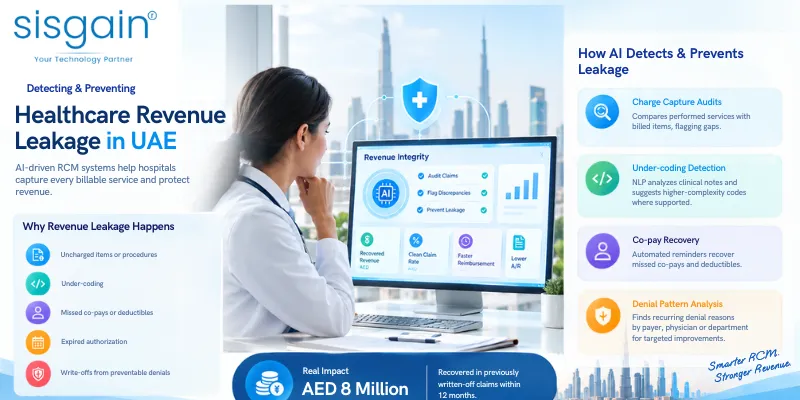
Healthcare revenue leakage detection UAE is a top priority for CFOs. Revenue leakage occurs when hospitals fail to capture all billable services due to:
- Uncharged items or procedures
- Under-coding (assigning lower-complexity codes than warranted)
- Missed co-pays or deductibles
- Expired authorizations
- Write-offs due to preventable denials
AI-powered RCM systems continuously audit claims, charge masters, and payment postings to identify leakage patterns. For instance:
- Charge capture audits: AI compares performed services (from EMR) against billed items, flagging discrepancies
- Under-coding detection: NLP analyzes clinical notes to suggest higher-complexity codes where documentation supports them
- Co-pay recovery: Automated patient billing reminders recover missed co-pays and deductibles
- Denial pattern analysis: AI identifies recurring denial reasons by payer, physician, or department, enabling targeted process improvements
One Dubai hospital group using AI-driven revenue integrity audits recovered AED 8 million in previously written-off claims within 12 months
Denial Prevention Healthcare Dubai: A Strategic Imperative
For denial prevention healthcare Dubai, the strategy is clear: shift from reactive denial management to proactive denial avoidance. Leading hospitals are adopting a three-layer approach:
Layer 1: Front-End Prevention
- Real-time eligibility verification at scheduling
- Automated prior authorization workflows
- Patient financial responsibility estimation (co-pays, deductibles)
- Insurance card scanning with OCR validation
Layer 2: Mid-Cycle Validation
- AI-assisted coding with clinical documentation checks
- Pre-submission claim scrubbing against 200+ payer rules
- Risk scoring to prioritize high-value, high-risk claims
- Automated modifier and code-pair validation
Layer 3: Post-Submission Intelligence
- Denial classification and root-cause dashboards
- AI-drafted appeal letters with evidence attachments
- Resubmission tracking with SLA monitoring
- Payer performance benchmarking (approval rates, turnaround times)
Reem Hospital’s partnership with Ntigra exemplifies this approach. By deploying Discovery AI-powered Auto Coding & Claim Validation and Octopus Autonomous Biller (OAB), Reem achieved significant reduction in claim denials and expedited reimbursements through predictive analytics and automation.
Choosing the Right AI-Powered RCM Software UAE
Not all AI-powered RCM software UAE solutions are created equal. When evaluating vendors, Hospital CFOs and billing heads should prioritize:
1. UAE-Specific Compliance
Ensure the platform is built for DHA, DoH, and MOHAP billing rules from the ground up—not a global solution with superficial localization.
2. Predictive Denial Analytics
Look for machine learning models trained on UAE-specific historical adjudication data, with denial risk scoring and root-cause analysis capabilities.
3. EMR/EHR Integration
Seamless integration with your existing EMR software in UAE eliminates data silos and accelerates coding cycles.
4. End-to-End Automation
From eligibility verification to payment posting, the platform should automate repetitive tasks while flagging exceptions for human review.
5. Revenue Intelligence Dashboards
CFOs need real-time visibility into denial rates, A/R aging, collection performance, and revenue leakage by facility, payer, and service line.
6. Scalability Across Multi-Emirate Operations
For hospital groups operating in Dubai, Abu Dhabi, Sharjah, and beyond, the solution should support multi-facility contracts with centralized analytics.
Vendors like SISGAIN, Revfinity, HealthOrbit AI, and Ntigra are leading this space with UAE-native AI RCM platforms that deliver measurable ROI within 6–12 months.
Implementation Roadmap: From Pilot to Enterprise Scale
Successful AI RCM deployment follows a phased approach:
Phase 1: Assessment (Weeks 1–4)
- Baseline denial rates, A/R aging, and collection metrics
- Identify top 5 denial reasons by volume and value
- Map current workflows (registration → coding → submission → payment)
- Select pilot department (e.g., emergency, outpatient, or a specific specialty)
Phase 2: Pilot Deployment (Weeks 5–12)
- Integrate AI RCM with EMR and billing systems
- Train coding and billing teams on AI-assisted workflows
- Run parallel processing (manual + AI) for 4 weeks to validate accuracy
- Measure improvement in first-pass acceptance rates and denial reduction
Phase 3: Optimization (Weeks 13–24)
- Refine denial prediction models based on pilot data
- Expand to additional departments or facilities
- Implement revenue intelligence dashboards for leadership
- Establish KPIs: denial rate reduction, A/R days, collection rate improvement
Phase 4: Enterprise Scale (Months 6–12)
- Roll out across all facilities and service lines
- Integrate with payer portals (eClaimLink, Shafafiya) for automated submission
- Deploy patient access automation (eligibility, authorization, co-pay estimation)
- Continuous monitoring and model retrainingescrow
One private hospital group in Dubai completed this roadmap in 9 months, achieving 95% first-submission approval rates and recovering AED 8 million in previously denied claims.

Final Thoughts: The Future of Revenue Cycle Management in UAE
The UAE healthcare RCM market is entering a new phase of digital maturity. With mandatory claims exchanges, cloud migration, and AI-assisted workflows becoming the norm, hospitals that delay adoption risk falling behind in both financial performance and operational efficiency.
For Hospital CFOs, billing heads, and clinic owners, the question is no longer whether to adopt AI-powered RCM—but how quickly you can deploy it to stay competitive. The technology is proven, the ROI is clear, and the UAE-native vendors are ready to partner.
The hospitals that thrive in 2026 and beyond will be those that treat healthcare RCM UAE not as a back-office function, but as a strategic lever for growth, sustainability, and patient care excellence.
Frequently Asked Questions (FAQs)
1. How much revenue do UAE hospitals typically lose to claim denials?
UAE hospitals and clinics lose an estimated 10–40% of annual revenue due to inefficient claims management, amounting to $1.2–1.9 billion annually across the country. Common causes include coding errors, missing pre-authorizations, insufficient documentation, and payer-specific policy exclusions.
2. How quickly can AI-powered RCM reduce denial rates?
Most UAE hospitals see measurable improvements within 3–6 months of deployment. Private hospital groups in Dubai have achieved 95% first-submission approval rates and recovered AED 8 million in previously denied claims within 12 months by implementing predictive denial scoring and automated claim scrubbing.
3. Does AI RCM software integrate with existing EMR systems in UAE?
Yes. Leading AI-powered RCM software UAE solutions integrate natively with popular EMR software in UAE, including custom platforms built by local EMR development companies. This seamless integration eliminates manual data re-entry, accelerates coding cycles by 40–60%, and ensures end-to-end audit trails for compliance with DHA, DoH, and MOHAP requirements.
4. What are the top denial reasons AI can prevent in UAE hospitals?
AI excels at preventing denials caused by:
- Missing or expired prior authorizations
- ICD-10/CPT coding mismatches
- Incomplete patient demographics
- Invalid code pairs or missing modifiers
- Non-covered services under specific payer policies
Machine learning models score each claim for denial risk before submission, enabling billing teams to intervene proactively.
5. Is AI RCM compliant with UAE healthcare regulations (DHA, DoH, MOHAP)?
Reputable vendors build their platforms specifically for UAE regulatory requirements, ensuring compliance with DHA (Dubai), DoH (Abu Dhabi), and MOHAP billing rules from the ground up. Features include automated ICD-10/CPT coding aligned with UAE reimbursement guidelines, real-time eligibility verification against local payer databases, and claim scrubbing against 200+ UAE-specific payer edits.




Sign in to leave a comment.