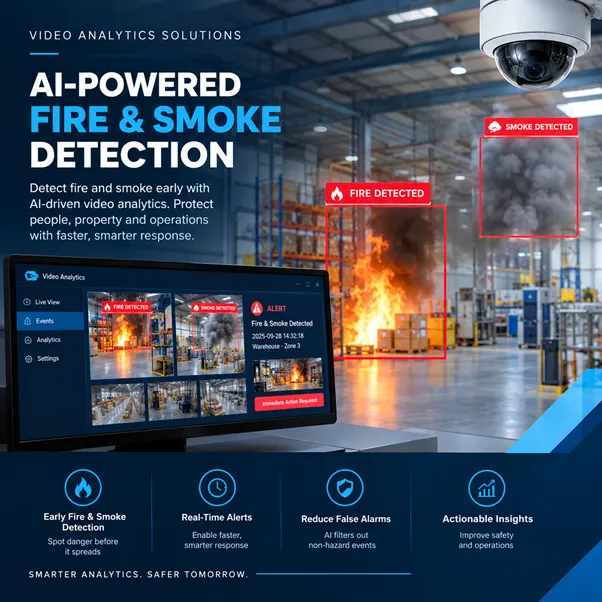

AI-powered fire and smoke detection with Video Analytics is changing how businesses across the Emirates protect people, property and operations from one of the most destructive risks they face. Instead of waiting for smoke to drift into a ceiling sensor, intelligent cameras recognise the first visible traces of flame or smoke and alert security and fire teams within seconds.
This guide explains how the technology works, where it delivers the most value in Dubai, Abu Dhabi and the Northern Emirates, how it fits within UAE regulations, and what decision-makers should evaluate before investing. It is written for facility managers, security directors, HSE leaders, consultants and property owners who want earlier warning, fewer false alarms and a clearer view of what is happening on site.

Why Fire Risk Demands a Smarter Approach in the UAE
The UAE's built environment is among the most ambitious in the world. Supertall towers in Dubai, sprawling logistics parks in Jebel Ali Free Zone, hydrocarbon facilities operated by ADNOC, hyperscale data centres and densely occupied malls all share one challenge: a fire can escalate quickly, and the cost of delay is measured in lives, downtime and reputation. Summer temperatures that regularly exceed 45°C add thermal stress to electrical panels, lithium-ion battery storage and cold-chain equipment, which raises ignition risk across almost every sector.
Conventional point detectors and aspirating systems remain essential and are required under the UAE Fire and Life Safety Code of Practice. However, they depend on smoke or heat physically reaching a sensor. In large atriums, high-bay warehouses, open industrial yards and tunnels, smoke stratifies, dilutes or is carried away by ventilation before it triggers an alarm. Cameras work differently. They observe a scene from a distance and can see the first wisps of smoke or the first flicker of flame the moment they become visible. That is the gap artificial intelligence closes.
Dubai Civil Defence and other emirate-level authorities continue to set the compliance baseline, so the strongest designs treat camera-based detection as an intelligent early-warning layer that works alongside certified detection and suppression systems, not as a shortcut around them.
How AI-Powered Fire and Smoke Detection Works
From Pixels to Alerts: The Detection Pipeline
Every camera frame is analysed by a deep-learning model, typically a convolutional neural network or a vision transformer, trained to separate fire and smoke from visually similar patterns such as steam, dust, vehicle exhaust, sun glare, welding arcs and orange safety vests. The model examines colour, texture, flicker frequency, motion direction and the way a plume expands over time. When confidence crosses a calibrated threshold and persists across consecutive frames, the platform raises an alert containing a snapshot, a short video clip and the exact camera location.
AI-Powered Video Analytics is what makes this practical at scale. Rather than relying on fixed rules such as a colour range or a pixel-change threshold, it learns the contextual signature of real combustion and keeps improving as it is exposed to site-specific footage. The result is detection that adapts to a bright Dubai marina promenade at noon as comfortably as to a dim cable tunnel at midnight.
Training Data, Accuracy and Site Tuning
Accuracy depends on the quality and diversity of the training data. Models exposed to daylight, night, infrared, dusty and humid conditions perform far better in Gulf environments than models trained only on clear-weather datasets. Good practice is to measure precision, recall and false-alarm rate on footage from the actual site during a pilot period, then fine-tune the model with confirmed events and confirmed non-events. Detection zones, minimum plume size and dwell time are adjusted so that a kitchen extractor in a restaurant or a flare stack on an industrial site does not generate nuisance alerts.
Edge, On-Premises and Cloud Processing
Processing can run inside the camera, on an on-premises edge server or in a private cloud. Edge processing reduces latency and bandwidth and keeps footage inside the facility, which supports data-residency and privacy requirements. Central servers make it easier to manage hundreds of cameras across several emirates from a single console. Many UAE enterprises adopt a hybrid design, with detection at the edge and event management, reporting and model updates at the centre.
Core Capabilities to Look for in a Modern Detection Platform
Effective Video Analytics Software for fire safety brings several capabilities together in a single dashboard. The following areas separate a dependable platform from a basic motion-detection add-on.
Early Flame and Smoke Recognition
The platform should identify smoke plumes and flame in the earliest visible stage, including in low light and partially obstructed views. Because cameras can monitor distances that point detectors cannot, a handful of well-placed units can cover loading bays, car parks, stockyards and façade areas that would otherwise need extensive wiring.
Thermal and Multispectral Fusion
Pairing visual cameras with thermal imagers adds a second layer of evidence. Thermal sensors detect abnormal heat signatures from overheating switchgear, conveyor bearings or stored materials before anything ignites, and they remain effective in darkness, haze and sandstorm conditions that degrade standard imaging.
False-Alarm Filtering and Human Verification
False alarms erode trust and can trigger costly evacuations. Mature systems use temporal consistency checks, zone-based rules and confidence scoring, then send the verified clip to a control-room operator who confirms the event in seconds. This human-in-the-loop step is a hallmark of responsible deployment and is one of the strongest signals of operational maturity when you assess a vendor.
Integration with Existing Safety Infrastructure
Open standards matter. Look for ONVIF-compatible camera support, integration with video management systems, building management systems and the fire alarm control panel through dry contacts or protocols such as BACnet and Modbus, and the ability to push notifications to mobile devices, SMS and command-centre software. When an alert fires, the system can automatically display the nearest cameras, unlock evacuation routes or notify Civil Defence contacts according to the site's emergency plan.
Beyond Fire: One Platform for Wider Risk Intelligence
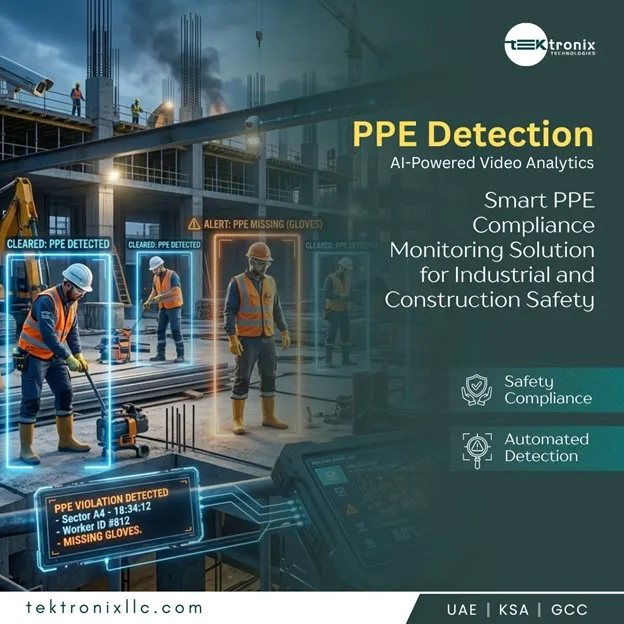
The cameras that watch for smoke can also support AI-Powered Threat Detection across the same estate. Intrusion detection, perimeter breach alerts, loitering analysis, abandoned object recognition, crowd density estimation, vehicle and number plate recognition, and PPE compliance checks all run on the same infrastructure. Consolidating these functions lowers hardware cost, simplifies maintenance and gives operators one view of safety and security instead of several disconnected tools. To see how these modules fit together, you can review Tektronix Global's AI-driven fire, smoke and security monitoring platform.
Identity Verification and Anti-Spoofing in Emergencies
During an incident, knowing who is inside a building matter as much as knowing where the fire is. Real-Time Identity Verification links camera feeds with access control so that security teams can confirm in seconds who entered a zone, who is still on site and who has reached the muster point. For this to be trustworthy, the system must resist fraud. Anti-Spoofing, also called liveness detection or presentation attack detection, distinguishes a real person from a printed photograph, a phone screen replay or a mask, and is typically evaluated against the ISO/IEC 30107 family of standards.
Biometric data is sensitive. Responsible providers therefore encrypt templates, limit retention periods, apply role-based access and maintain audit logs, in line with the UAE Federal Decree-Law No. 45 of 2021 on the Protection of Personal Data and with ISO/IEC 27001 information security practices.
Use Cases Across Dubai, Abu Dhabi and the Northern Emirates
Demand for Video Analytics UAE projects is rising as developers, government entities and private operators recognise that camera networks already installed for security can deliver safety value at modest incremental cost. The following sectors show the clearest returns.
High-Rise, Hospitality and Retail in Dubai
For Video Analytics Dubai deployments, towers, hotels and mega malls present unique challenges: large public atriums, back-of-house kitchens, basement parking and constant crowds. Camera-based detection offers early visibility in open volumes where smoke may take minutes to reach ceiling sensors, and it gives control rooms live visual confirmation to decide between a local response and a full evacuation.
Industrial, Oil and Gas, and Logistics
Facilities in Jebel Ali, Dubai Industrial City, Mussafah in Abu Dhabi and Hamriyah in Sharjah store combustible materials in huge open or semi-open areas. Visual detection of smoke in stockyards, tank farms, recycling facilities and warehouse racking, supported by thermal imaging for hot spots, gives operators a head start those conventional systems rarely match. PPE and restricted-zone analytics improve compliance on the same cameras.
Data Centres and Critical Infrastructure
Data centres, substations, desalination plants and telecom hubs cannot tolerate long outages. Early visual detection around battery rooms, generator yards and cable corridors complement very early smoke detection apparatus and gas suppression, providing additional context before automatic discharge decisions are made.
Transport Hubs and Public Venues
Airports, metro stations, ports, stadiums and event spaces such as Expo City Dubai combine large crowds with complex architecture. Analytics reduce the time between ignition and operator awareness, and crowd-density data helps plan safe evacuation flows.
Compliance, Standards and Data Privacy in the UAE
Fire protection in the UAE is governed by the UAE Fire and Life Safety Code of Practice and enforced by local Civil Defence authorities, which approve systems and issue completion certificates. International references such as NFPA 72, which recognises video image smoke and flame detection, and the EN 54 product series guide design and testing. Any camera-based layer should be specified with the consultant and the relevant authority from the earliest design stage, and it should never be presented as a replacement for approved detectors unless the authority has explicitly accepted it for that application.
On the data side, organisations must handle video responsibly. Clear signage, defined retention periods, restricted access and documented purposes for processing are baseline expectations. Selecting a provider that supports on-premises processing and local data hosting simplifies compliance with the Personal Data Protection Law and with internal governance policies.
Choosing the Right Video Analytics Solutions Provider
Technology selection is ultimately a trust decision, so evaluate vendors on evidence rather than slogans. Ask for documented accuracy results on comparable sites, references from UAE projects, local engineering and support teams, and a clear roadmap for model updates. Reputable Video Analytics Solutions are vendor-agnostic where possible, support open camera standards, and offer transparent pricing for licences, hardware and maintenance.
Also examine cybersecurity posture. Cameras and servers are network assets, so insist on encrypted communication, signed firmware, patch management and independent penetration testing. Finally, confirm that the provider can deliver complete lifecycle service, from site survey and design to commissioning, operator training and 24/7 support. Companies that want a single UAE partner for these stages can learn more about Tektronix Global's intelligent video monitoring suite and discuss requirements with its specialists.
A Practical Implementation Roadmap
A structured rollout reduces risk and builds internal confidence. Begin with a site survey and camera audit to check mounting height, field of view, lighting, resolution and network capacity, since many existing cameras can be reused with minimal change. Next, define use cases and success metrics with safety, security and operations teams, including target detection time, acceptable false-alarm rate and escalation procedures.
Run a four to eight week pilot on the highest-risk area, collect confirmed events and non-events, and tune the model and zones. After validation, integrate with the video management system, fire alarm panel and notification channels, then train operators with realistic scenarios and drills. Finally, schedule quarterly performance reviews so that the models, thresholds and workflows keep pace with changes in the building or process. For a full capability overview before you plan a pilot, explore the detailed service page.
Measuring Return on Investment
The business case rests on four pillars: faster detection, which limits damage and downtime; fewer false alarms, which saves evacuation and call-out costs; reuse of existing cameras, which avoids heavy capital spend; and multi-purpose analytics, which spreads the cost across fire, security and operational safety. Insurers increasingly take notice of documented risk-reduction measures, so discuss analytics with your broker when negotiating premiums. Track metrics such as time to detect, time to verify, alerts per camera per week and percentage of confirmed events, and report them to leadership regularly.
Conclusion
Fire and smoke no longer need to be smelled, heard or felt before action is taken, because Video Analytics UAE deployments can recognise the first visible sign of danger. AI-Powered Video Analytics turns existing cameras into tireless observers that filter false alarms and alert the right people within seconds. Choosing proven Video Analytics Solutions that integrate with certified fire alarm systems keeps your facility both compliant and protected. Adding Real-Time Identity Verification with robust Anti-Spoofing controls ensures you know exactly who is on site when every second counts.
Start with a focused pilot at your highest-risk location and let measured results guide a confident, portfolio-wide rollout.
























Sign in to leave a comment.