AI Powered Full Stack Testing Course in Telugu: How to Build an Automation Testing Framework

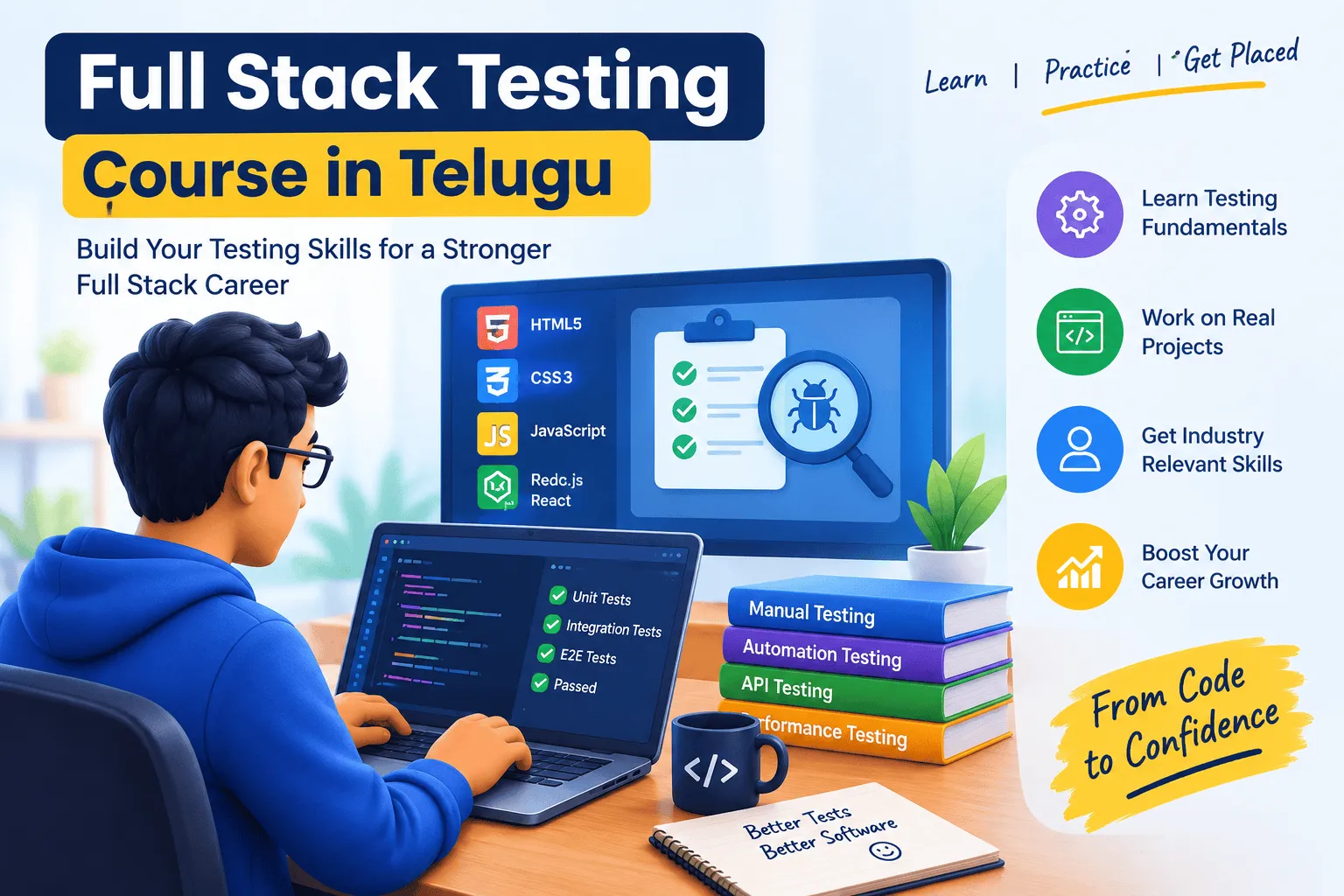
Software teams often need to test the same features whenever an application changes. Repeating every test manually can take significant time, especially when an application has many workflows. An automation testing framework helps organise test scripts, test data, reusable functions, reports, and execution processes so that tests can be maintained and repeated efficiently.
An AI Powered Full Stack Testing Course in Telugu can introduce learners to framework design and explain how to combine programming, UI automation, API testing, and reporting in a structured project.

What Is an Automation Testing Framework?
An automation testing framework is a collection of guidelines, reusable components, tools, and practices used to create and execute automated tests. It provides a consistent structure for writing test cases and managing results.
A well-designed framework can improve test maintenance, reduce duplicated code, support reusable test steps, and make test results easier to understand. However, automation still requires careful test design and regular maintenance.
Important Components of a Testing Framework
Before building a framework, understand its main components.
1. Test scripts: Contain the steps and assertions required to validate a feature.
2. Reusable utilities: Functions for common tasks such as browser setup, API requests, waits, or test-data preparation.
3. Test data management: Keeps test inputs separate from the test logic where practical.
4. Configuration: Stores environment-specific settings, such as the test URL and browser options.
5. Reporting and logging: Records passed tests, failed tests, errors, and execution details.
6. Test execution: Runs tests locally or through an automated pipeline.
7. Version control: Helps teams track changes and collaborate on test code.
Together, these components make automation projects more organised and maintainable.
How to Build an Automation Testing Framework Step by Step
Step 1: Choose the Right Tools
Select tools based on the application, team skills, and project requirements. For web UI automation, options include Selenium with Java or Playwright with a supported language. For API automation, teams may use REST Assured or other suitable tools.
Beginners should focus on one main stack rather than trying to learn every tool simultaneously.
Step 2: Create a Project Structure
Organise code into logical areas, such as tests, page objects, utilities, configuration, test data, and reports. The exact structure depends on the selected framework and project size.
A clean structure helps team members find and update code without changing unrelated tests.
Step 3: Build Reusable Components
Create shared methods for repeated actions, such as opening a browser, navigating to a page, entering test data, or validating a response. Avoid copying the same logic into every test.
For UI automation, the Page Object Model (POM) can separate page locators and page actions from test scenarios. This makes interface changes easier to manage.
Step 4: Add Assertions and Test Data
Assertions determine whether actual results match expected outcomes. Use meaningful assertions for elements, messages, response fields, and business rules.
Keep test data organised and avoid using real customer information. Make tests repeatable by preparing the required data and cleaning it up when appropriate.
Step 5: Add Reporting and Logging
Configure reports that show which tests passed, failed, or were skipped. Include useful error details to help the team identify the cause of a failure.
A report should help distinguish genuine application defects from test-script errors or environment problems.
Step 6: Integrate Continuous Integration
Once tests run reliably on a local machine, configure them to execute in a CI/CD pipeline. Automated runs can help teams detect regressions after code changes.
Start with a small, stable test suite before expanding execution across browsers or environments.
How Can AI Support Framework Development?
AI tools can help draft test scenarios, suggest reusable code, explain errors, and generate ideas for edge cases. They can also assist with documentation and test-data planning.
However, AI-generated scripts may contain incorrect selectors, weak assertions, or assumptions about application behaviour. Review and execute all generated code in a controlled test environment before relying on the results.
Beginner Project: Build a Login Automation Framework
Create a sample login-testing project with valid and invalid login scenarios. Organise test scripts, reusable page actions, configuration, test data, and reports.
Include tests for successful login, incorrect credentials, empty fields, and appropriate error messages. Add API checks for related authentication behaviour if the practice application supports them.
Document the framework structure, tools used, test coverage, and issues discovered. This creates a useful project to demonstrate during QA interviews.
Frequently Asked Questions
1. Which programming language is best for automation testing?
The right language depends on the selected tools and project. Java is commonly used with Selenium and REST Assured, while Playwright supports several languages.
2. Can beginners build an automation framework?
Yes. Beginners can start with a small test suite and gradually add reusable components, reporting, and CI integration.
3. What is the difference between a test script and a framework?
A test script validates a particular scenario. A framework provides the structure and reusable components used to organise and execute multiple tests.
4. Does AI eliminate the need for framework knowledge?
No. AI can accelerate some tasks, but testers still need to understand test design, assertions, debugging, maintainability, and reliable execution.
Conclusion
Building an automation testing framework helps testers move from isolated scripts to a repeatable and maintainable testing process. By learning project structure, reusable components, assertions, reporting, and CI integration, beginners can develop practical automation skills. An AI Powered Full Stack Testing Course in Telugu can help connect these concepts with UI automation, API testing, and database validation.




Sign in to leave a comment.