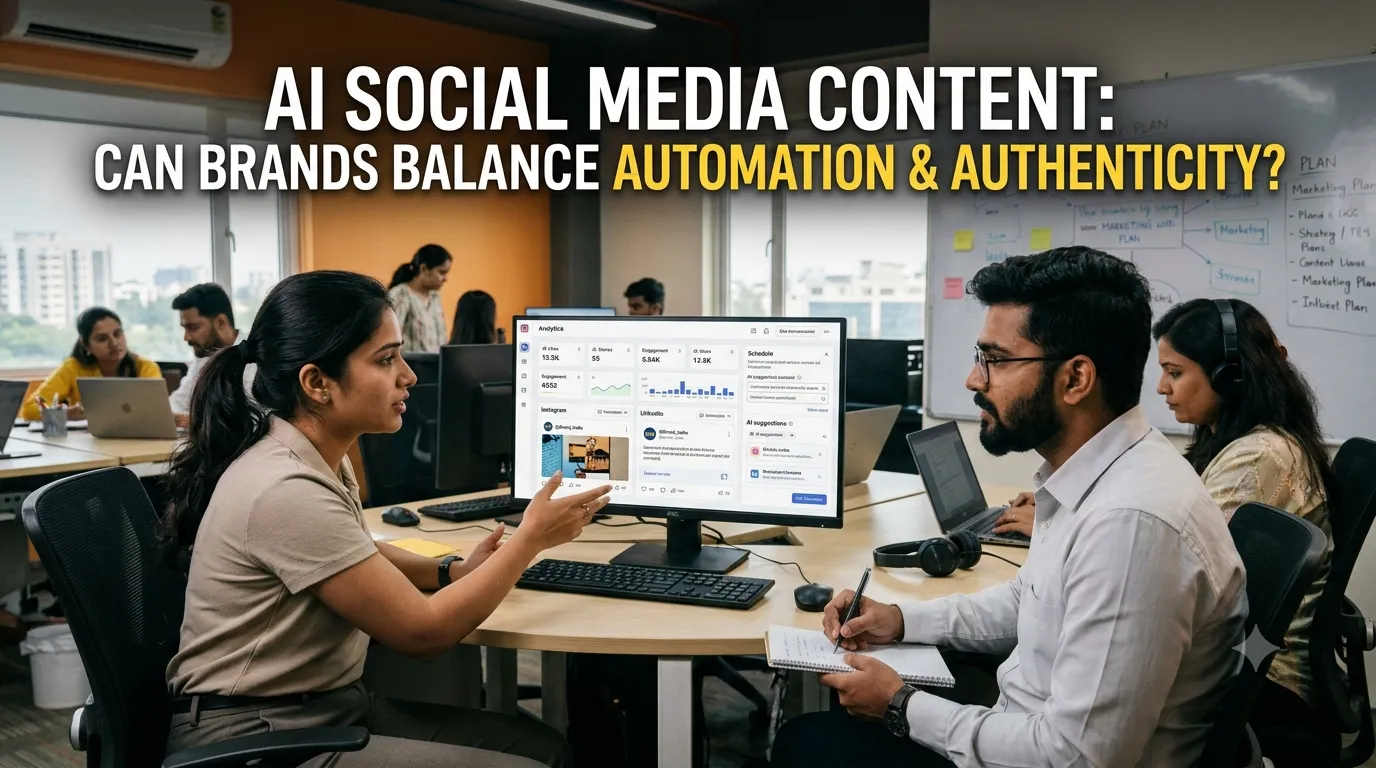

Your brand posts every day. The captions are polished. The graphics look clean. The calendar is never late. And somehow… nobody cares.
That is the uncomfortable side of automated content.
For brands evaluating the best social media marketing agency in Kolkata, the real question is no longer, “Do you use automation?” It is: “Can you use automation without making our brand sound automated?”
The stakes are significant. India had 491 million social media user identities in January 2025, according to DataReportal’s Digital 2025: India report. Meanwhile, Meta says 92% of surveyed businesses using its platforms in India considered its apps important for reaching customers, according to its India economic impact study.
Translation? Social media has serious business value—but audiences have endless options.
The winning strategy is not human vs machine. It is automation for speed, humans for taste, context, emotion, and judgment.
In this guide, you’ll discover what should be automated, what should stay human, and what to check before trusting a partner with your brand voice.
Can Brands Automate Social Media Without Losing Authenticity?
Yes—but automation should handle repetitive production and analysis, not replace human judgment. Brands can use automated tools for research, ideation, variations, scheduling, reporting, and workflow support while keeping positioning, storytelling, cultural context, community interaction, fact-checking, and final approval human-led.
Think of automation as the sous-chef, not the restaurant owner.
It can help a digital marketing company turn one campaign idea into multiple caption variations, summarize performance data, organize a content calendar, or identify recurring themes in audience comments.
But handing over the entire personality of a brand? Risky.
The difference becomes clearer here:
| Task | Automation Can Help | Human Input Still Matters |
|---|---|---|
| Content ideas | Generate directions quickly | Decide what fits the audience |
| Caption drafts | Produce variations | Add brand personality |
| Scheduling | Automate publishing | Decide timing and context |
| Reporting | Summarize performance | Interpret why it happened |
| Community replies | Suggest responses | Handle emotion and nuance |
| Trend research | Surface patterns | Decide whether the trend fits |
The sweet spot is simple: automate the repetitive; humanize the memorable.
Why Does Automated Content Start Feeling “Same-Same”?
Automated content often becomes generic when brands use similar tools, instructions, templates, and trend formats without adding original experience or brand-specific context. The result may be technically correct but emotionally interchangeable. Authenticity comes from recognizable opinions, customer insight, cultural awareness, original creative direction, and real human experiences.
You have probably seen it already.
“Ready to level up your business?”
“Unlock your brand’s potential.”
“Here are five game-changing tips…”
Perfect grammar. Zero pulse.
A fashion label in Kolkata should not sound identical to a SaaS founder in Bengaluru. Neither should a luxury jewellery brand speak like a meme page simply because a trending audio is performing well.
This is also where the expertise of an influencer marketing company in Kolkata can matter. Creator collaborations work best when creators are selected for audience fit and credibility—not simply follower count—and when scripts leave enough room for the creator’s natural voice.
Authenticity is not about deliberately making content imperfect. It is about making content specific enough that another brand could not post it unchanged.
What Should Brands Keep Human?
Keep humans closest to decisions where reputation, emotion, originality, cultural nuance, or customer trust are involved. Strategy, campaign concepts, sensitive replies, creator relationships, factual approval, brand positioning, and crisis communication deserve direct human oversight even when technology assists the workflow.
A practical rule is the “Could This Hurt Us?” test.
Before publishing, ask:
- Does the post make a factual or product claim?
- Is it responding to criticism?
- Does it reference a sensitive event or cultural moment?
- Could humour be misunderstood?
- Is a creator making a claim on the brand’s behalf?
- Would the brand be comfortable defending this post publicly?
If the answer to any of these is yes, human review should be non-negotiable.
This matters especially for influencer campaigns. India’s ASCI Guidelines for Influencer Advertising in Digital Media require appropriate disclosure when there is a material connection between an advertiser and influencer.
So no, “the tool generated it” is not a reputation strategy.
How Should Brands Build a Smarter Human + Automation Workflow?
Start with human strategy, use automation during production and analysis, then bring humans back for editing, verification, and approval. This creates efficiency without surrendering accountability. The workflow should also define who approves claims, creator content, community responses, and sensitive posts before anything reaches the public.
A practical workflow looks like this:
1. Human sets the brief.
Define the audience, business objective, platform, brand voice, offer, and desired action.
2. Technology accelerates production.
Generate directions, variations, hooks, research summaries, or repurposing opportunities.
3. Human adds the “only-us” layer.
Insert actual customer questions, local references, brand opinions, product details, founder insight, and original examples.
4. Verify before publishing.
Check facts, claims, links, disclosures, grammar, tone, and visual consistency.
5. Let performance data talk.
Review saves, shares, watch time, qualified DMs, clicks, leads, and conversions—not just likes.
A strong digital marketing company should be able to explain this workflow clearly. The same applies when comparing the best SEO agency in kolkata: tools can accelerate execution, but accountability should never disappear behind software.
How Do You Choose the Right Social Media Partner?
Choose a social media partner based on strategic thinking, creative quality, human review processes, measurement, transparency, and understanding of your audience. Ask how automation is used, who approves content, how brand voice is protected, how creator campaigns are vetted, and which metrics are connected to business outcomes.
Before signing a retainer, ask to see the machinery behind the pretty Instagram grid.
A potential best social media marketing agency in Kolkata should be able to answer:
- Who develops the actual strategy?
- Who writes and approves final content?
- How is brand voice documented?
- How are automated outputs fact-checked?
- What happens when a post receives negative comments?
- How are influencer partnerships selected and disclosed?
- Which metrics connect social activity to leads or sales?
If your strategy requires creators, an influencer marketing company in Kolkata should also explain audience relevance, creator vetting, deliverables, disclosure requirements, and measurement.
And if social content supports organic search or website acquisition, coordination with the best SEO agency in kolkata or the brand’s existing search team can prevent two teams from telling completely different stories.
The Bottom Line: Faster Content Is Not Better Content
Automation can make social media production dramatically faster. But speed without judgment can simply help a brand publish forgettable content more efficiently.
The strongest approach keeps strategy, originality, cultural understanding, trust, and final judgment human, while automation handles repeatable work and data-heavy tasks. When comparing the best social media marketing agency in Kolkata, look beyond posting frequency and tool stacks; ask how the team protects the human personality behind your brand.
The next step? Audit your last 20 posts. If half could be published by a competitor after changing the logo, your content system needs more humanity—not simply more content.
Frequently Asked Questions
1. Should brands use automated tools for all social media captions?
No. They can accelerate first drafts and variations, but important posts should receive human editing and fact-checking. Product claims, sensitive topics, creator collaborations, and reputation-related communication deserve particularly careful review.
2. What should I look for before choosing a social media agency?
Check its strategic process, portfolio, content quality, reporting, approval workflow, community-management approach, and ability to connect engagement with business outcomes. Ask who will actually work on your account.
3. Can automation replace social media managers?
Automation can reduce repetitive work, but social media management also requires judgment, cultural context, creative direction, customer understanding, community interaction, and reputation management. Those responsibilities still require meaningful human oversight.
4. How can ecommerce brands keep automated content authentic?
Feed the content process with real product information, customer questions, reviews, creator insights, brand opinions, and campaign data. Avoid publishing generic drafts unchanged. Every post should contain something recognizably specific to the brand.
5. Are disclosures required for influencer collaborations in India?
Where a material connection exists between an advertiser and influencer, appropriate disclosure is required under ASCI’s influencer advertising guidelines. Brands and creators should review the current guidelines and use disclosures that are clear and prominent.

























Sign in to leave a comment.