AI Tools for Travel Agents and DMCs to Work Smarter

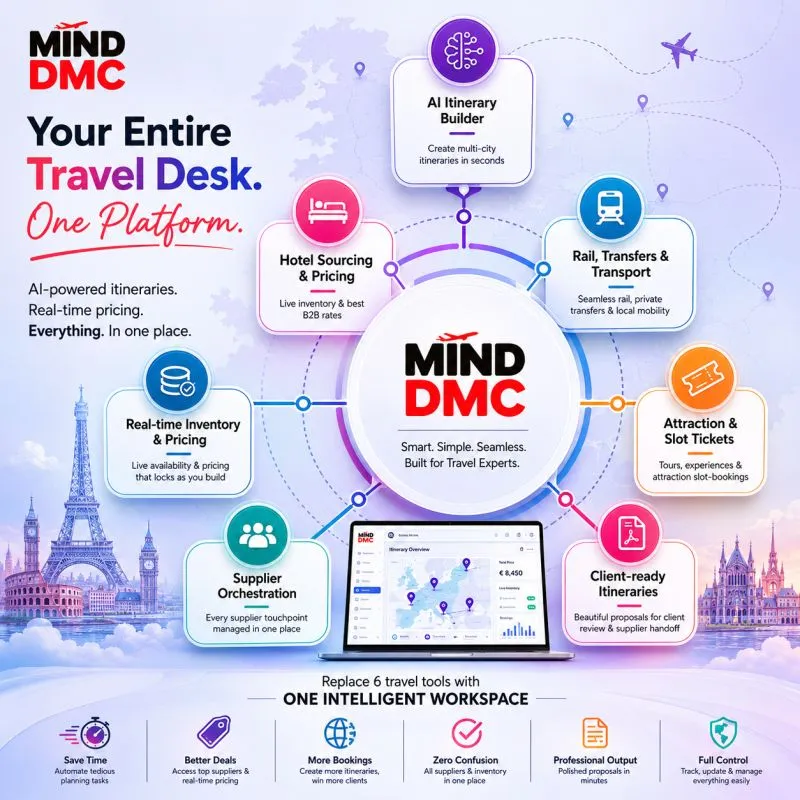
The travel industry is changing fast, and travelers now expect more than a simple hotel reservation or a standard holiday package. They want personalized experiences, quick responses, flexible itineraries, and memorable journeys. For travel agents and destination management companies (DMCs), meeting these expectations while managing daily operations can feel like juggling ten tasks at once.
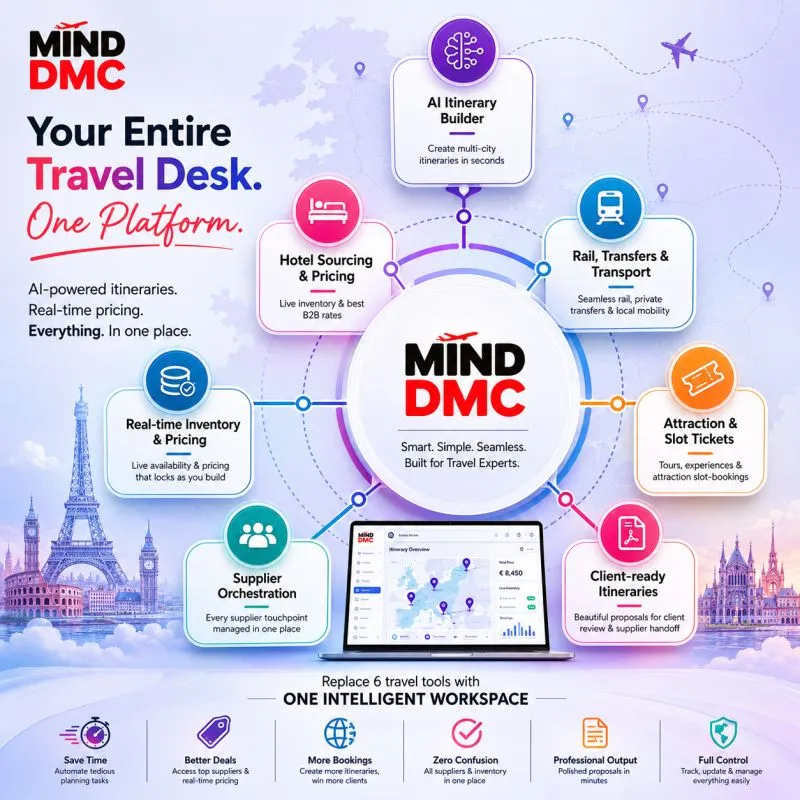
This is where AI tools for travel agents and DMCs can make a real difference. From creating customized itineraries to automating customer communication, artificial intelligence helps travel businesses save time, improve service quality, and handle more inquiries without adding unnecessary complexity.
Whether you run a small travel agency, manage inbound tourism, or operate a destination management company, AI can help you work smarter rather than harder. Let's explore how these tools work, their benefits, and how you can use them to grow your travel business.
What Are AI Tools for Travel Agents and DMCs?
AI tools are software applications that use artificial intelligence to perform tasks, analyze information, generate content, and support business decisions. In the travel industry, these tools can assist with itinerary creation, customer support, marketing, destination research, and administrative work.
For example, a travel agent can use an AI assistant to draft a seven-day family holiday itinerary. A DMC can use AI to organize destination information, prepare tour descriptions, and respond to common inquiries from international partners.
Instead of starting every task from scratch, your team can use AI to create a first draft, review the details, and deliver a polished result faster.
How AI Works in Travel Management
AI systems analyze the information you provide and generate useful outputs based on patterns learned from data. Depending on the tool, they may also summarize documents, classify customer inquiries, extract information, or connect with other business software.
Imagine AI as a capable digital assistant. It handles repetitive groundwork while your team focuses on supplier relationships, destination expertise, and the personal touches that make a trip special.
However, AI-generated information should always be checked, particularly when it involves prices, availability, visa requirements, local regulations, or travel schedules.
Why Travel Agents and DMCs Need AI Tools
Travel businesses often work with tight deadlines, multiple suppliers, changing customer preferences, and large volumes of inquiries. Managing everything manually can slow down operations and make it difficult to provide consistent service.
AI tools can help simplify these processes while allowing travel professionals to maintain control over important decisions.
Growing Customer Expectations
Today's travelers frequently research destinations online before contacting an agent. They may already know the experiences they want, the budget they can afford, and the type of accommodation they prefer.
They also expect quick answers and relevant recommendations.
AI can help your team prepare responses, compare customer preferences, and suggest suitable travel options. This makes it easier to deliver a more personalized experience without spending hours researching every inquiry.
Managing More Bookings With Less Manual Work
As your business grows, administrative tasks grow with it. Your team might spend hours writing proposals, updating itineraries, answering repetitive questions, and preparing supplier emails.
AI can assist with these tasks by generating drafts, summarizing requests, organizing information, and creating reusable templates.
The result? Your employees spend less time on repetitive work and more time building relationships, negotiating with suppliers, and closing bookings.
Top Benefits of AI Tools for Travel Agents and DMCs
The real value of AI comes from how effectively it solves everyday business problems. Here are three important benefits for travel professionals.
Faster Travel Planning and Itinerary Creation
Creating a detailed itinerary involves much more than listing attractions. You need to consider travel time, customer interests, accommodation preferences, meal options, and the overall pace of the trip.
AI can turn a customer's initial requirements into a structured itinerary draft in minutes. You can specify the destination, travel dates, budget, group size, and preferred experiences to generate a starting point.
Your team can then refine the itinerary, verify travel logistics, and add local recommendations that make the package more appealing.
Personalized Travel Recommendations
Not every traveler wants the same experience. Some prefer adventure, while others want luxury, cultural immersion, wildlife experiences, or relaxing beach holidays.
AI can help categorize preferences and generate recommendations tailored to different traveler profiles.
For example, a honeymoon couple might receive suggestions for private dining and boutique resorts, while a family could receive options featuring child-friendly attractions and convenient transportation.
The important thing is to use AI as a recommendation assistant, not as a substitute for understanding your customers.
Improved Customer Communication
Travel inquiries can arrive through email, messaging apps, websites, and social media. Responding to every message individually can consume valuable time.
AI writing assistants and chatbots can help prepare answers to frequently asked questions, draft follow-up emails, and create clear package descriptions.
For DMCs working with international travel partners, AI can also assist with translating and adapting communications into different languages. A human review is still essential to ensure the message is accurate, professional, and culturally appropriate.
Best Ways to Use AI in a Travel Business
AI becomes most useful when you apply it to specific business processes instead of using it simply because it is a new technology.
AI-Powered Itinerary Planning
Travel itinerary creation is one of the most practical applications of AI. A tool can help organize destination highlights, recommend activities based on traveler preferences, and structure a day-by-day travel plan.
For instance, a travel agent preparing a Rajasthan tour could ask AI to draft a six-day journey featuring Jaipur, Jodhpur, and Udaipur for a couple interested in heritage hotels and cultural experiences.
The agent can then review driving distances, opening hours, supplier rates, and seasonal conditions before sharing the final itinerary.
Creating Customized Travel Packages
AI can help turn a basic package into multiple versions for different customer segments.
You could prepare a budget-friendly option, a premium package, and a luxury experience using the same destination as your starting point. Each version can highlight different accommodation categories, activities, transportation choices, and inclusions.
This approach helps travel agents and DMCs respond to more inquiries without rewriting every proposal from the beginning.
Still, all quoted prices, supplier services, and inclusions should be confirmed before a proposal reaches the customer.
AI for Customer Support and Chatbots
An AI chatbot can answer routine questions about destinations, package inclusions, booking procedures, and general travel services.
For example, visitors to your website might ask whether airport transfers are available, what a package includes, or how to request a customized tour.
A well-configured chatbot can provide approved information at any time and direct complex inquiries to your sales team.
For sensitive situations involving cancellations, emergencies, refunds, or unexpected travel disruptions, customers should have an easy way to reach a human representative.
AI for Sales, Marketing, and Lead Generation
Marketing is another area where AI can support travel businesses. It can help create blog outlines, social media captions, email campaigns, destination guides, and descriptions for tour packages.
You can also use AI to adapt one piece of content for several channels. A destination guide, for instance, could become a short social media post, an email newsletter, and a series of frequently asked questions.
AI can help draft lead qualification questions and organize inquiries according to budget, travel dates, destination interests, or group size.
Your team can then prioritize promising opportunities and personalize its follow-up. Remember that AI-generated marketing content should reflect your actual services rather than making unsupported claims.
AI for Destination Management Companies
DMCs have different operational needs from many retail travel agencies. They coordinate local suppliers, transportation, accommodation, guides, activities, and ground-handling services.
AI can support these activities by helping teams summarize supplier proposals, organize destination information, draft partner communications, and prepare operational checklists.
A DMC managing multiple group arrivals, for example, could use AI to convert booking details into a structured checklist for staff review.
More advanced systems may also connect with operational databases to support reporting and workflow automation. These capabilities depend on the software, available integrations, and quality of the underlying data.
AI should not independently confirm supplier availability or make operational commitments unless the relevant systems reliably verify those details.
Essential Features to Look for in AI Travel Tools
Not every AI application is designed for travel businesses. Before choosing one, consider whether it supports your team's actual workflow.
Look for these useful features:
- Itinerary generation: Creates structured trip plans based on customer preferences and travel requirements.
- Content creation: Helps prepare package descriptions, destination guides, emails, and marketing materials.
- Multilingual support: Assists with communication across international markets.
- Customer service automation: Handles approved routine questions and routes complex cases to staff.
- Data security: Offers suitable privacy controls, access permissions, and data-handling options.
- Integration capabilities: Connects with your CRM, booking platform, email system, or other business applications when supported.
- Customization: Allows you to adapt outputs to your destinations, service standards, and brand voice.
The best solution is not necessarily the one with the most features. It is the one that solves your most important problems reliably and fits your budget.
How to Choose the Right AI Tools for Your Travel Business
Choosing the right AI tools for travel agents and DMCs starts with identifying where your team loses the most time.
Begin by reviewing your daily activities. Are your employees spending too long preparing proposals? Are customer inquiries going unanswered? Does your marketing team struggle to publish content consistently?
Once you identify the main bottleneck, select a tool that addresses it.
Next, test the software using real-world scenarios. Ask it to prepare a sample itinerary, draft a supplier email, or generate a tour description using your business requirements.
Check the quality of its output, ease of use, language capabilities, pricing, and privacy settings. If the tool needs access to customer information, confirm how that data is stored and processed.
Start with one or two workflows rather than automating everything at once. This gives your team time to learn the system, identify errors, and measure whether it actually improves productivity.
Challenges of Using AI in Travel Management
Although AI offers several advantages, it also has limitations.
AI-generated recommendations may contain inaccurate information, outdated details, or attractions that do not fit the customer's schedule. Some tools may generate convincing descriptions without verifying whether a hotel, tour, or service is currently available.
Privacy is another important consideration. Travel agencies may handle passport details, contact information, payment-related records, and other sensitive customer data. Avoid entering such information into AI tools unless their data policies and your organization's security requirements permit it.
There is also the risk of losing the personal touch. Travelers often choose specialist agents and DMCs because they value local knowledge, trusted advice, and human assistance.
The solution is to combine automation with professional judgment. Let AI handle suitable repetitive tasks while your team remains responsible for accuracy, customer relationships, and important travel decisions.
Best Practices for Using AI Tools Effectively
To get meaningful results, treat AI implementation as a business improvement project rather than a quick technology upgrade.
Follow these practical steps:
- Set clear goals: Decide whether you want to reduce proposal preparation time, improve response speed, or increase marketing output.
- Use specific prompts: Include the destination, budget, audience, trip duration, and required format when requesting content.
- Create reusable templates: Develop standard prompts for itineraries, supplier emails, destination guides, and customer follow-ups.
- Verify important details: Confirm prices, availability, opening hours, transport schedules, and travel requirements through reliable sources.
- Train your team: Make sure employees understand the tool's capabilities, limitations, and data-handling rules.
- Measure results: Track time saved, response quality, customer satisfaction, and the number of inquiries converted into bookings.
Review these results regularly. If a tool saves time but creates substantial editing work, adjust your process or consider a better alternative.
The Future of AI for Travel Agents and DMCs
AI is likely to become increasingly integrated into travel planning, customer relationship management, supplier coordination, and business analytics.
As AI assistants connect with reliable booking and operational systems, they may help travel professionals move from creating recommendations to supporting more connected workflows.
Imagine receiving a customer inquiry and using one integrated process to organize preferences, draft an itinerary, prepare a proposal, and schedule a follow-up. With suitable integrations and human approval, much of the repetitive groundwork could happen within a single workflow.
For DMCs, improved data analysis may also help teams understand demand patterns, evaluate package performance, and identify opportunities for new destination experiences.
However, technology alone will not determine which travel businesses succeed. Destination knowledge, dependable supplier relationships, service quality, and customer trust will remain essential.
Businesses that combine these strengths with thoughtful AI adoption will be better positioned to respond to changing traveler expectations.
Conclusion
AI is creating new opportunities for travel agents and destination management companies to improve productivity, personalize customer experiences, and streamline everyday operations. From itinerary planning and customer support to marketing and supplier communication, AI tools for travel agents and DMCs can reduce repetitive work and help teams focus on delivering better journeys.
You do not need to automate your entire business overnight. Start with one task that consumes too much time, test a suitable tool, and measure the results. Keep human expertise at the center of your service, verify important information, and protect customer data.
Ultimately, the goal is not to replace the personal touch that makes travel memorable. It is to use AI to give your team more time to create exceptional experiences, build lasting relationships, and grow your travel business.
Frequently Asked Questions
1. How can AI tools help travel agents?
AI tools can help travel agents create itinerary drafts, write travel proposals, prepare marketing content, answer common customer questions, and organize inquiries. They reduce repetitive manual work, allowing agents to spend more time advising clients and developing suitable travel packages.
2. Can DMCs use AI to create travel itineraries?
Yes. DMCs can use AI to draft destination itineraries, organize activities, prepare tour descriptions, and customize packages for different traveler groups. However, staff should verify supplier availability, travel times, prices, and operational requirements before confirming any itinerary.
3. Are AI tools affordable for small travel agencies?
Many AI tools offer free plans, entry-level subscriptions, or pay-as-you-go options, although pricing and features vary. Small agencies can begin with a tool for writing, itinerary drafting, or customer communication and upgrade as their needs grow.
4. Can AI replace travel agents and DMCs?
AI can automate selected tasks, but it cannot reliably replace every aspect of travel expertise. Human professionals remain important for complex arrangements, negotiations, unexpected disruptions, personalized advice, and building customer trust. AI works best as an assistant to experienced travel professionals.
5. How should a travel agency get started with AI?
Start by identifying one repetitive task, such as preparing itineraries or writing customer emails. Choose a suitable tool, test it with sample workflows, verify its output, and train your team. Measure the time saved and quality improvements before expanding AI use to other business activities.


Sign in to leave a comment.