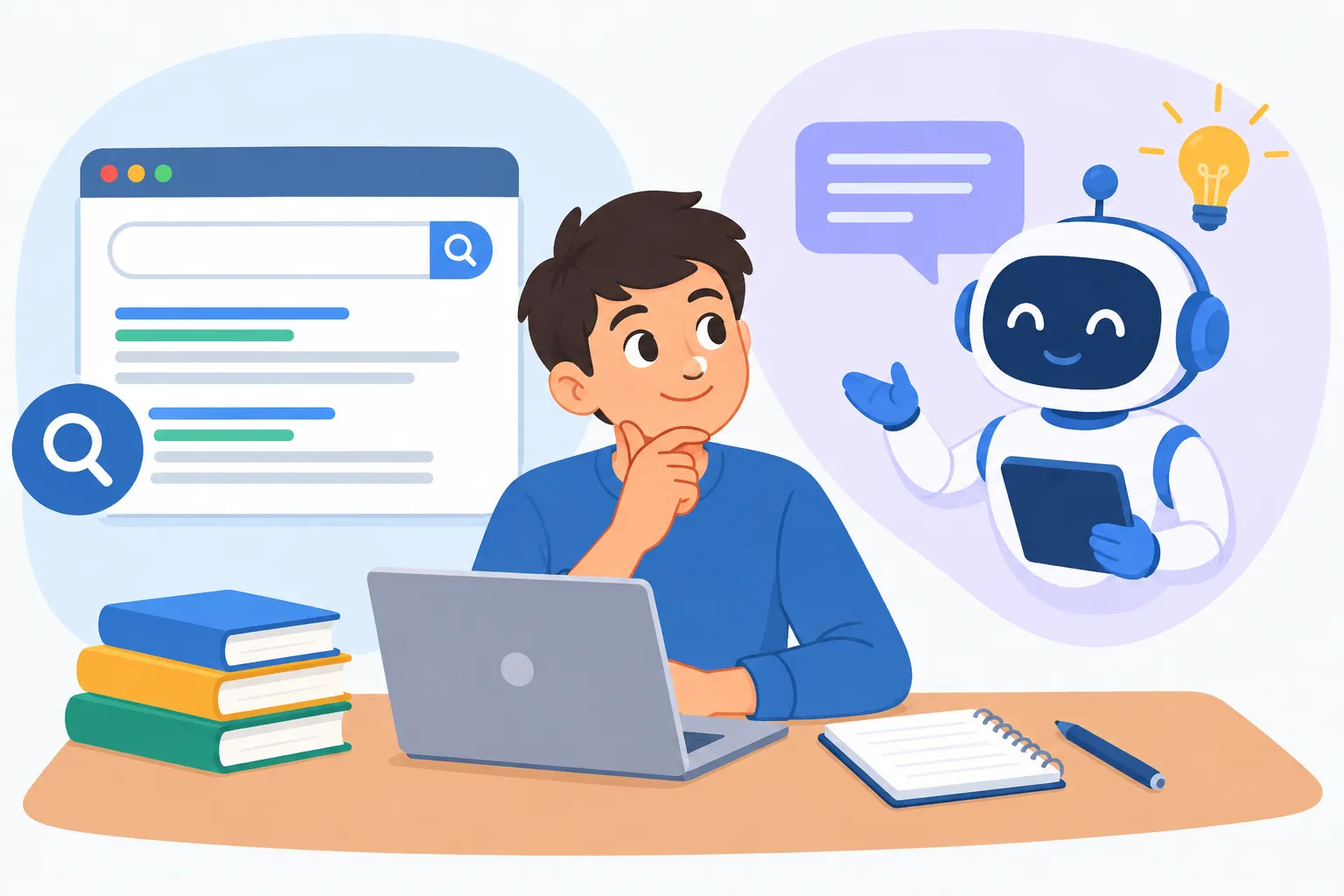

Students have more access to information today than ever before. A few words typed into a search engine can produce thousands of webpages, videos, articles, and educational resources within seconds. At the same time, artificial intelligence has introduced a different way to learn: interactive AI tutors that can explain concepts, answer questions, and provide personalized study support.
This raises an important question: AI tutor vs. search engine — which is more useful for learning?
The answer depends on what a student is trying to accomplish. Search engines are excellent for discovering information and reliable resources, while an AI tutor can make learning more interactive by helping students understand, practice, and explore concepts through conversation.
Understanding the difference can help students use both technologies more effectively.
What Is a Search Engine?
A search engine helps users discover information available across the internet. Students can search for definitions, educational websites, research papers, tutorials, videos, news, and other resources.
For example, a student researching the solar system might search for information about planets, orbital motion, or the history of space exploration. The search engine then provides relevant webpages and other resources.
Search engines are particularly useful when students need:
- Multiple sources for research
- Official or academic websites
- Current information
- Educational videos and tutorials
- Original documents and references
- Different perspectives on a subject
However, searching for information does not necessarily mean understanding it. Students may need to open several webpages, determine which information is reliable, and connect the information themselves.
What Is a Personal AI Tutor?
A personal AI tutor is an AI-powered learning assistant that allows students to interact with educational content through natural-language conversations.
Instead of simply displaying webpages, an AI tutor can explain a concept, answer follow-up questions, provide examples, and create practice activities based on the student's request.
For example, instead of searching for "quadratic equations explained," a student could ask an AI tutor:
"Explain quadratic equations as if I'm learning them for the first time."
The student could then continue with questions such as:
- "Can you give me a simple example?"
- "Why do we use this formula?"
- "Give me three practice problems."
- "Can you explain where I made a mistake?"
This conversational approach can make studying more interactive.
AI Tutor vs. Search Engine: The Key Difference
The biggest difference is how each technology supports the learning process.
A search engine primarily helps students find information. An AI tutor can help students work with information and understand concepts.
Consider a student who does not understand photosynthesis.
With a search engine, the student might find several articles explaining photosynthesis. They then need to read those resources and determine which explanation makes sense to them.
With an AI tutor, the student can ask for a simple explanation, request an analogy, ask questions about specific terms, and practice explaining the concept.
Neither approach eliminates the need for critical thinking. In fact, students should use critical thinking with both.
When Is a Search Engine More Useful?
Search engines remain an important part of education because they provide access to a huge range of information.
1. Conducting Research
When students are preparing research projects, they often need multiple sources. Search engines can help them discover academic publications, institutional websites, educational organizations, and other relevant resources.
2. Finding Primary Sources
For certain assignments, students may need original documents, official statistics, scientific publications, or institutional information. Search engines can help locate these sources.
3. Finding Current Information
The internet contains constantly changing information. Students researching recent developments may need to search for current articles, announcements, reports, or official updates.
4. Comparing Different Sources
Searching across multiple sources can help students compare explanations and identify differences. This is especially useful when learning how to evaluate the reliability of information.
When Is an AI Tutor More Useful?
AI tutors can be particularly useful when the main challenge is understanding rather than finding information.
1. Understanding Difficult Subjects
Some concepts are difficult to understand from a textbook or webpage alone. An AI tutor can provide another explanation when the first one does not make sense.
For example, a student struggling with a physics formula can ask for the meaning of each variable and see how the formula works in a practical example.
2. Asking Follow-Up Questions
Learning often involves a series of questions. One answer can lead to another question, and students may need several explanations before a concept becomes clear.
An AI tutor supports this conversational style of learning.
3. Practicing What You Learn
Students can use an AI tutor to generate quizzes, practice questions, examples, and revision exercises. This can help turn passive reading into active practice.
4. Learning at an Individual Pace
In a classroom, teachers generally have to follow a schedule that applies to a group of students. An AI learning assistant can allow an individual student to spend additional time on a particular concept.
Students who understand a topic quickly can move forward, while students who need more explanation can continue asking questions.
A Comparison of AI Tutors and Search Engines
| Learning Need | Search Engine | AI Tutor |
|---|---|---|
| Finding websites | Excellent | Limited |
| Finding multiple sources | Excellent | Can assist |
| Finding current information | Excellent | Depends on the system |
| Explaining a difficult concept | Depends on the source | Strong use case |
| Asking follow-up questions | Requires additional searches | Interactive |
| Creating practice questions | Requires finding resources | Can assist |
| Personalized explanations | Limited | Strong use case |
| Research and source discovery | Excellent | Can support |
| Step-by-step guidance | Depends on the resource | Can provide |
| Fact verification | Useful for finding sources | Should be supplemented with reliable sources |
The table shows that these technologies are not necessarily competitors. They can perform different roles in the learning process.
Why Students Should Use Both
The most effective approach may be to combine search engines and AI tutors rather than treating them as alternatives.
A student could follow a simple learning process:
Search → Understand → Practice → Verify → Review
First, use a search engine to find reliable educational resources. Next, use a personal AI tutor to clarify concepts that are difficult to understand. Then practice the material through questions or exercises.
After that, verify important information against trustworthy sources and review the concepts independently.
This approach combines the broad information access of search engines with the interactive nature of AI-assisted learning.
The Importance of Verifying AI-Generated Information
AI tutors can be useful learning tools, but students should not assume that every AI-generated response is automatically correct.
AI systems can sometimes produce inaccurate, incomplete, or misleading information. This is particularly important when students are studying scientific facts, historical information, mathematical solutions, or preparing academic assignments.
Students should:
- Check important facts against reliable sources.
- Use textbooks and educational materials alongside AI.
- Ask for explanations rather than blindly copying answers.
- Work through problems independently.
- Follow their school's academic integrity policies.
- Consult teachers when an explanation remains unclear.
The purpose of an AI tutor should be to support learning, not replace learning.
How Vidyalabh Can Support Students
Platforms such as Vidyalabh demonstrate how AI can be incorporated into a more interactive learning experience. As an AI learning platform and personal AI tutor, Vidyalabh can help students engage with questions and educational topics through AI-powered assistance.
Instead of treating AI simply as a tool for obtaining answers, students can use an AI tutor to explore concepts, ask follow-up questions, and get support while studying.
The value of this approach depends on how students use the technology. Asking questions, requesting explanations, practicing concepts, and checking information can make AI a useful part of a broader study routine.
What Should Students Choose?
There is no single tool that is better for every learning situation.
A search engine is particularly useful when a student needs to discover information, locate sources, research a topic, or find current material.
A personal AI tutor can be useful when a student needs interactive explanations, practice, step-by-step guidance, or additional support understanding a difficult concept.
The choice should therefore depend on the learning goal.
For research, students may start with a search engine. For understanding and practice, they may use an AI tutor. For important information, they should verify what they learn using reliable sources.
Conclusion
The comparison between an AI tutor and a search engine is less about choosing one technology over the other and more about understanding what each tool does well.
Search engines give students access to a vast amount of information and help them discover valuable educational resources. AI tutors provide a more conversational approach that can help students ask questions, clarify concepts, and practice what they have learned.
Used responsibly, both can become useful parts of a student's learning process. The goal should not simply be to find answers faster, but to understand concepts, develop problem-solving skills, and become a more independent learner.
As AI continues to develop, personal AI tutors may become an increasingly common complement to traditional educational resources. For students, learning how to combine AI assistance with reliable sources, critical thinking, and independent study can be more valuable than relying on any single technology.

























Sign in to leave a comment.