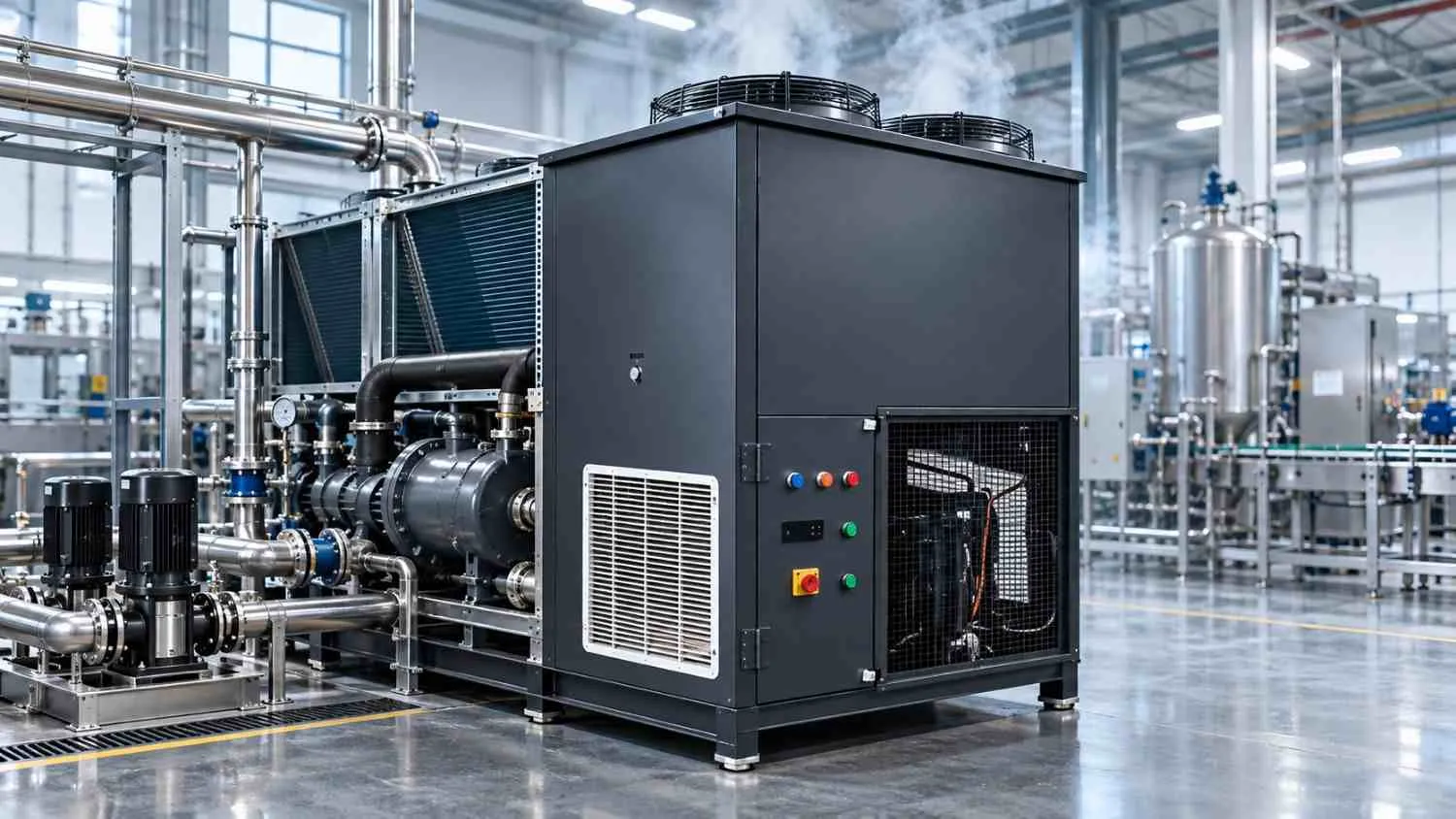


A cooling tower sounds simple until you're the one filling out the water board compliance form every quarter. That's usually the moment plants start asking about an air cooled screw chiller instead. An air cooled screw chiller removes the cooling tower from the equation entirely, rejecting heat straight to ambient air rather than through a water loop — which matters enormously in regions where water allocation for industrial cooling is getting harder to secure, not easier. Nobody markets that as the main benefit. It usually is.
What Changes When You Remove the Cooling Tower
An air cooled screw chiller is so much more than just a water cooled chiller on a different tower. The physics of rejection are different and this impacts on the sizing, siting and operation of them to a much greater extent than most buyers are aware of.
Condenser Design
The air cooled units use finned condenser coils and fan arrays in place of a water cooled shell-and-tube condenser. The surface area of the condenser needs to be much larger to dissipate the same amount of heat and this is why air cooled units tend to have a higher footprint per ton.
Ambient Temperature Sensitivity
Performance degrades at higher ambient temperatures, and in most of India summer ambient can far exceed the rated condition of the unit. A chiller rated efficient at 35 deg C ambient will perform significantly worse once site conditions exceed 42 deg C in the peak months.
The Detail Buyers Skip
Fan noise and air flow clearances. An air cooled screw chiller requires free air flow on all sides of the condenser array, and buyers often position units along wall or in tight courtyards, which smothers air flow and silently kills rated capacity. That‘s a by placement, not spec sheet number, and the one most site surveys overlook.
Benefits That Matter Beyond "No Cooling Tower"
An air cooled screw chiller earns its place for reasons that go past the obvious water-saving pitch.
- Zero cooling tower water consumption removes a recurring compliance and cost burden entirely, not just an operational inconvenience.
- No Legionella risk management program required, which eliminates a regulatory and liability exposure water-cooled systems carry permanently.
- Lower water treatment chemical spend, since there's no condenser water loop to dose and monitor.
- Simpler installation footprint in plants without existing cooling tower infrastructure, avoiding a major civil works addition.
- Reduced maintenance complexity, with no tower fill, basin cleaning, or biocide dosing schedule to manage.
- Faster deployment timeline for new facilities, since there's no tower foundation or water piping loop to design around.
Why Site Climate Data Should Drive Your Sourcing Decision
We size air cooled screw chillers against actual regional ambient data, not a generic national design condition, and that distinction matters more in India than in most markets given the ambient swing between coastal and inland sites. As air cooled screw chiller manufacturers in India, we factor in dust loading and summer peak temperatures specific to your plant's location, because a unit undersized for local ambient conditions will fall short of rated capacity exactly when your production demand peaks. Buyers evaluating air cooled screw chiller suppliers in India should ask directly whether sizing was done against a national default or their actual site data — the answer changes your real-world performance significantly. An air cooled screw chiller dealer in India who can't produce site-specific sizing calculations hasn't actually done the engineering work yet.
About Us
We're Aquatech Plus, and we lost a warranty argument in 2020 over exactly this — a client's air cooled unit underperformed during a 44°C ambient spike that our own sizing calculation hadn't accounted for. We rebuilt our sizing methodology that year to use a five-year historical ambient maximum for each site, not a single seasonal average. It cost us that one dispute. It's saved every client since from the same surprise.
Conclusion
An air cooled screw chiller solves more than a water-availability problem — it changes your maintenance load, your compliance exposure, and your installation timeline all at once. Get the ambient sizing and placement clearances right, and it becomes the lower-hassle option most plants expect it to be from the start. That's the outcome worth engineering for before the unit ever ships.
FAQs
Is an air cooled screw chiller less efficient than a water cooled unit?
Generally, yes, by a measurable margin at the same tonnage, because air rejection is less efficient than water rejection. The trade-off is no cooling tower water consumption or Legionella management burden.
How much footprint does an air cooled screw chiller need compared to a water cooled system?
Typically 30–50% more footprint for the condenser array alone, though you gain back space by eliminating the cooling tower and its associated piping.
Do air cooled screw chiller manufacturers size units differently for coastal versus inland Indian climates?
They should, and reputable ones do — coastal humidity affects heat rejection differently than dry inland heat, and a single national sizing default ignores that difference.
What's the realistic lifespan of an air cooled screw chiller versus a water cooled one?
Comparable at 15 to 20 years with proper maintenance, though air cooled units can see faster condenser coil fouling in high-dust environments if cleaning schedules slip.
Can an air cooled screw chiller dealer retrofit a water cooled system to air cooled?
Sometimes, but it's rarely a simple swap — piping, electrical load, and footprint requirements usually mean a significant redesign rather than a direct replacement.




















Sign in to leave a comment.