
The All-in-One GNSS Receiver Market: Strategic Trends and Commercial Opportunities
The global positioning technology landscape has long relied on modular, multi-component workflows where receivers, antennas, inertial measurement units, and communication modules were assembled separately to meet end-user specifications. That paradigm is shifting decisably. Over the past half-decade, the all-in-one GNSS receiver market has expanded from approximately 990 million USD in 2020 to an estimated 1.45 billion USD by 2025, and forward trajectories project sustained growth through 2032, with a compound annual growth rate holding around 8.15 percent. This expansion is not merely numerical. It reflects a structural reorientation in how positioning hardware is engineered, deployed, and valued across surveying, construction, agriculture, infrastructure, and geospatial operations.
The momentum behind the all-in-one category stems from converging pressures on field operators: tighter project timelines, greater demand for sub-centimeter accuracy without complex field calibration, and a growing preference for streamlined field equipment that reduces setup time, minimizes failure points, and simplifies training. These receivers now integrate antennas, processors, multi-constellation tracking, communication links, and increasingly, inertial sensors and tilt compensation into a unified enclosure. The result is a product class that delivers rapid deployment, higher resilience to challenging environments, and a stronger value proposition for organizations seeking to reduce the total cost of ownership across equipment, logistics, and field labor.
GNSS Market
Yet the market is not a smooth upward curve. Beneath the revenue trajectory lies a set of structural tensions that will shape competitive positioning over the next several years. Identifying these inflection points is essential for any executive planning capacity investments, M&A strategy, product roadmaps, or procurement decisions.
Market Snapshot and Core Friction Points
A maturing ecosystem with accelerating integration
The historical arc from 2020 to 2025 shows consistent expansion, with year-over-year gains reflecting broad acceptance beyond traditional surveying into machine control, precision agriculture, and field mapping applications. The forecast period through 2032 implies continued scale, but the nature of growth is evolving. Early-phase expansion was heavily tied to replacement cycles and the gradual migration from external-base-station workflows to self-contained RTK-capable units. The current phase is increasingly driven by feature consolidation, broader constellation support, hardened field designs, and connectivity options that enable real-time corrections, telemetry, and remote diagnostics.
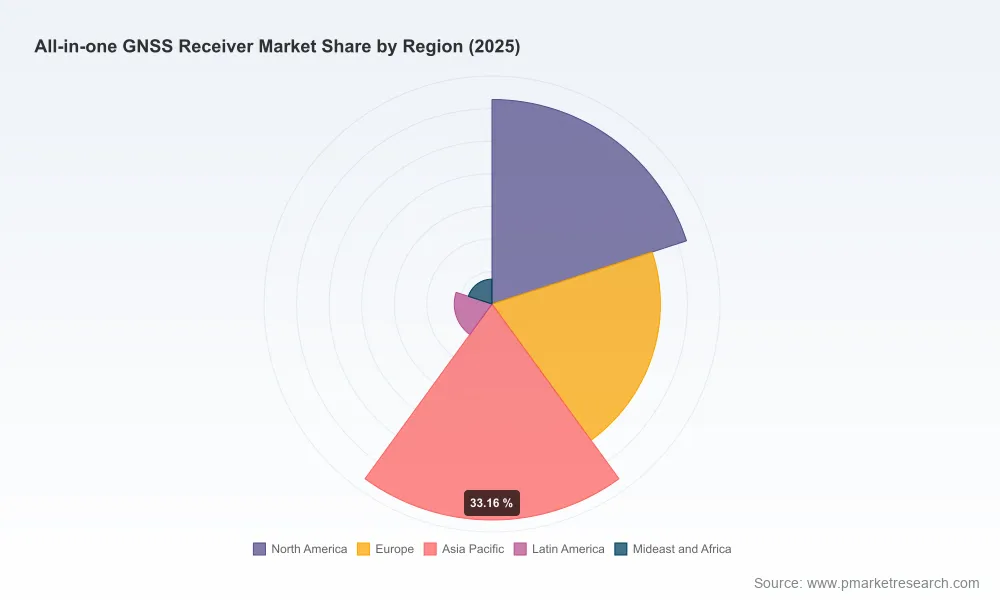
Market leadership remains concentrated. A small group of manufacturers accounts for a notable share of global revenue, reflecting the capital intensity of high-precision development, the importance of certification and compliance, and the entrenched relationships that established players have built with channel partners, integrators, and enterprise customers. At the same time, regional demand is unevenly distributed, with strong activity across North America, Europe, and Asia Pacific, while other regions are growing from smaller bases and are influenced by localized infrastructure programs, agricultural modernization, and cost sensitivity.
Key challenges and inflection points
Three interlocking dynamics warrant close attention.
- Component dependency and supply-chain sensitivity. High-precision GNSS performance depends on advanced semiconductor chipsets, multi-frequency antenna designs, and carefully calibrated RF front ends. The broader semiconductor environment has repeatedly demonstrated that leading-edge availability, packaging constraints, and test-and-calibration bottlenecks can affect product launch timing, cost structures, and margin stability. For all-in-one receivers, where RF, processing, and connectivity are tightly coupled, any disruption in key components propagates quickly through design cycles and production planning.
- Regulatory and certification complexity. Compliance requirements are no longer a background concern. In the EU, receivers must align with the Radio Equipment Directive and demonstrate CE conformity, including ETSI EN 303 413 for RF interference protection. In the US, most civil and commercial receivers fall under the Export Administration Regulations rather than more restrictive export controls, but higher-performance variants or targeted applications still require careful licensing review. Maritime-grade equipment must also meet IEC 61108 series performance standards under IMO resolutions. Add electromagnetic compatibility requirements such as FCC Part 15 in relevant markets, and the compliance burden becomes a real differentiator for manufacturers seeking global distribution.
- Performance expectations and environment resilience. Field conditions are increasingly demanding. Construction sites, quarries, agricultural operations, and utility corridors expose equipment to vibration, shock, dust, moisture, and interference. Operators no longer view robustness as a premium feature; it is a baseline requirement. Receivers that cannot maintain fixed solutions under multifrequency interference, spoofing attempts, or challenging multipath conditions risk rapid devaluation in competitive procurements. This is particularly true as anti-jamming and anti-spoofing capabilities migrate from specialized high-end platforms into mainstreamall-in-one designs.
The implication is clear: the all-in-one GNSS receiver market is moving from an era of product adoption to an era of performance, resilience, and regulatory fluency. Companies that treat integration as a one-time engineering milestone will lose ground to those that treat it as an ongoing competitive moat.
Core Drivers Shaping the Next Growth Cycle
Technology innovation as the foundation of differentiation
The central technical story is the convergence of multi-constellation, multi-frequency tracking with onboard intelligence. All-in-one receivers increasingly combine GNSS front ends with inertial measurement units, tilt compensation, and modem or cellular capabilities. This convergence supports practical benefits: faster initialization, continuity under brief signal interruptions, reduced dependence on external base stations, and better performance when line-of-sight to satellites is partially obstructed. Recent product activity illustrates the direction of travel. In 2026, CHC Navigation updated several of its receiver lines and base station offerings with an updated GNSS chip architecture, emphasizing improved RTK performance, enhanced anti-interference capability, and integration with a cloud corrections service. Around the same time, Septentrio introduced a high-precision multi-frequency receiver, reinforcing the industry's push toward resilient, precision-oriented designs.
PW Consulting Information & Electronics Research Center
Another important thread is the integration of communication and positioning into a single form factor. Quectel's launch of a smart connected all-in-one GNSS receiver for base station and RTK applications reflects a broader trend: receivers are becoming network-aware endpoints rather than isolated measurement instruments. This shift has practical consequences for enterprise customers, who can now reduce the number of discrete components carried to site, simplify maintenance, and enable remote configuration and monitoring.
Policy and regulatory intensity raising the bar
Regulations are increasingly shaping both design and market access. Compliance with RF emission limits, electromagnetic compatibility, and interference protection standards is now a gating factor for market entry in multiple regions. For manufacturers, the implication is that design-for-compliance must be embedded early in the product lifecycle, not retrofitted before shipment. For buyers, certification status is becoming part of supplier qualification, especially in public-sector, utility, and maritime-adjacent applications where auditability and standards adherence carry operational and legal weight.
While the regulatory burden can raise costs and lengthen development cycles, it also creates a barrier that rewards established engineering capabilities. Companies with mature testing, certification, and documentation processes can convert compliance into a commercial advantage by reducing risk for large customers and accelerating procurement approval.
GNSS Chip Market
Demand-side behavior shifting toward consolidated, field-ready solutions
User expectations are changing. Surveyors, machine operators, and field technicians increasingly prefer equipment that reduces setup steps, supports one-person operation, and maintains performance across variable conditions. In construction and surveying workflows, the pressure to reduce rework and improve measurement throughput favors receivers that combine accurate positioning with tilt and orientation compensation, because they can be deployed without perfectly leveled setups or additional ancillary sensors. In precision agriculture, the convergence of GNSS with machine guidance and variable-rate application logic is raising the value of reliable, field-hardened receivers that stay connected under challenging canopy and terrain conditions.
A parallel demand-side shift is the desire for smarter return on equipment investment. Buyers are increasingly attentive not only to purchase price but to durability, warranty support, calibration intervals, firmware update cadence, and the availability of correction services or network compatibility. This is especially relevant for organizations managing fleets of receivers across multiple projects or regions, where consistency of performance and ease of support materially affect total cost of ownership.
Supply-side and cost structure dynamics
On the supply side, economies of scale are increasingly tied to platform thinking. Manufacturers that can share core RF and processing architectures across multiple product tiers, while differentiating through enclosure, ruggedness, firmware features, or service integration, are better positioned to manage cost while expanding portfolio breadth. Conversely, companies with highly fragmented architectures or limited reuse across models may face more difficult margin dynamics as component costs fluctuate and customer expectations rise.
The all-in-one model itself changes cost structure considerations. By removing the need for separate antennas, cables, separate processing units, and sometimes external comms modules, these receivers can simplify logistics and reduce assembly complexity. But the value depends on execution quality: if integration compromises thermal management, antenna performance, or durability, the supposed simplicity becomes a liability. This makes design discipline and testing rigor central, not peripheral, to commercial success.
Competitive Landscape and Strategic Positioning
The market features a mix of established precision manufacturers, technology-driven entrants, and specialists expanding into connected field solutions. Several firms stand out for how they are shaping the competitive conversation.
Trimble continues to emphasize integrated GNSS systems that pair receivers with antennas for surveying, construction, and precision applications, reinforcing a systems-level value proposition. Topcon Positioning Systems markets compact, lightweight all-in-one receivers that embed antennas, IMU, and modem functions for surveying and civil engineering, appealing to customers who value portability and reduced field clutter. Leica Geosystems, under Hexagon, delivers professional-grade GNSS systems with integrated high-precision receivers that target demanding geospatial workflows and institutional buyers. Septentrio contributes a resilience-oriented angle with receivers and modules designed for precise positioning under challenging RF conditions, which is increasingly relevant where interference and spoofing are genuine field concerns. NovAtel, also under Hexagon, continues to provide OEM and integrated platforms with multi-constellation, multi-frequency tracking, offering a foundation for customers who need scalable precision building blocks.
A strong set of challengers and fast-moving specialists is also reshaping the market. CHC Navigation supplies integrated receivers and base stations aimed at surveying workflows, with a growing emphasis on combining antenna, IMU, and advanced features in a unified package. Emlid has carved a reputation in field-survey RTK receivers that combine integrated antennas, tilt compensation, and rugged design, often at a price-performance point that appeals to smaller firms and distributed field teams. SingularXYZ and ComNav Technology are expanding high-precision GNSS solutions, including handheld all-in-one terminals and RTK systems targeting surveying, precision agriculture, and machine control. Quectel has moved into the all-in-one receiver space with connected base station and RTK-oriented hardware, signaling that connectivity-centric manufacturers are increasingly viewed as credible participants in precision positioning ecosystems.
What distinguishes the leaders is not simply product breadth, but the coherence of their strategic positioning. The most effective players are aligning product roadmaps with several priorities simultaneously:
- Integration depth with practical usability. The best offerings do not just combine components; they optimize the combined system for setup speed, field robustness, and intuitive operation.
- Resilience to interference and environmental stress. Anti-jamming and anti-spoofing features, multi-constellation tracking, and durable enclosures are becoming baseline expectations rather than niche add-ons.
- Connectivity and service integration. Receivers that support remote updates, telemetry, correction services, and integration with higher-level workflows hold a growing advantage as customers move from point solutions to platform thinking.
- Regulatory and certification readiness. Global distribution increasingly depends on demonstrated compliance, and the firms that normalize this process can serve multi-region customers more efficiently.
The competitive structure is evolving along two directions at once. There is consolidation pressure among larger players seeking to strengthen integrated portfolios and cross-sell across construction, surveying, and precision agriculture. At the same time, there is differentiation pressure as new entrants and regional specialists compete on form factor, price-performance, tilt compensation, connectivity, and ease of use. This dual dynamic means the market is not simply becoming more concentrated or more fragmented; it is becoming more stratified, with premium resilience and platform integration at one end and accessible, field-oriented integrated solutions at another.
Forward Outlook: Three Trends to Watch Over the Next Three to Five Years
Resilience and interference hardening will become standard purchase criteria
As the all-in-one category matures, buyers will increasingly judge receivers not only by nominal accuracy but by performance under interference, signal degradation, and spoofing risk. This trend will favor manufacturers that treat RF resilience as a core engineering discipline rather than a specialized security feature. It will also push convergence between precision positioning and broader site communications, because connected receivers can combine correction data, diagnostics, and security monitoring in a single operational context.
For commercial planning, this suggests that product roadmaps emphasizing anti-jamming, multi-frequency robustness, and secure correction pathways will have stronger differentiation potential than roadmaps that add features without improving real-world reliability. It also implies that procurement criteria will increasingly include resilience testing evidence, not just specification sheets.
Convergence of positioning, tilt, and field intelligence into handheld and mobile form factors
The rise of handheld and mobile all-in-one terminals reflects a broader push to reduce equipment footprint while expanding capability. Recent moves toward integrated handheld terminals that combine high-precision GNSS with smart terminal functions point toward a future in which field workers carry fewer devices and gain more context at the point of work. Tilt compensation and IMU integration are likely to become more common in these devices because they reduce setup constraints and broaden the situations in which accurate data can be captured quickly.
This trend creates opportunities for workflows that depend on rapid asset verification, mapping, inspection, and field data collection. It also raises the importance of software and data integration, because hardware consolidation only pays off if the data produced can flow efficiently into project management, GIS, and asset systems.
Platformization and service-linked business models will reshape value capture
The market is moving toward receivers that are not just hardware but part of a connected precision ecosystem. Correction services, remote diagnostics, firmware lifecycle management, and interoperability with downstream applications all contribute to the value equation. Over the next few years, manufacturers and channel partners that can bundle hardware, support, and digital services in coherent bundles will likely capture more of the long-term value than those competing primarily on unit price.
A parallel opportunity lies in application-specific optimization. Precision agriculture, infrastructure and utility management, and machine control each place different demands on receivers, even when the underlying GNSS technology is similar. Companies that can tailor integration, connectivity, and durability to specific verticals will have stronger commercial resonance than those offering generic hardware with limited workflow alignment.
These trends do not come without risk. Component availability and cost volatility can disrupt launch timing and pricing. Regulatory evolution may raise compliance costs or shift market access conditions, especially where emission limits, interference protection, or maritime-related standards are involved. Competitive intensity may compress margins in segments where differentiation is thin. And the shift toward connected, service-linked models can create new expectations around uptime, update cadence, and support responsiveness that some organizations may find difficult to meet consistently.
Strategic Guidance for Decision Makers
For manufacturers and product leaders
Treat integration as a durable competitive asset, not a product launch checkbox. The next generation of advantage will come from combining robust RF performance, tilt and IMU integration, and connectivity in ways that reduce field friction without compromising durability or accuracy. Invest early in compliance and certification processes so that regulatory readiness supports global expansion rather than delaying it. Where possible, build on reusable platform architectures that allow differentiation across product tiers while protecting cost structure. Finally, ensure that hardware improvements are matched by software, documentation, and support so that customers experience the full value of the integrated design in daily operation.
For investors and corporate development teams
Look beyond headline revenue growth and assess which players are building defensible positions through resilience, platform reuse, and service integration. Companies that can sustain multi-constellation, multi-frequency performance, demonstrate real anti-interference capability, and support connected workflows are better placed to defend margins than those competing primarily on price in undifferentiated segments. In M&A and partnership evaluation, pay close attention to certification maturity, supply-chain resilience, and the ability to serve multiple verticals without diluting product focus. The market is attractive, but value capture will increasingly favor organizations that can translate hardware integration into recurring workflow value.
For procurement and operations leaders
When evaluating all-in-one receivers, expand the assessment beyond accuracy specifications and unit cost. Include setup speed, tilt and IMU capability, durability in relevant field conditions, certification status for target regions, and the practicality of firmware updates and support. Where operations span multiple projects or regions, consistency of performance and ease of maintenance can matter as much as peak precision. Also consider how well the receiver fits into correction services, data workflows, and downstream systems, because a compact device that generates data that is hard to use will underdeliver relative to its promise.
The all-in-one GNSS receiver market is entering a phase where execution quality, resilience, and ecosystem fit matter more than ever. Detailed segment data, company-level positioning, and region-specific dynamics can sharpen these decisions further. For teams that need a deeper, structured view of where value is concentrating and how competitive dynamics are evolving, the full PW Consulting research report provides expanded segmentation detail, company profiles, and tailored scenario analysis to support planning and investment choices.
For detailed analysis of this topic, please visit the official page: All-in-one GNSS Receiver Market
Lacy Lee
Senior Marketing Manager
[email protected]
PW Consulting: www.pmarketresearch.com






















Sign in to leave a comment.