
Launching a new product on Amazon is very different from managing an established listing.
An established product may already have reviews, organic rankings, historical conversion data, and a steady stream of sales. A new product has none of those advantages. It starts with limited visibility, little or no advertising history, and no proven keyword performance.
That is why Amazon PPC should be treated as part of the product-launch strategy — not simply as a traffic source.
A well-structured PPC campaign can help a new listing collect valuable search-term data, generate initial sales, identify high-performing keywords, and build momentum. But launching too aggressively without a clear framework can also lead to wasted spend and poor campaign data.
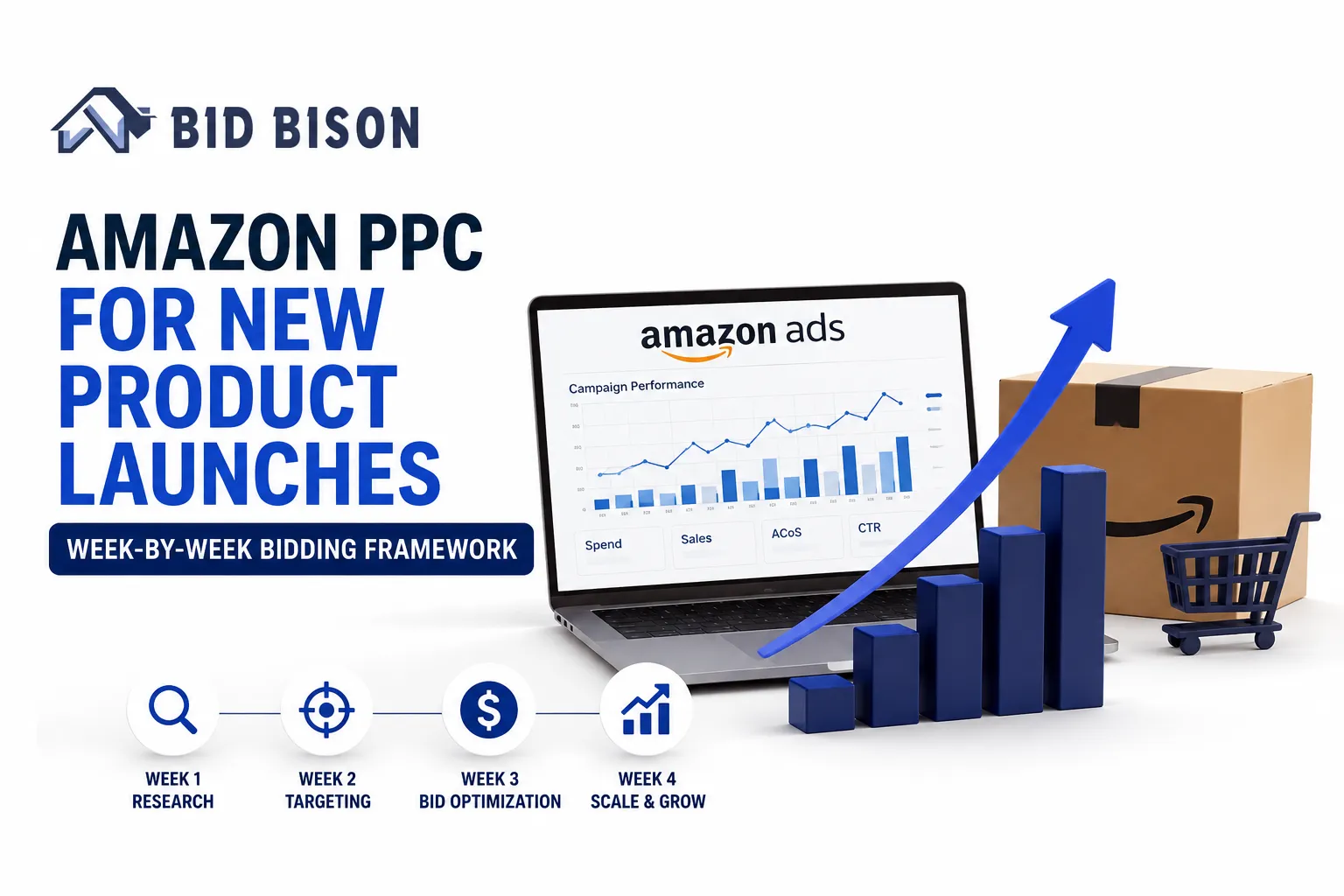
Here is a practical framework Amazon sellers can use to structure PPC during the first stage of a new product launch.
1. Start With the Right Launch Objective
One of the biggest mistakes sellers make is setting a profitability target too early.
When a product has just launched, the primary objective may not be achieving the lowest possible ACoS immediately. Instead, sellers may need to prioritize visibility, data collection, conversions, and keyword discovery.
Your launch objective should therefore answer a simple question:
What does success look like during the first few weeks?
Depending on the product, the goal could be:
- Generate initial sales
- Discover converting search terms
- Build keyword relevance
- Increase impressions
- Improve organic visibility
- Establish a baseline for future PPC optimization
Once the product has enough data, the strategy can gradually shift toward efficiency and profitability.
2. Build Your Campaign Structure Before Spending
A new product launch should not rely on a single campaign.
Different campaign types serve different purposes, so separating them makes performance easier to analyze.
A basic structure can include:
Automatic Campaign
Automatic targeting can help discover search terms and products that Amazon considers relevant to the listing.
This campaign can be useful during the research phase because it may uncover search queries that were not included in the original keyword research.
Manual Keyword Campaign
Manual campaigns give sellers greater control over the keywords they want to target.
Consider separating keywords into groups such as:
- Exact match
- Phrase match
- Broad match
This allows you to understand how different keyword variations perform and eventually move proven search terms into more controlled campaigns.
Product Targeting Campaign
Product targeting can help you reach shoppers browsing specific competing or complementary products.
For certain categories, this can become an important source of incremental sales.
3. Don’t Treat Every Keyword the Same
One of the most important parts of Amazon PPC management is understanding that keywords have different levels of intent.
For example, a highly specific search such as:
“wireless ergonomic vertical mouse for laptop”
may indicate stronger purchase intent than a broad search such as:
“computer mouse.”
That doesn’t mean broad keywords should automatically be avoided. They can be valuable for discovery and audience expansion.
Instead, your campaign structure and bidding strategy should reflect the different roles of your keywords.
High-intent keywords can receive more focused attention, while broader terms can be used to discover additional opportunities.
4. Give Your Campaigns Enough Data
A common launch mistake is making major bid changes too quickly.
A keyword receives a few clicks without a sale, and the seller immediately pauses it. Another keyword generates one sale, so the bid is increased dramatically.
This creates unstable campaign behavior and makes it harder to understand what is actually working.
Instead, evaluate performance using enough data to identify meaningful patterns.
Look at metrics such as:
- Impressions
- Clicks
- CTR
- CPC
- Orders
- Conversion rate
- Spend
- Sales
- ACoS
- Search-term performance
The exact amount of data required will vary by product category, price point, competition, and traffic volume.
The key principle is simple:
Don’t confuse short-term variation with long-term performance.
5. Search-Term Data Is One of Your Biggest Assets
PPC isn’t only about generating sales.
It is also a research mechanism.
As your campaigns collect data, you can identify search terms that generate:
- Clicks
- Orders
- Strong conversion rates
- High sales volume
- Poor performance
- Irrelevant traffic
The strongest converting search terms can then become priorities for more controlled targeting.
At the same time, irrelevant or consistently unproductive queries may become candidates for negative targeting.
This creates a continuous feedback loop:
PPC → Search-term data → Optimization → Better targeting → More efficient PPC
6. Control Your Budget by Campaign Purpose
A new product does not necessarily need the same budget allocation across every campaign.
For example, a seller may allocate more budget toward campaigns designed to generate direct keyword sales while maintaining smaller testing budgets for discovery-oriented campaigns.
A simple starting framework might look like this:
Campaign PurposeExample Budget ShareHigh-intent keyword targeting40–50%Keyword discovery20–30%Product targeting10–20%Brand-focused campaigns10–15%
These percentages are not universal rules. Your category, competition, margins, product price, and launch objective should determine the actual allocation.
The important point is to allocate budget according to purpose instead of treating every campaign equally.
7. Optimize Bids Gradually
Bid optimization is another area where sellers can easily overreact.
Suppose a keyword is performing well. Increasing the bid can potentially generate more impressions and clicks — but an aggressive increase can also raise CPC and push advertising costs beyond what the product can support.
Likewise, cutting a bid too quickly can reduce visibility on a keyword that was beginning to perform.
A more controlled approach is to make incremental adjustments and then monitor the resulting performance.
Think of bid optimization as steering rather than switching between “on” and “off.”
8. Watch Conversion Rate, Not Just ACoS
ACoS is an important Amazon PPC metric, but looking at it in isolation can lead to poor decisions.
Imagine two keywords:
Keyword A
- High clicks
- High conversion rate
- Higher CPC
- Higher ACoS
Keyword B
- Low clicks
- Low conversion rate
- Low CPC
- Lower ACoS
Keyword B may look better if you only consider ACoS.
But Keyword A may be generating significantly more sales and could have greater strategic value for the product.
During a launch, consider the relationship between:
Traffic + Conversion + Sales + Cost
rather than optimizing around one metric alone.
9. Your Product Listing Is Part of the PPC Strategy
PPC cannot compensate indefinitely for a weak product listing.
If advertising generates relevant traffic but shoppers don’t convert, increasing bids may simply increase the amount of money being spent on the same problem.
Before scaling PPC, review:
- Main image
- Product title
- Bullet points
- Product description
- A+ Content
- Price
- Reviews
- Ratings
- Product differentiation
A useful way to think about it is:
PPC brings shoppers to the listing. The listing has to convince them to buy.
If traffic is increasing but conversion remains weak, the solution may not be another bid adjustment.
10. Use a Launch-to-Scale Framework
The first stage of a product launch should eventually transition into a more mature PPC strategy.
A simple lifecycle could look like this:
Phase 1: Discovery
Focus on generating traffic and collecting search-term data.
Phase 2: Validation
Identify keywords, targets, and campaigns that are producing meaningful results.
Phase 3: Optimization
Shift budget toward stronger performers while reducing inefficient spend.
Phase 4: Scaling
Increase investment in campaigns and keywords that can support additional sales volume.
Phase 5: Profitability
Once sufficient data exists, introduce stronger efficiency and margin controls.
This lifecycle prevents sellers from treating a brand-new product exactly like a mature listing.
11. Automation Can Help as Campaign Complexity Grows
Managing a handful of campaigns manually may be manageable.
But as the account grows, sellers may have hundreds or thousands of keywords, multiple products, different campaign types, and changing budgets to monitor.
That is where PPC automation can become useful.
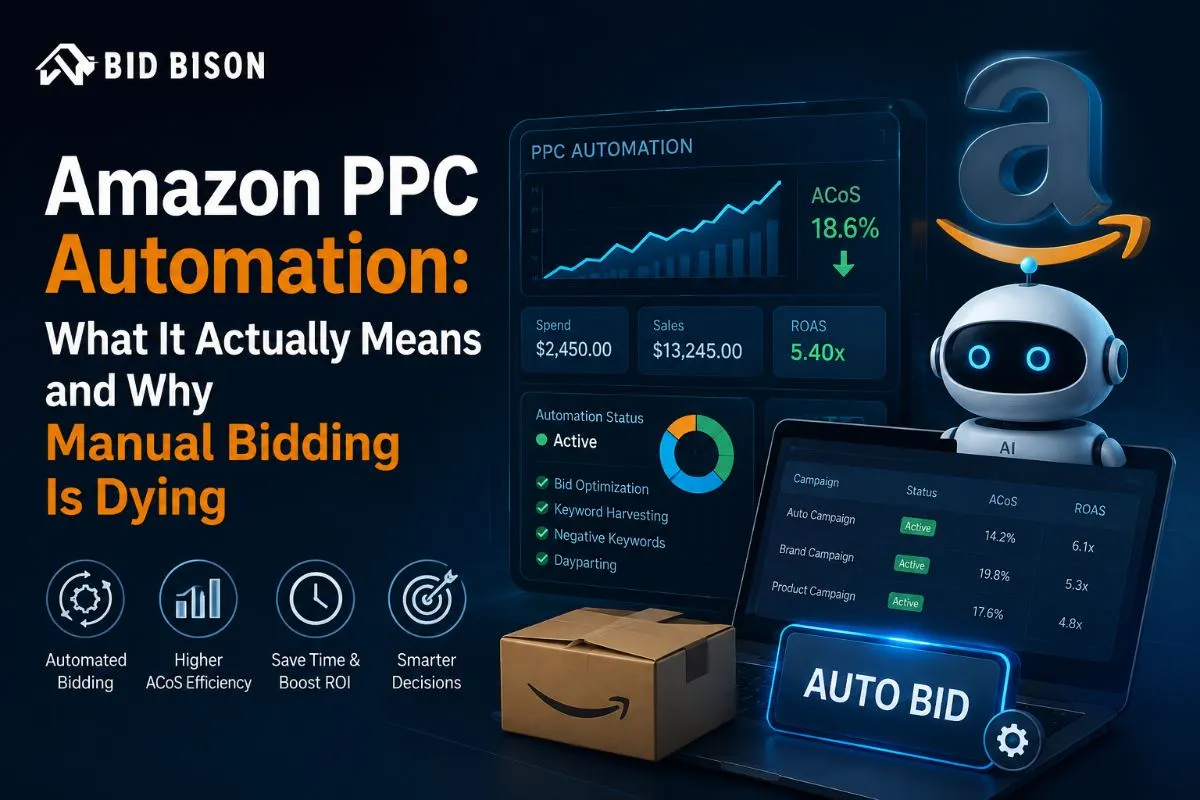
Modern Amazon PPC platforms can automate repetitive tasks such as bid adjustments, budget management, search-term harvesting, negative keyword management, and dayparting.
For example, BidBison positions its platform around goal-based Amazon PPC automation, allowing sellers to choose an objective such as getting a new product found quickly, maintaining a target ACoS, scaling successful campaigns, reducing ACoS, or clearing inventory.
The benefit of this approach is that sellers can spend less time making repetitive bid changes and more time working on product, pricing, inventory, and overall growth strategy.
12. Review Performance on a Regular Schedule
PPC optimization works better when it follows a repeatable process.
Instead of randomly checking campaigns throughout the day, establish a review routine.
Daily
Monitor major issues such as:
- Unexpected spend spikes
- Campaign eligibility
- Budget depletion
- Out-of-stock products
- Significant performance changes
Weekly
Review:
- Search-term performance
- Keyword winners and losers
- ACoS and ROAS
- Conversion rates
- Budget allocation
- New keyword opportunities
Monthly
Step back and evaluate:
- Overall advertising efficiency
- Organic sales trends
- Product profitability
- Campaign structure
- Scaling opportunities
- Whether your original launch objective has changed
This separates short-term campaign management from broader strategic decisions.
Final Thoughts
Launching a new product on Amazon requires more than simply turning on PPC campaigns and increasing bids.
The strongest approach is built around a clear sequence:
Define the objective → Structure campaigns → Collect data → Identify winners → Optimize → Scale → Improve profitability
Your initial PPC strategy should also evolve as the product moves through its lifecycle. What makes sense during the first weeks of a launch may not make sense once the listing has established conversion history and organic visibility.
Most importantly, remember that PPC is only one part of the Amazon growth equation. Advertising can generate valuable traffic and data, but product quality, listing optimization, pricing, reviews, inventory, and customer experience all influence the final result.
A structured launch framework gives sellers a better way to turn that traffic into meaningful, measurable growth.

























Sign in to leave a comment.