Amazon Product and Price Scraping: Track Prices and Inventory in Real Time


Amazon product prices and inventory availability can change frequently due to demand, promotions, seller activity, and stock levels. For brands, retailers, sellers, and market researchers, keeping track of these changes is essential for making informed pricing and inventory decisions.
Amazon product and price scraping helps collect product information, pricing data, and availability signals from Amazon product listings. With regularly refreshed data, businesses can monitor price fluctuations, identify competitive changes, and understand how products perform across the marketplace.
What Is Amazon Product and Price Scraping?
Amazon product and price scraping is the process of collecting structured product data from Amazon listings, including prices, product titles, seller information, and inventory availability indicators.
Depending on the data collection method and source, the information may also include discounts, ratings, review counts, product identifiers, and delivery estimates.
Businesses use this data to understand marketplace conditions, evaluate competitors, and monitor changes that could affect their pricing strategies or sales performance.
When supported by an appropriate data collection system, scraping can provide frequent updates that help businesses respond to marketplace changes more quickly.
What Product Data Can You Collect from Amazon?
The specific fields available depend on the listing, marketplace, seller, and data collection method.
| Data field | What it helps you understand |
|---|---|
| Product title | Identify and categorize products |
| ASIN | Match products to Amazon catalog listings |
| Current price | Monitor listed selling prices |
| List price and discounts | Identify promotional pricing and price reductions |
| Seller information | Understand which sellers offer a product |
| Buy Box information | Monitor the featured offer and its seller, where available |
| Availability status | Identify whether a product is listed as in stock, out of stock, or unavailable |
| Ratings and review counts | Track customer feedback signals |
| Product URL | Connect collected data to the original listing |
| Timestamp | Compare observations across different collection periods |
Not every field is available for every product, and inventory status or seller information may not always be exposed in a consistent format.
How Does Real-Time Amazon Price Scraping Work?
Real-time Amazon price scraping involves collecting and processing listing information frequently enough to identify meaningful marketplace changes.
A typical workflow includes the following steps.
1. Identify Products to Monitor
Start by selecting the products you want to track. You can use ASINs, product URLs, keywords, or other supported product identifiers to identify relevant listings.
For competitive analysis, businesses may monitor their own products alongside competing brands and alternative products within the same category.
2. Collect Product Pricing Data
A data collection system retrieves available product information, including the displayed price, discounts, seller details, and other supported listing attributes.
The collection frequency depends on the monitoring requirements, available infrastructure, and applicable access restrictions.
3. Check Inventory Availability
The system records available stock-status signals, such as in-stock, out-of-stock, or currently unavailable.
These signals help businesses identify changes in product availability. However, a listing's displayed availability does not necessarily reveal the exact number of units remaining in a seller's inventory.
4. Compare Changes Over Time
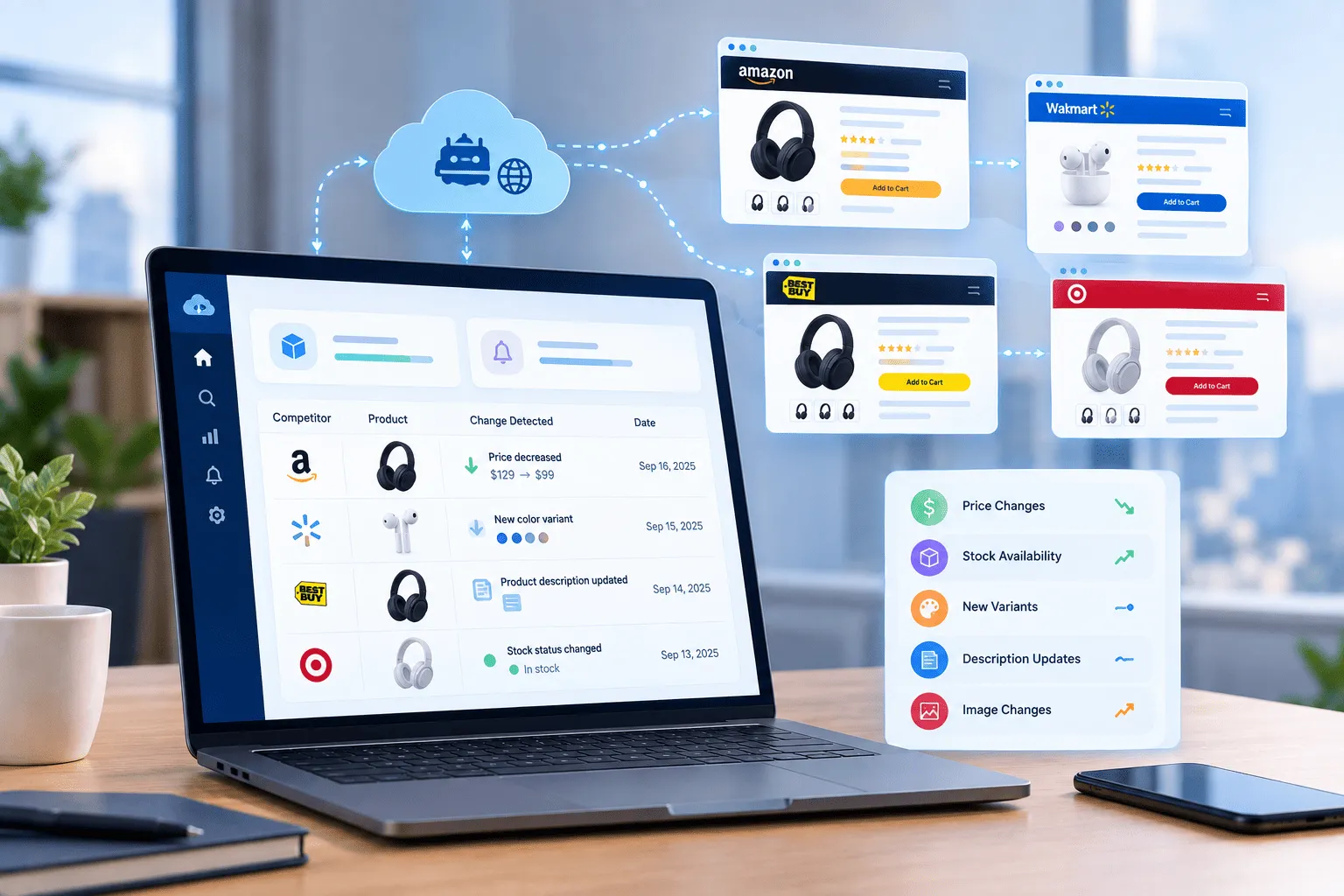
Collected data can be compared with previous observations to identify price increases, price reductions, changes in discounts, seller changes, and availability fluctuations.
Historical records are particularly useful for distinguishing temporary changes from longer-term pricing patterns.
5. Turn Data into Actionable Insights
The resulting data can support pricing dashboards, competitive intelligence reports, inventory monitoring workflows, and automated alerts.
For example, a brand may investigate a sudden competitor price reduction, while a marketplace seller may review changes in the featured offer or product availability.
Why Is Real-Time Amazon Price Monitoring Important?
Amazon marketplace conditions can change quickly. Periodic checks may miss short-lived promotions, seller changes, or availability disruptions.
Frequent monitoring helps businesses respond to these changes with better information.
Monitor Competitor Prices
Tracking competitor prices helps businesses understand how competing products are positioned in the market. Price comparisons can reveal pricing gaps, discount patterns, and changes in competitive positioning.
Identify Price Fluctuations
Historical price data helps businesses understand how frequently prices change and whether current prices differ from previous observations.
This information can support pricing reviews, promotional planning, and competitive benchmarking.
Track Product Availability
Availability monitoring helps businesses identify listings that become unavailable or return to stock. These signals can inform marketplace operations and competitive analysis.
For brands, monitoring competitor availability can also help explain changes in the visibility or performance of competing products.
Evaluate Promotions and Discounts
Comparing listed prices and promotional information over time helps businesses investigate discount activity and identify potential pricing opportunities.
Accurate comparisons require consistent product matching and consideration of variations such as pack sizes, models, and product bundles.
Support Better Pricing Decisions
Combining price history, seller information, and availability data gives pricing teams a broader view of marketplace conditions.
Rather than reacting to a single price observation, teams can use recurring data to identify patterns and evaluate potential responses.
Amazon Product Price Scraping vs. Manual Price Tracking
Manual tracking can work for a small number of products, but it becomes difficult to maintain as product catalogs and monitoring requirements grow.
| Factor | Manual tracking | Automated data collection |
|---|---|---|
| Data collection | Requires repeated manual checks | Can be scheduled or automated |
| Product coverage | Usually limited by available time | Can support larger product sets |
| Update frequency | Depends on the person checking | Depends on the configured collection schedule |
| Historical analysis | Requires manual recordkeeping | Can maintain structured historical observations |
| Change detection | Requires reviewing individual records | Can flag defined changes automatically |
| Reporting | Often involves manual spreadsheet updates | Can feed dashboards and analytical workflows |
Automation does not automatically guarantee real-time accuracy. Results depend on collection frequency, data quality, product matching, and the reliability of the underlying source.
Who Uses Amazon Product and Price Scraping?
Amazon product and price scraping supports several business functions.
- E-commerce sellers: Monitor competing offers, pricing changes, and listing availability.
- Brands and manufacturers: Track marketplace pricing, seller activity, and the availability of their products.
- Pricing teams: Evaluate competitive price movements and support pricing decisions.
- Retail and market research teams: Analyze category-level pricing patterns and product positioning.
- E-commerce analysts: Build reports using product, seller, pricing, and availability data.
- Marketplace account managers: Investigate listing changes and identify products that may require attention.
The most useful data fields depend on the team's objectives, whether that means competitor benchmarking, pricing analysis, or marketplace operations.
How to Choose an Amazon Product and Price Scraping Solution
Selecting an appropriate solution requires more than checking whether it can retrieve product prices.
Consider the following factors:
Data freshness: Determine how often the solution collects and refreshes product information.
Product coverage: Check whether it supports your target products, categories, and Amazon marketplaces.
Pricing accuracy: Evaluate how consistently the collected prices match the relevant listing or offer, accounting for variations such as shipping, seller, and customer eligibility.
Inventory signals: Confirm which availability indicators can be collected and how frequently they are updated.
Historical data: Look for the ability to compare current observations with previous pricing and availability records.
Data structure and integration: Assess whether the output can be exported or integrated into your existing analytics, reporting, or pricing workflows.
Compliance: Review the applicable terms of service, access permissions, privacy requirements, and restrictions on automated data collection before implementing a scraping workflow.
Frequently Asked Questions
What is Amazon product and price scraping?
Amazon product and price scraping is the automated collection of available product listing information, including prices, discounts, seller details, and availability indicators, for analysis and monitoring.
Can Amazon product prices be tracked in real time?
Prices can be monitored at frequent intervals, depending on the data collection system and its access to current listing information. Strict real-time updates cannot be guaranteed for every product or marketplace.
Can scraping identify Amazon out-of-stock products?
A monitoring system can record available stock-status signals and flag changes to unavailable or out-of-stock states. These signals may not reveal exact inventory quantities.
What is the difference between Amazon price scraping and price monitoring?
Price scraping refers to collecting pricing information. Price monitoring uses collected data over time to identify changes, compare competitors, maintain price histories, and generate alerts or reports.
Can Amazon price scraping track competitor prices?
Yes. When relevant competitor listings can be identified and their pricing information collected, the data can support price comparisons, competitive benchmarking, and pricing analysis.
How often should Amazon prices and inventory be checked?
The appropriate frequency depends on how quickly prices change, the number of products being monitored, and the importance of timely alerts. High-priority products may require more frequent checks than products in relatively stable categories.
Make Better Decisions with Amazon Product and Price Data
Amazon product and price scraping helps businesses turn marketplace listing information into structured data for competitive research, pricing analysis, and inventory availability monitoring.
By combining frequent data collection with historical comparisons and reliable product matching, businesses can better understand price movements, evaluate seller activity, and identify changes in product availability.
The result is a more informed approach to marketplace monitoring, supported by timely data rather than isolated manual checks.






Sign in to leave a comment.