
The battery industry is moving toward technologies that can deliver higher energy density, better safety, and longer operating life. Solid-state batteries are one of the most promising directions because they replace conventional liquid electrolytes with solid materials. However, building a reliable solid-state battery requires more than simply changing the electrolyte. Every component must work together, including the cathode, electrolyte, current collector, and interfaces. This is why cathode active materials for solid-state batteries are receiving growing attention from battery developers and researchers. Ampcera is focused on advanced materials and solutions for next-generation energy storage. Its work in solid-state battery materials reflects the growing need for carefully engineered components that can perform consistently during demanding battery operation.
Why Cathode Materials Matter in Solid-State Batteries
The cathode plays a major role in determining the energy capacity and overall performance of a rechargeable battery. It stores and releases lithium ions during charging and discharging. Its chemistry, particle structure, surface condition, and interaction with the electrolyte can all influence battery performance.
In a solid-state cell, these requirements become even more important. Instead of a liquid electrolyte naturally flowing around particles, solid materials need strong and stable physical contact. Poor contact can increase resistance and make it harder for lithium ions to move efficiently.
For this reason, cathode active materials for solid-state batteries need to be selected and processed with the complete cell architecture in mind.
What Makes a Good Cathode for Solid-State Applications?
A suitable cathode material should offer a balance between energy performance, stability, processability, and compatibility with the solid electrolyte.
Important considerations include:
- High specific capacity
- Suitable operating voltage
- Good structural stability
- Strong interface compatibility
- Efficient lithium-ion transport
- Consistent particle size
- Controlled surface chemistry
- Good processing characteristics
High-nickel layered oxide materials, including NMC-based chemistries, are often considered attractive because they can provide high energy density. However, their surfaces may interact with solid electrolytes under certain operating conditions. Surface engineering can therefore become an important part of material development.
The Role of Surface Coatings
One way to improve cathode performance is to apply a thin protective coating to the active material. A well-designed coating can help create a more stable interface between the cathode and electrolyte.
The coating needs to be carefully controlled. If it is too thick or poorly distributed, it can increase resistance. If it is too thin or incomplete, it may not provide sufficient protection.
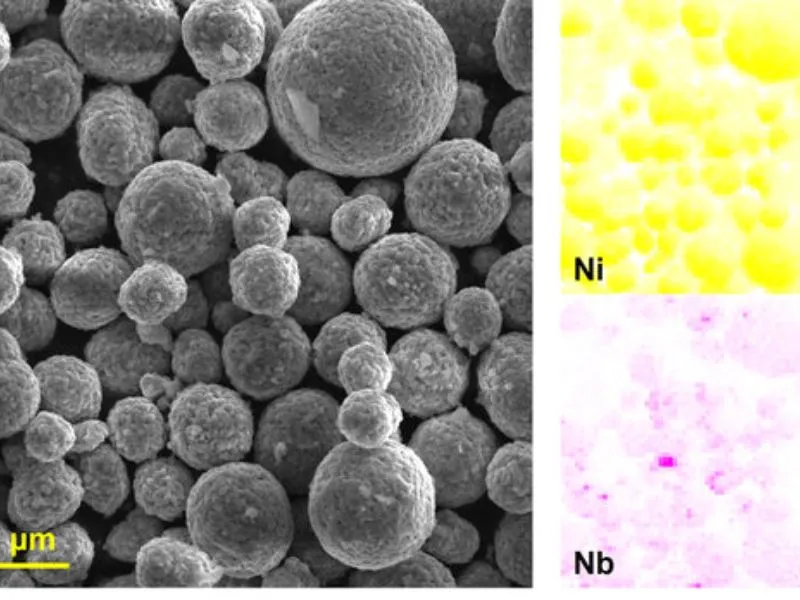
Ampcera offers coated cathode materials designed for advanced battery research. Its portfolio includes lithium niobium oxide and lithium zirconium oxide coated cathode powders. These materials are developed with the goal of improving surface stability and supporting better electrochemical performance.
The concept behind coated cathode active materials for solid-state batteries is relatively straightforward: engineer the surface so that the active cathode can work more effectively with the surrounding solid electrolyte.
Why Lithium Niobium Oxide Coatings Are Interesting
Lithium niobium oxide is one surface coating that has attracted attention in solid-state battery research. A carefully applied coating can act as a protective layer between the cathode and solid electrolyte.
Ampcera's coated cathode portfolio includes lithium niobium oxide coated NMC materials. These products are intended to support research and development where cathode-electrolyte interface behavior is an important consideration.
The coating approach does not replace the underlying cathode chemistry. Instead, it modifies the surface environment while allowing researchers to continue using high-performance active materials.
NMC Materials and Energy Density
NMC cathodes contain nickel, manganese, and cobalt. Different ratios can be used to adjust the balance between energy density, stability, and other performance characteristics.
Higher-nickel compositions can provide attractive capacity, making them relevant to applications where energy density is important. At the same time, high-nickel materials can present challenges related to surface stability, structural changes, and interface reactions.
This makes surface engineering especially relevant when developing cathode active materials for solid-state batteries based on high-energy cathode chemistries.
Researchers may evaluate coated and uncoated materials under controlled conditions to understand differences in capacity retention, impedance, cycling behavior, and interface stability.
Why Particle Characteristics Matter?
Cathode performance is influenced not only by chemical composition but also by physical characteristics. Particle size distribution, morphology, surface area, and consistency can affect electrode processing and electrochemical behavior.
A controlled powder can help researchers create more repeatable composite cathodes. Consistency is particularly valuable when comparing different formulations or studying the impact of a specific coating.
For advanced battery development, material quality should therefore be considered from both a chemical and manufacturing perspective.
Cathode and Solid Electrolyte Compatibility
A solid-state battery contains several interfaces. The cathode must maintain suitable contact with the solid electrolyte so lithium ions can move through the composite structure.
At the same time, unwanted chemical or electrochemical reactions at the interface can affect long-term performance. The choice of cathode, electrolyte, particle size, mixing process, coating, and pressure can all influence the final cell.
This is why selecting cathode active materials for solid-state batteries should not be treated as an isolated purchasing decision. Material compatibility with the intended cell design is equally important.
Ampcera's broader materials portfolio includes sulfide solid electrolytes and other battery development solutions. Having access to complementary materials can make it easier for researchers to evaluate complete material combinations instead of testing individual components separately.
From Powder to Practical Battery Research
Good cathode powder is only one part of battery development. Researchers also need suitable processing methods to convert powders into functional electrodes.
Composite cathodes commonly combine active material, solid electrolyte, and conductive additives. Achieving a uniform mixture can be important because uneven distribution may create regions with poor ionic or electronic transport.
Ampcera also provides dry-processing services that support cathode composite powder mixing and electrode fabrication. Such services can help development teams evaluate materials without building every processing capability internally.
The relationship between material design and manufacturing is particularly important for cathode active materials for solid-state batteries, because laboratory results need to translate into repeatable electrode structures.
Processing Considerations
When evaluating cathode materials, researchers may consider:
- Powder handling requirements
- Mixing uniformity
- Electrode thickness
- Solid electrolyte distribution
- Conductive additive dispersion
- Applied pressure
- Environmental conditions
- Repeatability between batches
Careful control of these factors can make experimental results easier to interpret.
Supporting Next-Generation Battery Development
Solid-state battery research continues to involve many technical challenges. Improvements in one material can sometimes create new requirements elsewhere in the cell. For example, a high-capacity cathode may require better interface protection, while a new solid electrolyte may require adjustments to electrode composition or processing.
This system-level approach is one reason advanced material suppliers are becoming important partners in battery development.
Ampcera works across several areas of solid-state battery materials, including sulfide electrolytes, coated cathodes, processing services, and battery research equipment. Its approach connects material development with practical research needs.
For developers evaluating cathode active materials for solid-state batteries, this broader perspective can be useful when comparing material options and planning experiments.
How Should Developers Evaluate Cathode Materials?
There is no single cathode material that is ideal for every solid-state battery. The best choice depends on the target application, electrolyte chemistry, voltage range, electrode design, manufacturing process, and performance goals.
A practical evaluation can include:
- Check the chemistry: Understand the cathode composition and target voltage.
- Review particle properties: Look at particle size and morphology.
- Study surface treatment: Determine whether a coating is appropriate.
- Test electrolyte compatibility: Evaluate interface behavior with the selected electrolyte.
- Measure electrochemical performance: Compare capacity, efficiency, impedance, and cycling.
- Assess processing: Confirm that the material can be incorporated into the intended electrode process.
- Consider scale-up: Examine whether the material and process can remain consistent as production increases.
This structured approach helps prevent researchers from judging a cathode based on a single performance number.
Frequently Asked Questions
What are cathode active materials for solid-state batteries?
Cathode active materials for solid-state batteries are electrochemically active compounds used in the positive electrode of solid-state cells. They store and release lithium ions during battery operation and must work effectively with the selected solid electrolyte.
Why are cathode coatings useful?
Cathode coatings can provide a protective surface layer and help manage reactions at the cathode-electrolyte interface. Their effectiveness depends on coating chemistry, thickness, uniformity, and compatibility with the complete battery system.
Does a coated cathode automatically improve battery performance?
Not necessarily. A coating can be beneficial when it is properly designed for the cathode and electrolyte combination. Performance still depends on electrode formulation, processing, pressure, cell design, and testing conditions.
Why are NMC cathodes used in advanced battery research?
NMC materials offer a useful combination of energy density and tunable chemistry. Different nickel, manganese, and cobalt ratios allow researchers to study various performance and stability trade-offs.
What should researchers consider when selecting a cathode?
Researchers should look beyond capacity alone. Surface stability, particle characteristics, electrolyte compatibility, processing behavior, cycling performance, and reproducibility are all important factors.
Looking Ahead
The development of solid-state batteries will require continued improvements across every part of the cell. Cathode materials are especially important because they directly influence energy density while also interacting closely with the solid electrolyte.
Future progress will likely depend on better control of particle structures, surface coatings, composite electrode processing, and cathode-electrolyte interfaces. These improvements can help researchers move from promising laboratory materials toward more practical battery systems.
For companies and research teams exploring cathode active materials for solid-state batteries, choosing well-engineered materials is an important step toward reliable experimentation and future scale-up. With its focus on advanced battery materials and related development services, Ampcera provides solutions designed to support researchers working on the next generation of energy storage.
The path toward better solid-state batteries is not based on one breakthrough alone. It comes from improving materials, interfaces, processing, and testing together. As these areas continue to develop, carefully engineered cathode materials will remain a key part of the journey toward safer, higher-energy, and more capable battery technologies.
























Sign in to leave a comment.