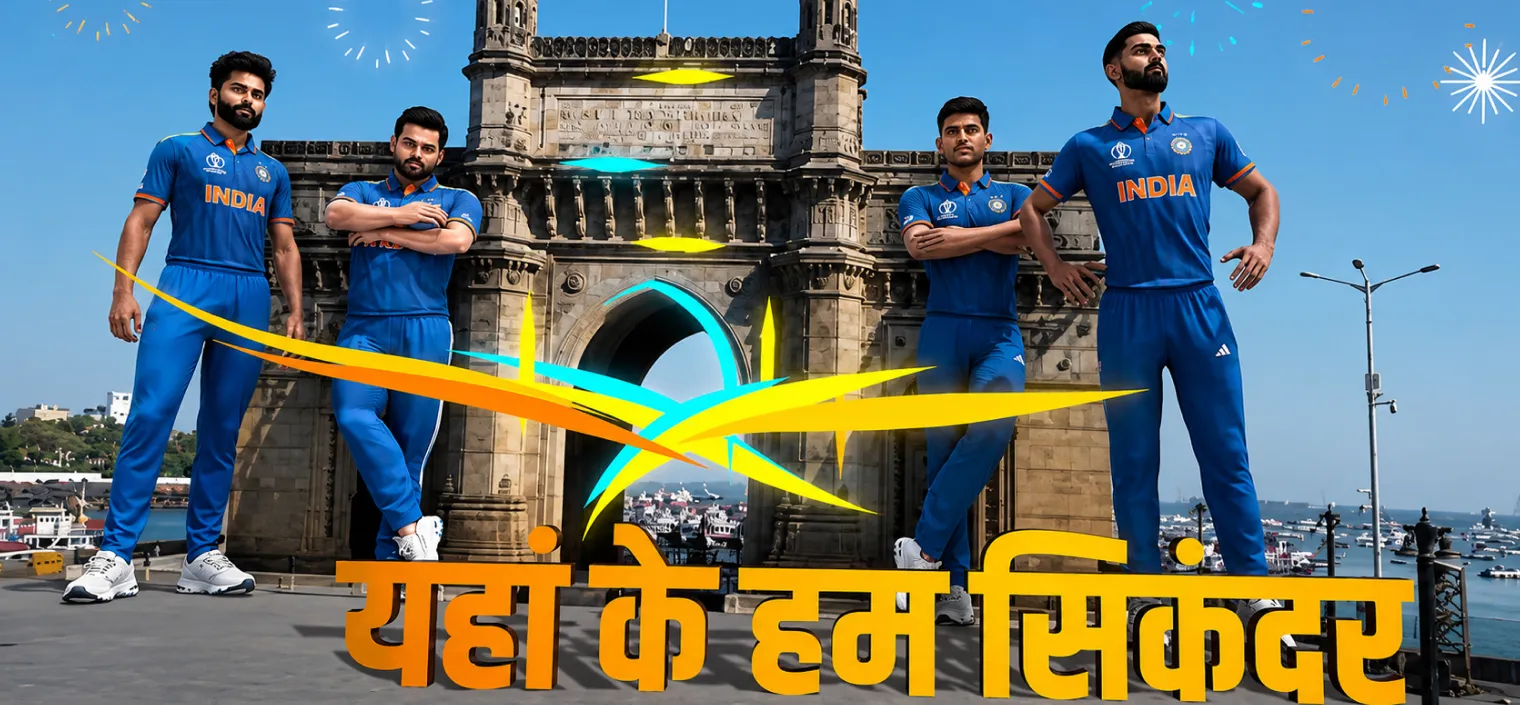

Hold your phone at arm's length. Everything on it, however polished, is a flat rectangle you look through like a window. Now picture that window swinging open and a six-foot cricketer stepping into the room. That shift, from looking at a picture to sharing a space with it, is what anamorphic 3D illusion software for spatial brand experiences makes possible.
Star Sports wanted the same shift for the World Cup. It began by retiring the cardboard cutout.
The market is heading here anyway. The immersive segment of experiential marketing is projected to grow at 28.6% a year from 2024 to 2030.
Flat is a choice
Screens went flat because flat was cheap to make and easy to ship. For a brand, flat also means forgettable. A logo on a rectangle looks like every other logo on a rectangle.
Spatial content changes what the audience is being asked to do. They no longer decode a message. They notice something that seems to be there.
What "spatial" means for a brand
Four qualities do the work:
- Depth. Things sit in front of and behind each other
- Scale. A person or product appears larger than life
- Presence. It seems to occupy the same room as you
- Place. It belongs where you're standing
Get all four and the audience stops treating your content as media and starts treating it as an event.
Case study: Star Sports and the World Cup avatars
For the World Cup, Star Sports wanted to replace flat 2D cutout graphics in its broadcasts with 3D CGI segments featuring real Indian players, with quirky messaging and multilingual delivery. Then the idea left the studio.
- Five players, five cities. Larger-than-life avatars appeared in Mumbai, Lucknow, Ahmedabad, Dharamshala and Bangalore. Each sat at a location tied to a player's home city, such as the Gateway of India and the Narendra Modi Stadium.
- Five languages. The CGI segments were produced in five languages for a country that watches cricket in many tongues.
- Three days for the models. Photogrammetry-driven photoshoots produced detailed 3D models in a three-day window.
- 240 FPS motion capture. Signature moves were recreated at 240 frames per second.
- Built with Starlab. The team fitted the segments into live broadcasts, using object tracking and props to keep movement believable.
Viewers across the country met their favourite players as dynamic 3D figures, and the multilingual layer made it personal.
One point of accuracy: this campaign was 3D CGI and avatar work, not an anamorphic LED installation. We include it because it shows the spatial principle at full stretch.
Anamorphic content creation for many screens: model once, render many
The costly part of spatial work is the 3D asset: the model, the rig, the motion. Once it exists, it can in principle be rendered for different surfaces, such as a broadcast, a curved LED or a corner wall. That's why we treat a 3D library as an asset rather than a one-off. The anamorphic step then bends each render for a fixed viewpoint.
Our anamorphic content services cover the range: anamorphic animation, billboard animation, 3D CGI animation, VFX animation, 3D product animation and video marketing.
3D anamorphic LED screen: what changes at the hardware level
Moving from a broadcast graphic to a physical screen brings new decisions:
- Screen geometry. Flat, curved or corner, each with its own distortion maths
- Pixel pitch. Finer for close viewing, coarser for distance
- Brightness. Outdoor screens must compete with daylight
- Viewing zone. The place the illusion is designed to be seen from
- Sync. Every panel showing the same frame at the same instant
Curved LED screens paired with careful lighting and shadow work are a large part of what makes depth read as real.
Anamorphic stage design: turning a corner into a stage
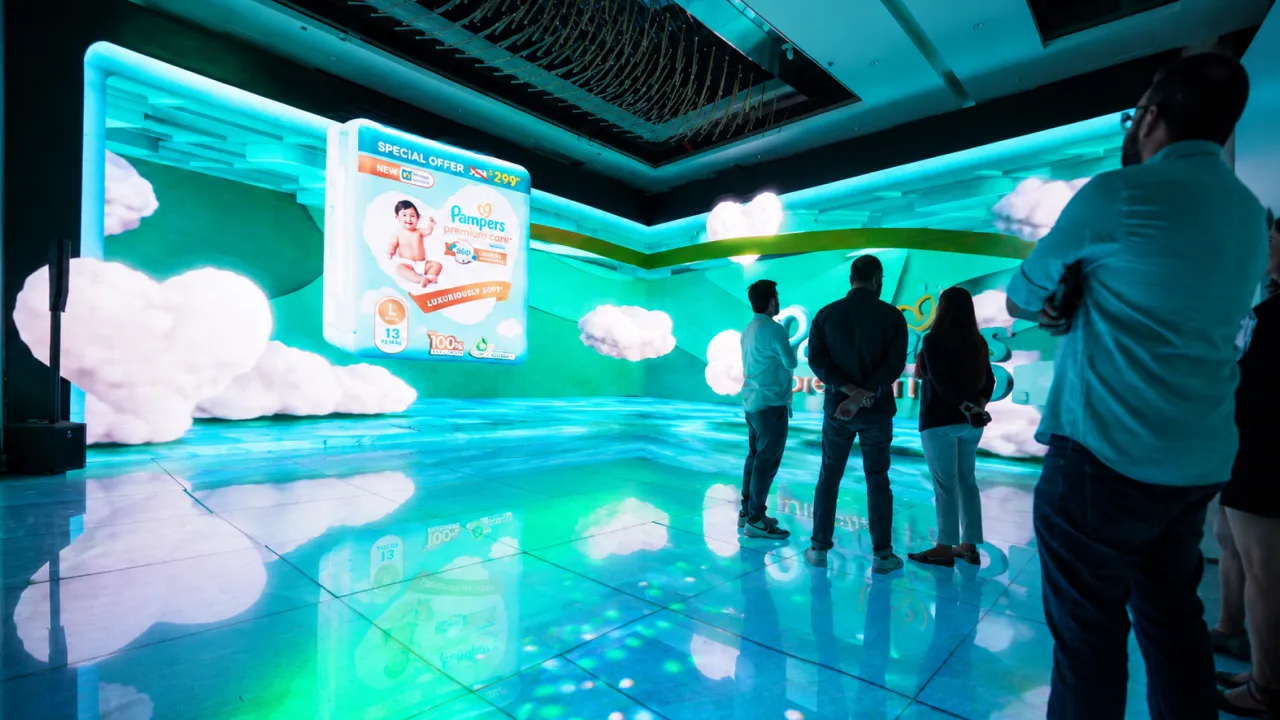
Stage design starts with where the audience stands. A mall atrium, a stadium concourse or a lobby corner can all become sets when the content respects the edges of the screen.
- Choose the spot first and mark it on the floor
- Let the strongest object grow towards that spot
- Keep the surrounding light low enough that the screen wins
High-impact 3D animation for anamorphic billboards: the outdoor test
Outdoors is the hardest room. There's daylight, moving viewers and no control over who stands where. It's also where high-impact 3D animation for anamorphic billboards earns its reputation. If a piece holds up there, it will hold up in most indoor venues.
Looking for examples of experiential marketing that helped B2B brands?
B2B brands often sell things people can't hold: platforms, networks, stacks. Spatial and immersive work makes the abstract tangible. From our portfolio:
- Reliance Jio: its AI stack at the India AI Impact Summit 2026
- JioHotstar: an immersive experience at the same summit
- Star Sports and Airtel: a motion-capture project called "Bridging the Gap"
Tips for brands to create memorable interactive installations
The Star Sports project offers five tips:
- Put it where the story already lives. The Gateway of India needs no explanation.
- Localise it. Five languages meant five audiences felt addressed.
- Make it photographable. A larger-than-life figure is a picture waiting to be taken.
- Build a fast pipeline. Three days for the models left time to refine.
- Keep motion honest. Capturing signature moves at 240 frames per second made the avatars feel like the players.
What do retail brands gain from immersive marketing activation?
Retail gains presence. Our retail thinking maps distorted content onto storefront glass, interior walls and floor space. A brand stops competing for a glance on a shelf and starts occupying part of the store.
The measurable side is straightforward. Retail KPIs for immersive work include interactions, dwell time, product engagement, QR scans, walk-ins, assisted sales and conversion impact. Decide those before you build, and the experience becomes a business tool.
Explore the retail use case and sports and media use case.
FAQs
What is a spatial brand experience?
It's an experience where content has depth, scale and presence in a physical space, so people feel they share the room with it.
Is 3D CGI the same as anamorphic content?
No. 3D CGI builds the model and the motion. Anamorphic content takes 3D work and bends it for a fixed viewpoint on a physical screen so it appears to leave the surface.
Which formats can IIC produce?
Anamorphic animation, billboard animation, 3D CGI, VFX, 3D product animation and video marketing.
Ready to take your brand off the flat screen?
IIC Lab is a Mumbai-based MarTech and immersive technology agency. We design, build and calibrate spatial brand experiences under one roof. Send us your brief, your venue and your favourite impossible idea.
Get in touch

























Sign in to leave a comment.