
If you've ever stood next to a running compressor and felt the floor buzz beneath your boots, you already understand the problem anti vibration rubber mounts are built to solve. Machinery shakes. That shaking travels into frames, floors and everything nearby, wearing down bolts, cracking welds and generally making life noisier than it needs to be. In this guide we'll walk through what these mounts are, how they work, the main types you'll come across, and how to choose and fit them properly.
What Are Anti Vibration Rubber Mounts?
Anti vibration rubber mounts are elastic components, either solid rubber or a bonded rubber-and-metal assembly, that sit between a piece of machinery and whatever supports it. Think of them as a cushion with a job to do. That job is to reduce the transmission of vibration, mechanical shock and structure-borne noise from the equipment into its frame, floor or enclosure.
They're deceptively simple bits of kit. There are no moving parts, no fluids to top up, nothing electronic to fail. But they punch well above their weight. A handful of correctly specified mounts can be the difference between a machine that rattles itself loose over a few months and one that runs quietly for years. Wherever there's rotating or reciprocating equipment, you'll usually find rubber mounts working away quietly underneath.
How Anti Vibration Rubber Mounts Work
The clever bit comes down to rubber's two useful properties: elasticity and damping. When the machine pushes down or shakes, the rubber deforms under load and absorbs the mechanical energy. Its elasticity provides the isolation, essentially decoupling the equipment from its supporting structure so that vibration has a much harder time crossing over.
At the same time, internal damping within the rubber converts a portion of that vibrational energy into heat. Nothing dramatic, you won't feel it, but it's what stops the system bouncing endlessly.
Here's the part people often get wrong: effective isolation depends on the mount's natural frequency sitting well below the equipment's operating frequency. Get that relationship right and the mount does its job beautifully. Get it wrong, and you can actually amplify vibration rather than reduce it. Selection matters as much as the rubber itself.
Common Types: Rubber Buffer and Rubber Bush Explained
There's no one-size-fits-all mount, so it helps to know the main families.
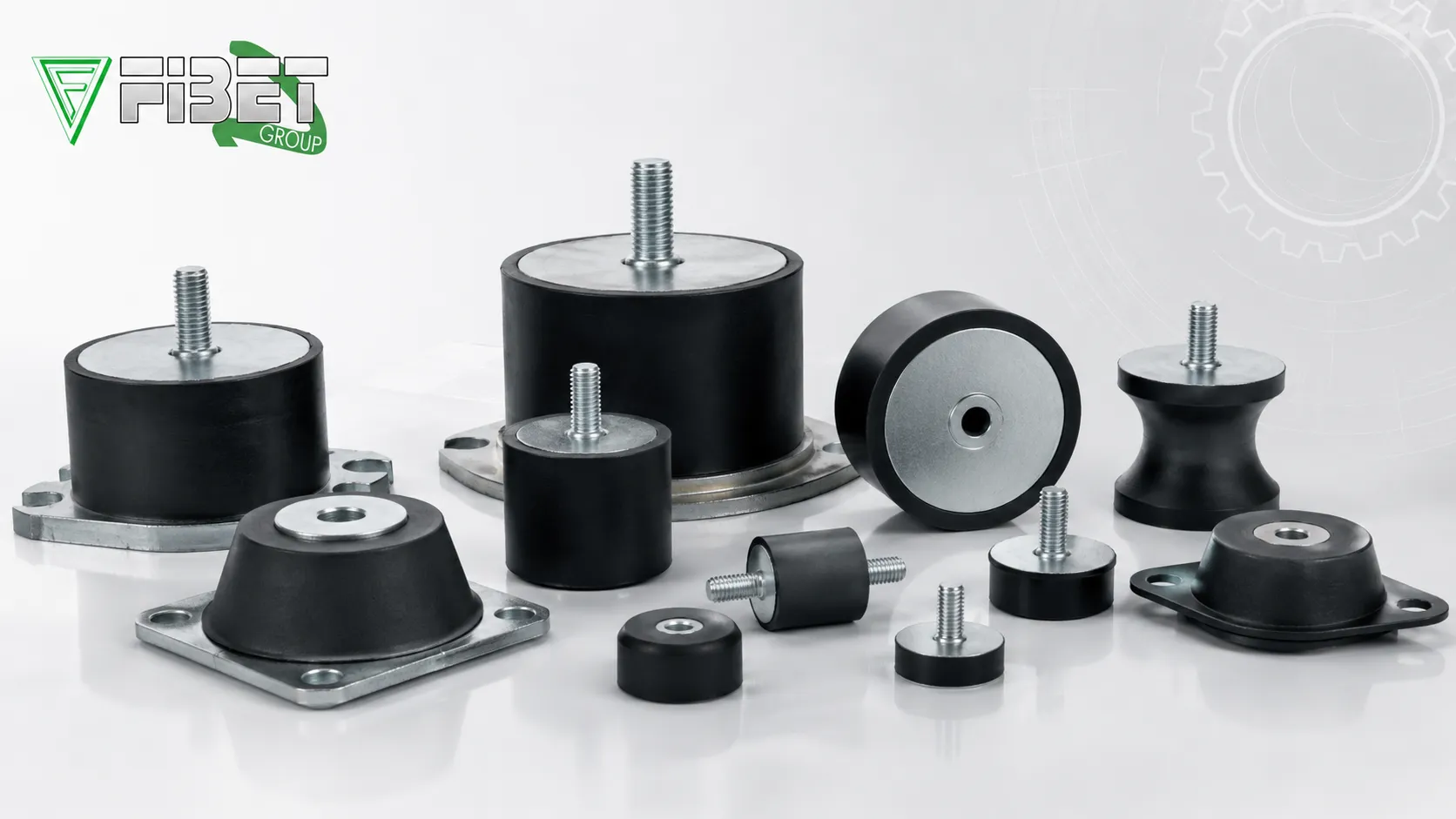
Rubber buffer – These are solid elements, often cylindrical, conical, tapered or parabolic in shape, and they work mainly in compression. A rubber buffer is brilliant at absorbing impact and doubles up as an end stop or bumper. You'll see them on motors, pumps, compressors, automation equipment and transport systems where sudden shock loads need soaking up.
Rubber bush – A rubber bush is usually bonded to an inner and outer metal sleeve, which lets it accommodate radial, axial and shear movement all at once. That versatility explains why the rubber bush is so common in vehicle suspension, engine mounts, pipe supports and machinery brackets.
Two others worth knowing:
- Bobbin (cylindrical) mounts: rubber bonded between threaded metal studs, handling compression and shear.
- Sandwich or pad mounts: rubber bonded between metal plates, generally used for vertical compression loads.
Key Benefits of Using Rubber Mounts
Why bother fitting them at all? Because the payoff is genuinely significant, and it shows up in more places than you might expect.
- Reduced vibration and noise – the headline benefit, and often the reason people go looking in the first place.
- Fewer failures – less vibration means a lower risk of metal fatigue, loosened fasteners and premature component wear.
- Better operator comfort – quieter, smoother-running equipment makes for a nicer place to work.
- Protection for surroundings – floors, frames and adjacent machinery all last longer when they're not being constantly shaken.
- Longer equipment life and lower maintenance costs – arguably the one your finance team will care about most.
Put simply, a modest investment in the right mounts tends to pay for itself several times over across the life of the machine.
Typical Applications Across Industries
The reach of anti vibration rubber mounts is enormous, which is part of why they're such a staple engineering component. You'll find them supporting electric motors, pumps, compressors, fans and generators, basically anything that spins or reciprocates.
HVAC equipment relies on them heavily, as do machine tools where precision would otherwise suffer from stray vibration. Out in the field, agricultural machinery and construction equipment use them to survive rough, punishing duty cycles.
Then there's transport. Vehicles use rubber mounts throughout their suspension and engine bays, and marine engines depend on them to keep vibration out of the hull. Add general industrial plant to the list and it's clear these components turn up almost everywhere heavy or continuous machinery is used. If something runs and something else needs protecting from it, there's a mount for the job.
How to Choose the Right Anti Vibration Mount
This is where we earn our keep, because choosing well is more than picking a size that fits the hole. A few factors deserve real attention:
- Load – total equipment weight, the load per mount, and how many mounts you're using and where you position them.
- Direction of forces – vertical, lateral, axial and shear loads all behave differently.
- Frequency – operating speed and vibration frequency, which drive the required static deflection and isolation level.
- Rubber specification – hardness and compound to suit the duty.
- Environment – temperature, plus exposure to oil, chemicals, weather and ozone, all of which age rubber differently.
- Fit and hardware – available space, mounting pattern, thread size and fasteners.
- Shock and balance – any shock loads, and where the equipment's centre of gravity sits.
Get these right and the mount will perform. Guess, and you may end up replacing it far sooner than planned.
Installation and Maintenance Best Practices
Even the perfect mount underperforms if it's fitted badly. Start with clean, level surfaces and correctly aligned mounting holes. Tighten fasteners to the manufacturer's specified torque, no more, no less, and take care not to pre-compress or distort the rubber, since that ruins its isolation characteristics. Spread the load evenly across the mounts and keep them away from sharp edges, excessive heat, oils and incompatible chemicals.
Maintenance is refreshingly light-touch. Inspect periodically for cracking, hardening, tearing, deformation, corrosion, loose fasteners and any loss of clearance. When a mount is damaged or permanently compressed, replace it, and where the design calls for it, replace in matched sets so the load stays balanced. Stick to the manufacturer's inspection intervals and torque specs.
Do that, and your rubber mounts will quietly keep noise and vibration in check for years, protecting both your machinery and the people working around it.
Frequently Asked Questions About Anti-Vibration Rubber Mounts
What exactly are anti-vibration rubber mounts and how do they work?
Anti-vibration rubber mounts are elastic rubber or bonded rubber-metal components placed between machinery and its supporting structure. They absorb mechanical energy through elasticity and damping, with internal damping converting vibrational energy into heat, effectively decoupling the equipment to reduce vibration transmission.
What's the difference between a rubber buffer and a rubber bush?
A rubber buffer is a solid element working mainly in compression, absorbing impact and acting as an end stop for motors and compressors. A rubber bush is bonded to inner and outer metal sleeves, accommodating radial, axial and shear movement simultaneously, making it ideal for suspension and engine mounts.
How do I choose the right anti-vibration rubber mount for my equipment?
Consider the total load, direction of forces (vertical, lateral, axial, shear), operating frequency, rubber hardness, environmental exposure (temperature, oil, chemicals), available space, and shock loads. The mount's natural frequency must sit well below the equipment's operating frequency for effective isolation.
Can anti-vibration rubber mounts reduce noise from industrial equipment?
Yes, noise reduction is a primary benefit. By absorbing vibration and shock, these mounts significantly diminish structure-borne noise transmission to floors and adjacent structures, creating a quieter, more comfortable working environment whilst protecting surrounding machinery.
What maintenance do rubber mounts require?
Inspect periodically for cracking, hardening, tearing, deformation and loose fasteners. Tighten fasteners to manufacturer specifications without over-compressing the rubber. Replace damaged or permanently compressed mounts in matched sets to maintain balanced load distribution and optimal isolation performance.
What happens if you choose a mount with the wrong natural frequency?
Selecting a mount whose natural frequency isn't sufficiently below the equipment's operating frequency can actually amplify vibration rather than reduce it. This is why proper specification based on operating speed and frequency is critical—selection matters as much as the rubber material itself.
























Sign in to leave a comment.