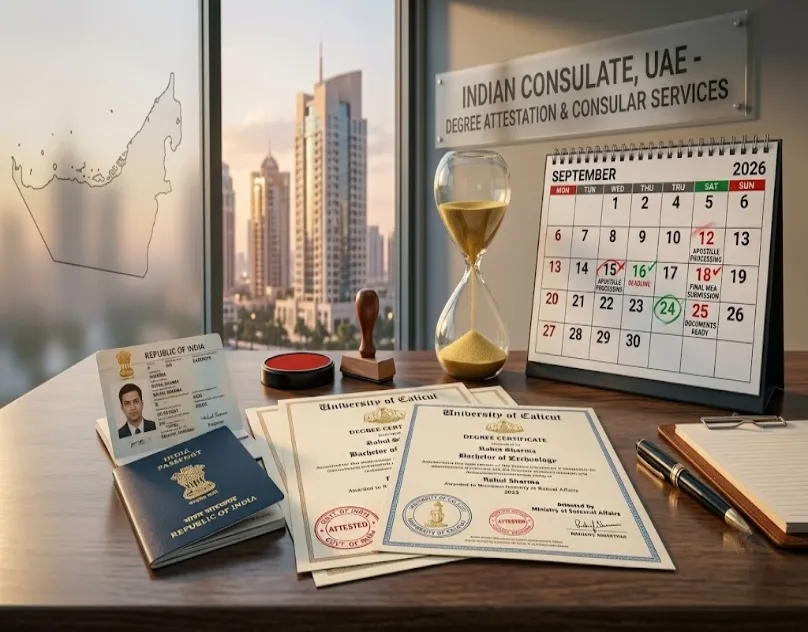

Moving to a foreign country for higher education, job opportunities, or family relocation involves significant paperwork. If your destination country is a member of the 1961 Hague Apostille Convention, your Indian certificates must undergo an official authentication process known as Apostille.
Understanding the complete apostille process is key to ensuring your legal papers are accepted internationally without hassle.
What is an Apostille?
An Apostille is a standardized, square-shaped sticker affixed to the back of an original Indian document by the Ministry of External Affairs (MEA), Government of India. It features a unique serial number, issuing date, official seal, and verification QR code.
Once an Indian document receives an MEA Apostille, it is recognized as legally valid across all 120+ member nations of the Hague Convention (such as the USA, UK, Germany, France, Australia, and Japan) without requiring separate embassy authentication.
Key Document Types That Require Apostille
- Educational Documents: Degree certificates, diploma certificates, transcripts, and mark sheets.
- Personal Documents: Birth certificates, marriage certificates, police clearance certificates (PCC), single status affidavits, and death certificates.
- Commercial Documents: Power of attorney, board resolutions, articles of association, and commercial invoices.
Step-by-Step Apostille Workflow in India
Step 1: Notary Attestation
The original document is first authenticated by a registered Notary Public in the issuing city or state.
Step 2: State-Level Authentication / SDM
- Educational papers: Require validation from the State Human Resource Development (HRD) or Higher Education Department.
- Personal papers: Require verification from the State Home Department or the Sub-Divisional Magistrate (SDM).
- Commercial papers: Validated by the local Chamber of Commerce.
Step 3: MEA Apostille Legalisation
After state-level verification, the document is submitted to the Ministry of External Affairs (MEA) in New Delhi, where the official computer-generated Apostille sticker is applied.
Crucial Tips for a Smooth Apostille
- Check Passport Details: Ensure your name and parents' names on the certificate match your active passport.
- Avoid Damaged Documents: Heavily laminated or torn documents should be de-laminated carefully before submission.
- Verify Hague Membership: Always check if your target destination is a Hague Convention member before choosing Apostille over Embassy legalisation.
























Sign in to leave a comment.