


AQA GCSE physics paper 1 topics are an essential part of your GCSE Physics preparation, covering Energy, Electricity, Particle Model of Matter and Atomic Structure. Knowing exactly what you need to study can make revision more focused and help you spend more time practising the areas where you lose marks. This guide explains the key content, important calculations, practical skills and effective revision techniques you can use before your exam.
For students preparing for GCSE Physics in the UK, including learners around Great Portland Street, London, a structured revision plan can make studying more manageable. Whether you are revising independently or looking for online GCSE tuition, understanding the specification is the best place to start.
What is covered in AQA GCSE Physics Paper 1?
AQA GCSE Physics Paper 1 assesses Topics 1 to 4 of the specification:
- Energy
- Electricity
- Particle Model of Matter
- Atomic Structure
The examination lasts 1 hour and 45 minutes and is worth 100 marks, representing 50% of the GCSE. Students can be entered for either Foundation or Higher Tier. The paper includes multiple choice, structured, closed short answer and open response questions.
Paper 1 is not simply a test of memorised definitions. Questions can require calculations, explanations, interpretation of information and application of scientific ideas to unfamiliar situations.
AQA physics paper 1 topic list
Use the following as a starting checklist when planning your revision.
Energy
Energy is the first major area of the specification. Important concepts include:
- Energy stores and energy transfers
- Conservation of energy
- Kinetic energy
- Gravitational potential energy
- Elastic potential energy
- Work done
- Power
- Efficiency
- Energy resources
- Energy calculations
You should understand how energy is transferred between different stores and why some energy becomes less useful.
For example, when an object falls, its gravitational potential energy decreases while its kinetic energy increases. Some energy may also be transferred to the surroundings through heating and sound.
Electricity
Electricity is another important section and requires both conceptual understanding and mathematical skills.
Key areas include:
- Current
- Potential difference
- Resistance
- Series circuits
- Parallel circuits
- Circuit diagrams
- Electrical power
- Electrical energy
- Domestic electricity
- The National Grid
Make sure you understand how current, potential difference and resistance are related.
You should also practise interpreting circuit diagrams and selecting the correct equation for different situations.
Particle Model of Matter
The Particle Model of Matter explains how substances behave as solids, liquids and gases.
Important areas include:
- Density
- States of matter
- Changes of state
- Internal energy
- Specific heat capacity
- Specific latent heat
- Particle motion
- Gas pressure
AQA expects students to use the particle model to explain physical behaviour. For example, heating a system increases the energy stored by its particles. Depending on the situation, this can increase temperature or cause a change of state.
Students should also be prepared for calculations involving density, thermal energy and changes of state.
Atomic Structure
Atomic Structure introduces the structure of atoms, isotopes and radioactive processes.
You should revise:
- Protons, neutrons and electrons
- Atomic number
- Mass number
- Isotopes
- Development of the atomic model
- Alpha radiation
- Beta radiation
- Gamma radiation
- Nuclear equations
- Half life
- Background radiation
- Uses of radiation
- Risks of ionising radiation
AQA also expects students to understand how scientific evidence contributed to changes in models of the atom, including the development of the nuclear and Bohr models.
AQA GCSE physics paper 1 topics explained
Knowing the four topic names is useful, but effective revision requires you to understand the concepts within each section.
Which Energy topics should you prioritise?
Start with energy stores and transfers before moving on to calculations.
Make sure you can use and understand equations involving:
- Kinetic energy
- Gravitational potential energy
- Elastic potential energy
- Power
- Efficiency
- Work done
Do not treat equations as isolated formulas. Understand what each quantity represents and when the equation should be used.
A useful revision technique is to explain the energy transfer in words before completing the calculation.
What should you revise in Electricity?
Begin with the basic relationship between current, potential difference and resistance.
Then practise:
- Series and parallel circuits
- Resistance calculations
- Power calculations
- Energy transferred
- Domestic electrical safety
- Circuit symbols and diagrams
Try answering calculation questions without immediately looking at your notes. If you make a mistake, identify whether the problem was choosing the equation, rearranging it, substituting values or using the wrong unit.
How should you revise Particle Model of Matter?
Start with the arrangement and movement of particles in solids, liquids and gases.
Then revise density, internal energy, specific heat capacity and specific latent heat.
You should also understand heating and cooling graphs and be able to explain what happens to particle energy during changes of state. AQA includes practical opportunities involving topics such as specific heat capacity and latent heat.
What should you know about Atomic Structure?
Atomic Structure combines factual knowledge with scientific reasoning.
Make sure you can explain the difference between alpha, beta and gamma radiation and understand their relative properties.
You should also know how to work with half life and interpret radioactive decay information.
Rather than memorising separate facts, practise comparing radiation types in a table. Include penetration, ionisation, range and typical uses.
How to prepare for Paper 1 calculations
Mathematical skills are an important part of GCSE Physics assessment. AQA states that students are required to demonstrate mathematics skills in their Physics assessments.
Use a clear calculation method
For calculation questions, follow a consistent process:
- Identify the quantity you need
- Write the relevant equation
- Substitute the values
- Calculate the answer
- Include the correct unit
- Check whether the answer is reasonable
For example, when calculating kinetic energy, make sure the mass is in kilograms and understand that speed is squared in the equation.
Practise rearranging equations
Some questions provide all the information except the quantity you need.
Practise rearranging equations before the exam so that you can work confidently with unfamiliar question formats.
Remember that the Physics equation sheet provides equations during the exam, but you still need to understand which equation is appropriate and how to use it.
Practical skills you should revise
Practical knowledge should not be left until the final few days.
AQA describes practical work as being central to its GCSE Physics specification.
What should you know about practical work?
For relevant experiments, revise:
- The aim
- Equipment
- Independent variable
- Dependent variable
- Control variables
- Method
- Measurements
- Safety
- Results
- Graphs
- Sources of error
- Improvements
You may be given an unfamiliar experiment and asked to identify variables, explain a method or suggest an improvement.
The best preparation is therefore to understand why each stage of an experiment is necessary rather than memorising a fixed procedure.
GCSE Physics Paper 1 revision strategies
Good revision is not about reading the same notes repeatedly. You need to retrieve information, apply it and learn from your mistakes.
Use active recall
Close your textbook and explain a concept from memory.
For example, explain the difference between current and potential difference without looking at your notes. Then check your explanation against the specification.
This approach can quickly reveal gaps in your knowledge.
Practise topic questions
Once you have revised a concept, complete questions specifically focused on that area.
Pay attention to command words such as:
- Calculate
- Describe
- Explain
- Compare
- Determine
- Evaluate
The command word tells you what the examiner expects from your answer.
Move from topic practice to mixed practice
Once you are comfortable with individual topics, start mixing questions from Energy, Electricity, Particle Model of Matter and Atomic Structure.
This is important because an actual exam will not always tell you which topic or equation you need to use.
Online learning for GCSE Physics revision
Independent study is valuable, but some students benefit from structured lessons, instant feedback and direct teacher support.
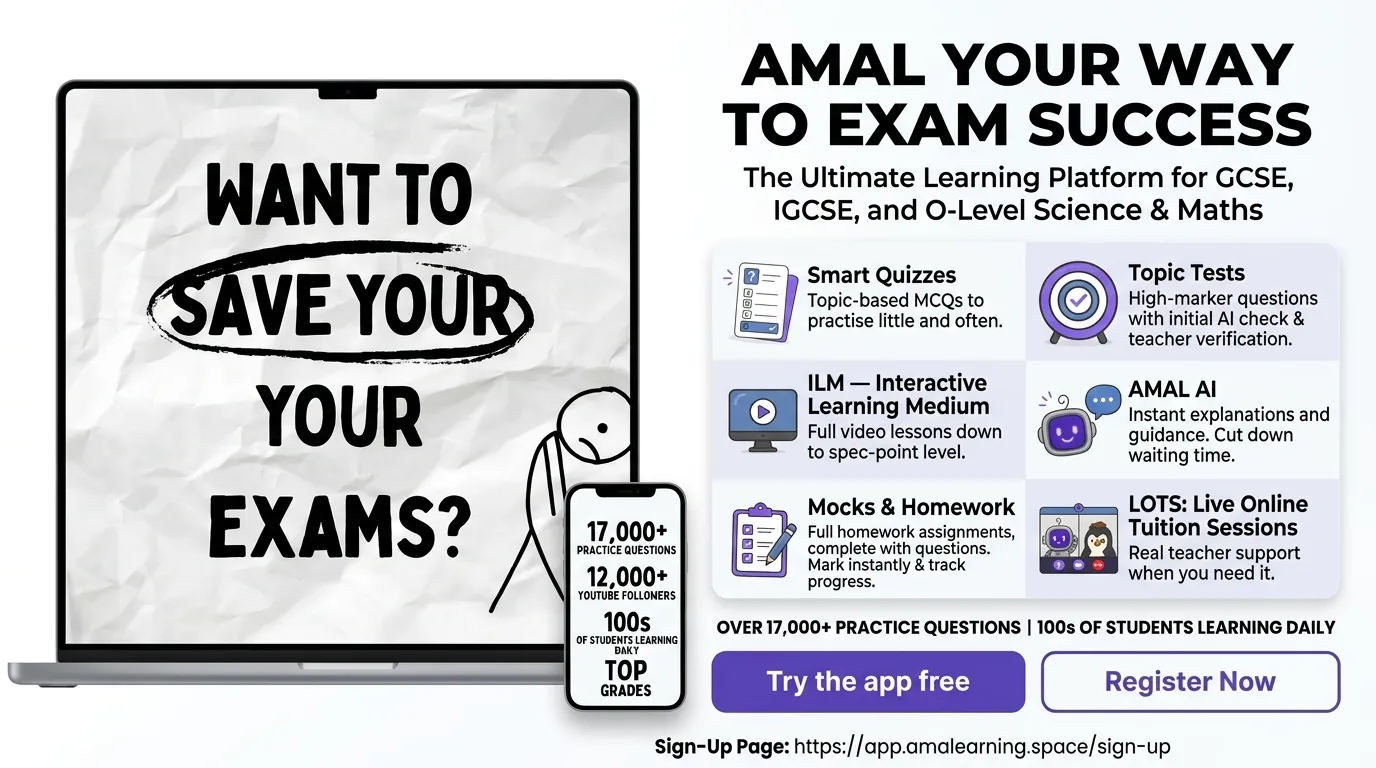
AMALearning provides online classes through the AMAL app for AQA and Edexcel students studying Physics, Chemistry, Maths and Biology at GCSE, IGCSE and O Level.
The platform brings lessons, practice, assessment and teacher support together in one learning environment.
Smart Quizzes and Topic Tests
Smart Quizzes use random and topic based MCQs to help students practise little and often.
Topic Tests include higher marker questions that are initially checked by AI and can also be verified by teachers. This gives students an opportunity to identify weaknesses and understand where additional practice is needed.
ILM and Wall of Knowledge
The Interactive Learning Medium provides video lessons covering almost every topic down to specification point level.
The Wall of Knowledge provides reports showing what students understand well, what needs attention and what is improving.
This can help learners focus their revision instead of spending equal time on every topic.
AMAL AI and Mocks
AMAL AI provides instant explanations and guidance when students need help understanding a question.
Mocks provide full exam papers designed to mirror real examinations. Results can be marked and tracked through the app, giving students a clearer picture of their progress.
Homework and LOTS
Homework can be set and completed through the platform, with instant marking helping students receive feedback quickly.
For students who need additional teacher support, LOTS provides Live Online Tuition Sessions.
AMALearning works with UK licensed teachers who have 15 or more years of teaching experience.
How to build a Paper 1 revision timetable
A good revision plan should gradually move from learning to application and then timed exam practice.
Two weeks before the exam
Review all four areas and identify your weakest concepts.
Use short quizzes to test recall and topic questions to check whether you can apply what you have learned.
One week before the exam
Start completing mixed questions under timed conditions.
Include calculations, practical questions, multiple choice questions and longer explanation questions.
Review every incorrect answer and record the reason for the mistake.
The final few days
Focus on areas where you continue to lose marks.
Review important equations, units, practical methods, radiation properties and difficult concepts.
Avoid spending your final revision sessions simply rereading the entire textbook.
Students around Great Portland Street, London can also use online learning from home, making it easier to fit revision around school and other commitments.
Common Paper 1 mistakes to avoid
Many students lose marks because of simple errors that can be reduced through regular practice.
Watch out for:
- Forgetting units
- Choosing the wrong equation
- Not showing working
- Misreading graphs
- Confusing current and potential difference
- Mixing up radiation properties
- Giving incomplete explanations
- Ignoring command words
- Memorising definitions without understanding them
After completing a practice paper, do not only check your score. Analyse every lost mark and identify what caused the mistake.
Frequently Asked Questions
What topics are in AQA GCSE Physics Paper 1?
Paper 1 covers Energy, Electricity, Particle Model of Matter and Atomic Structure. It also assesses mathematical skills, practical understanding and the application of scientific knowledge.
How many marks is AQA Physics Paper 1?
The paper is worth 100 marks and lasts 1 hour and 45 minutes. It accounts for 50% of the GCSE Physics assessment.
Is Electricity difficult in GCSE Physics?
Electricity can be challenging because students need to combine circuit knowledge with mathematical calculations. Regular practice with circuit diagrams, equations and exam questions can make the topic easier to understand.
How can I revise GCSE Physics Paper 1 effectively?
Start with the four specification areas, identify your weakest concepts and use active recall, topic questions and timed practice. Gradually move towards mixed questions and full mock papers.
Does AQA Physics Paper 1 include practical questions?
Practical knowledge and scientific skills form an important part of the AQA GCSE Physics specification. Students can be assessed on areas such as variables, methods, measurements, results, graphs, errors and improvements.
Conclusion
Understanding AQA GCSE physics paper 1 topics gives you a clear foundation for effective GCSE Physics revision. Energy, Electricity, Particle Model of Matter and Atomic Structure all require a combination of scientific knowledge, calculations, practical understanding and exam technique.
If you are searching for what's on AQA physics paper 1, start by using the four areas as your revision checklist. Then move from learning individual concepts to practising mixed exam questions, reviewing mistakes and completing timed mock papers.
For students studying AQA or Edexcel Physics, Chemistry, Maths or Biology at GCSE, IGCSE or O Level, AMALearning provides online classes through the AMAL app. With Smart Quizzes, Topic Tests, ILM video lessons, Wall of Knowledge reports, AMAL AI, Mocks, Homework and Live Online Tuition Sessions, students can build a structured revision routine with support from UK licensed teachers with 15 or more years of experience.






















Sign in to leave a comment.