

AQA GCSE Physics Paper 2 topics cover the second half of the specification, and knowing exactly where the paper starts and stops is one of the easiest ways to stop wasting revision time on content that will never appear.
Plenty of students walk into Paper 2 having revised Energy and Electricity again, because those are the topics they know best. Those sit on Paper 1. This guide sets out what's on AQA physics paper 2, how the paper is structured, which required practicals can appear, and how to build a revision plan that targets the right four topics.
Always confirm details against the current specification on the AQA website, since content and exam arrangements are reviewed from time to time.
What's on AQA Physics Paper 2?
Quick answer: AQA GCSE Physics Paper 2 covers Topic 5 Forces, Topic 6 Waves, Topic 7 Magnetism and Electromagnetism, and Topic 8 Space Physics. Paper 1 covers Energy, Electricity, Particle Model of Matter and Atomic Structure. The two papers do not overlap.
Paper 2 at a Glance
- Specification: AQA GCSE Physics 8463
- Length: 1 hour 45 minutes
- Marks: 100
- Weighting: 50 percent of the GCSE
- Tiers: Foundation and Higher
- Calculator: allowed
- Question types: multiple choice, structured, closed short answer and open response
Triple Physics and Combined Science Are Not the Same Paper
If you sit Combined Science Trilogy, your Physics Paper 2 is shorter, worth 70 marks, and covers Forces, Waves, and Magnetism and Electromagnetism only. Space Physics is not on the Combined Science course at all.
Separate Physics students sit all four topics, including the physics only content that Combined Science students skip. Getting this wrong is one of the most common revision mistakes we see, because a student follows a topic list built for the wrong course.
The Full AQA GCSE Physics Paper 2 Topics List
Here is the AQA physics paper 2 topic list broken down topic by topic. Content marked physics only appears for Separate Physics students, not Combined Science.
Topic 5: Forces
The largest topic on the paper, and usually the one that carries the most calculation marks.
- Scalars and vectors, contact and non contact forces, gravity, weight and mass
- Resultant forces, free body diagrams and resolving forces (Higher Tier)
- Work done, energy transfer and forces and elasticity, including Hooke's law and spring constant
- Moments, levers and gears (physics only)
- Pressure in fluids, upthrust, floating and atmospheric pressure (largely physics only)
- Distance, displacement, speed and velocity, plus distance time and velocity time graphs
- Acceleration, free fall and terminal velocity
- Newton's first, second and third laws, inertia and inertial mass
- Stopping distance, thinking distance, braking distance and the factors affecting each
- Momentum, conservation of momentum and changes in momentum (Higher Tier)
Topic 6: Waves
- Transverse and longitudinal waves, amplitude, wavelength, frequency, period and wave speed
- Reflection and refraction, and what happens at a boundary between materials
- Sound waves, the ear, ultrasound, echo sounding and seismic waves (physics only)
- The electromagnetic spectrum, and the properties, uses and hazards of each region
- How radio waves are produced and received
- Refraction and wave front diagrams (Higher Tier, physics only)
- Black body radiation and the temperature of the Earth (physics only)
- Lenses, convex and concave, ray diagrams and magnification (physics only)
- Visible light, colour, filters, and transparent, translucent and opaque objects (physics only)
Topic 7: Magnetism and Electromagnetism
- Permanent and induced magnets, magnetic fields, plotting compasses and the Earth's magnetic field
- The magnetic field around a current carrying wire and around a solenoid
- The motor effect, Fleming's left hand rule and the equation for force on a conductor
- Electric motors and loudspeakers (physics only)
- The generator effect, alternators, dynamos and microphones (physics only)
- Transformers and their role in the National Grid (physics only)
Topic 8: Space Physics
Physics only, and worth revising properly because it is often left until last.
- The solar system, and the shift from geocentric to heliocentric models
- The life cycle of a star, from nebula and main sequence through to white dwarf, supernova, neutron star and black hole
- Orbital motion, satellites, and how orbital speed changes with radius
- Red shift, the expanding universe, evidence for the Big Bang, and dark mass and dark energy
Required Practicals That Can Appear on Paper 2
Examiners test practical skills in written questions, so revise the method, the variables and the sources of error, not just the result.
- Force and extension, investigating Hooke's law with a spring
- Acceleration, investigating the effect of varying force and mass
- Waves, measuring wavelength, frequency and speed in a ripple tank and in a solid
- Infrared radiation, using a Leslie cube (physics only)
- Light, investigating reflection and refraction with a ray box (physics only)
GCSE Physics Paper 2 Revision: Where Marks Are Usually Lost
Paper 2 is not conceptually harder than Paper 1, but it punishes sloppy technique more heavily.
- Graph work: gradients on distance time and velocity time graphs, and area under a velocity time graph
- Unit conversions, especially centimetres to metres, grams to kilograms and kilometres per hour to metres per second
- Newton's third law, where answers name a single force instead of an equal and opposite pair
- Six mark extended response questions, which need a plan rather than a paragraph of everything you remember
- Momentum calculations, where direction is ignored on Higher Tier questions
- Required practical questions, where the method is described but the control variables are missing
How to Revise the AQA GCSE Physics Paper 2 Topics Efficiently
- Print the specification for Topics 5 to 8 and rate every point good, okay or weak.
- Learn the equations first, since almost every Forces question depends on one.
- Work through weak topics with active recall, not by re reading notes.
- Move to timed past paper questions by topic, marked against the official mark scheme.
- Sit a full past paper under exam conditions at least two weeks before the exam.
- Rework every question you dropped marks on after revising the topic behind it.
A Note on Equations
Some equations must be recalled from memory and others are provided in the exam. The arrangements around equation sheets have changed more than once in recent years, so check what AQA currently provides before you decide what to memorise. Either way, knowing how to rearrange an equation matters more than knowing the sheet exists.
Getting Structured Support for Paper 2
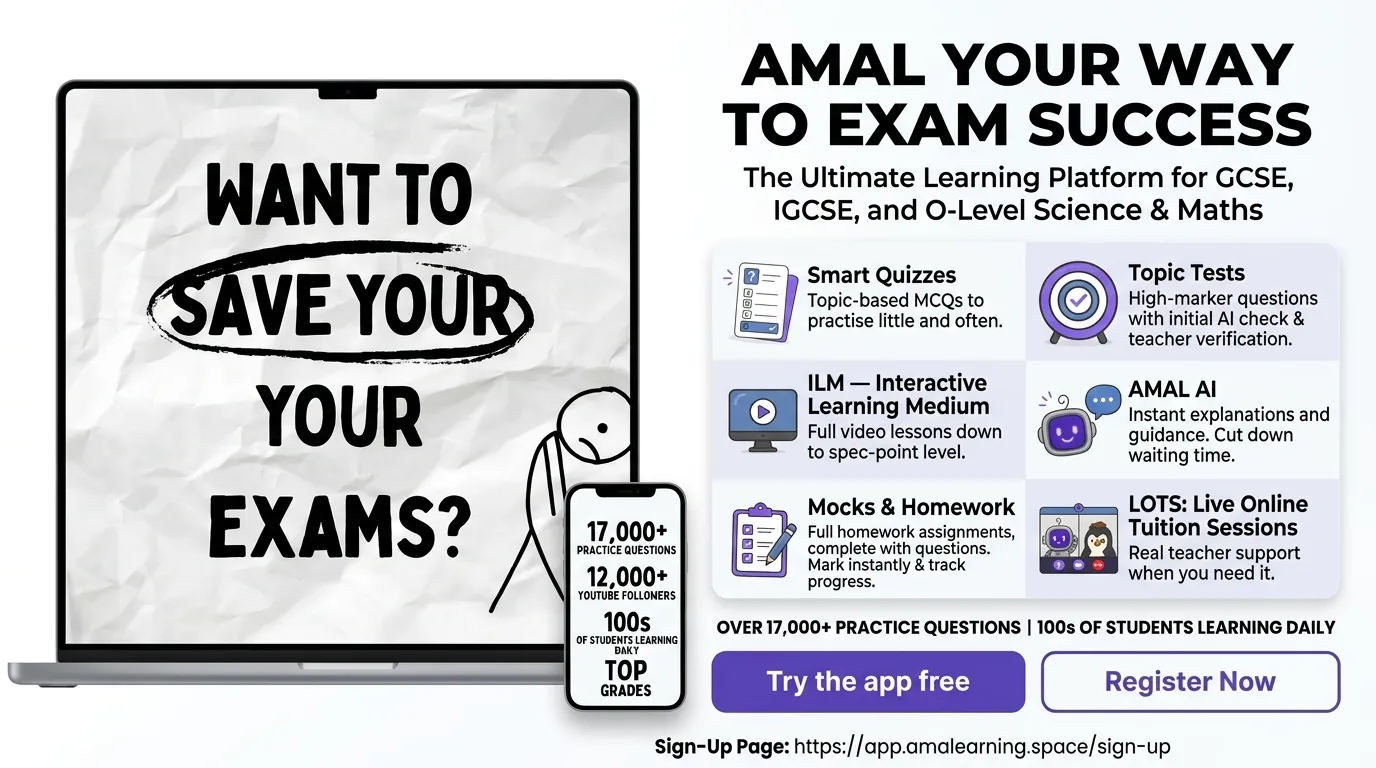
AMALearning is based at Great Portland Street, London, and every lesson is delivered online through the AMALearning app. There are no physical classrooms, so a student in central London and a student sitting the same AQA paper from abroad get identical teaching, marking and teacher access.
Who Teaches the Courses
Every subject is taught by UK teachers with 15 or more years of classroom experience, including Cambridge University licensed teachers. We cover Chemistry, Physics, Biology and Maths for AQA and Edexcel at GCSE, IGCSE and O Level.
Features Students Use for Paper 2 Preparation
- Smart Quizzes: random and topic based MCQs so you practise little and often
- Topic Tests: high mark questions checked first by AI and verified by teachers
- ILM (Interactive Learning Medium): video lessons covering almost every topic down to specification point level
- Wall of Knowledge: WOK reports showing what is strong, weak and improving at a glance
- AMAL AI: instant explanations so you are never stuck waiting on a Forces calculation
- Mocks: full mock papers that mirror the real exams, marked and tracked in the app
- Homework: set and completed in app with instant marking, so feedback never waits
- LOTS (Live Online Tuition Sessions): real teacher support when self study is not enough
Because the video lessons run down to specification point level, you can revise a single awkward idea such as terminal velocity or the generator effect without rewatching an entire topic.
Frequently Asked Questions
What topics are on AQA GCSE Physics Paper 2?
Forces, Waves, Magnetism and Electromagnetism, and Space Physics. Combined Science students cover the first three only.
Is Space Physics on Paper 2?
Yes, for Separate Physics students. It is Topic 8 and sits on Paper 2. Combined Science Trilogy does not include Space Physics.
How long is AQA GCSE Physics Paper 2?
One hour 45 minutes for 100 marks in Separate Physics, worth 50 percent of the grade. Combined Science Physics Paper 2 is one hour 15 minutes for 70 marks.
Are equations given in the exam?
Some are provided and some must be recalled. The rules have changed in recent years, so check the current position on the AQA website before finalising what you learn by heart.
What is the difference between Physics Paper 1 and Paper 2?
Paper 1 covers Energy, Electricity, Particle Model of Matter and Atomic Structure. Paper 2 covers Topics 5 to 8. The papers do not share content, so revising Paper 1 material will not help you on Paper 2.
Conclusion
Once you know the AQA GCSE Physics Paper 2 topics properly, revision becomes a much smaller job. You are working on four topics, not eight, and the marks concentrate in predictable places: Forces calculations, graph interpretation, the electromagnetic spectrum, and the required practicals. Rate each specification point honestly, learn the equations early, then spend the bulk of your time on timed questions rather than reading.
If you want your GCSE physics paper 2 revision structured, marked and tracked for you, AMALearning does exactly that online, with experienced UK teachers and board specific resources.
You can sign up to the AMALearning app for free and start with the Physics quizzes, topic tests and full mock papers today.























Sign in to leave a comment.