
Strategic Trends and Commercial Opportunities in the ASA Copolymers Market
ASA copolymers have long occupied a specialized but critical niche in the thermoplastics landscape, prized for their exceptional weather resistance, UV stability, and aesthetic versatility. As global industrial demand shifts toward durability, sustainability, and design flexibility, the market for acrylonitrile-styrene-acrylate copolymers is entering a phase of accelerated commercial realignment. The sector’s growth trajectory reflects broader macroeconomic dynamics, but more importantly, it reveals how material science, regulatory pressure, and supply chain restructuring are converging to reshape competitive positions and open new commercial pathways.
Market Landscape and Structural Crossroads
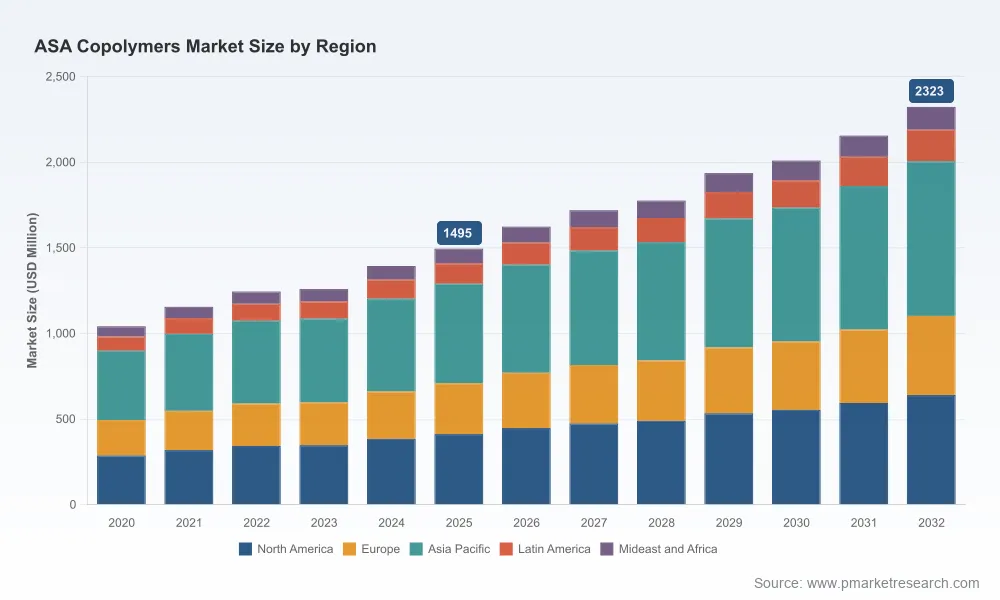
The global ASA copolymers market has demonstrated sustained expansion over the past half-decade, driven by steady adoption in exterior-grade applications and infrastructure-adjacent manufacturing. Revenue levels have climbed consistently, with the market crossing the $1.4 billion threshold in 2025 and extending toward the low $2 billion range by the end of the forecast window. Compound annual growth across the projection period sits in the high single digits, signaling that demand is not merely recovering from cyclical dips but is being structurally reinforced by application migration and performance substitution.
Despite the upward trajectory, the market faces a narrowing window of operational stability. Three intersecting challenges are forcing manufacturers, formulators, and downstream users to recalibrate their strategies.
First, raw material volatility is compressing margin predictability. The acrylonitrile and styrene monomer ecosystem has become more susceptible to regional supply interruptions, freight bottlenecks, and feedstock pricing swings. When input costs move sharply within a single quarter, ASA producers must choose between absorbing the impact, passing it downstream, or reconfiguring grade formulations to preserve competitiveness. None of these options are frictionless, and the choice often depends on a company’s geographic footprint and customer concentration.
Second, regulatory scrutiny is intensifying around compound disclosure and outdoor-exposed material compliance. Authorities are tightening expectations for labeling, chemical transparency, and long-term weathering documentation, particularly in automotive and construction applications. This shift is not merely administrative; it alters qualification timelines, testing requirements, and the cost of demonstrating sustained performance in exterior environments. Companies that treat compliance as a back-office function are finding that it increasingly influences product adoption and specification decisions.
Third, trade policy friction is reshaping regional supply logic. Tariff escalation on certain cross-border flows has altered sourcing economics for downstream compounders and processors, especially where import-dependent supply chains once relied on price arbitrage. The result is a gradual rerouting of procurement, more aggressive inventory planning, and renewed interest in regional production or dual-sourcing strategies to reduce exposure to policy shocks. These dynamics are not isolated disruptions; together, they mark a transition from a relatively open, price-sensitive marketplace to one where resilience, compliance readiness, and grade-level differentiation carry greater commercial weight.
Core Drivers Shaping Market Direction
The current expansion of ASA copolymers is not the product of a single tailwind. It reflects a convergence of technological, regulatory, demand-side, and supply chain forces that reinforce one another.
Technological Innovation and Performance Differentiation
Material innovation remains the most direct lever for market growth. ASA grades continue to evolve beyond baseline weather resistance toward specialized performance profiles, including higher heat tolerance, improved surface finish, enhanced impact retention, and tailored flow characteristics for complex molding. These advances matter because they expand the material’s addressable applications and strengthen its position against competing engineering plastics and coated alternatives. When manufacturers introduce grades that reduce the need for secondary finishing, support non-painted exterior aesthetics, or maintain stability under more demanding thermal and UV conditions, they create a clearer value proposition for automotive designers, construction material producers, and consumer goods manufacturers seeking both durability and visual consistency. Innovation in ASA is increasingly less about proving general weatherability and more about engineering specific performance outcomes for targeted use cases.
Policy and Regulatory Environment
Regulatory developments are influencing both market access and formulation strategy. Stricter expectations around compound transparency, outdoor exposure labeling, and material documentation are raising the bar for qualification in specification-driven industries. In practice, this means that products with strong technical performance must also be supported by robust compliance documentation and clear communication around long-term exterior behavior. Rather than slowing adoption outright, these requirements are filtering the market toward suppliers that can integrate regulatory readiness into product development and customer support. For end-use sectors such as automotive and construction, the effect is twofold: procurement teams are placing higher value on supplier consistency and documentation quality, while producers are incentivized to build compliance into the product lifecycle rather than treating it as a post-launch add-on.
Demand-Side Shifts in End-Use Industries
Downstream behavior is shifting in ways that favor ASA copolymers, particularly where exterior durability and aesthetic longevity are priorities. Automotive applications continue to be a major demand center, supported by lightweighting goals, exterior part performance requirements, and a growing interest in surfaces that can maintain finish integrity without extensive painting processes. Building and construction demand is also relevant, as outdoor fixtures, profiles, and architectural components increasingly seek materials that withstand prolonged weathering while preserving appearance. Consumer goods and electrical/electronic applications contribute additional volume, particularly where color stability, surface quality, and environmental resistance are tied to product perception and lifecycle expectations. Across these segments, the common thread is a move toward materials that reduce maintenance, extend service life, and support design ambition without compromising durability.
Supply Chain and Cost Structure Dynamics
Cost structures are being reshaped by both input volatility and logistics uncertainty. ASA production depends on a monomer ecosystem that can be sensitive to regional disruptions, and even short-lived supply interruptions can ripple through pricing and availability. At the same time, trade policy adjustments are altering the attractiveness of specific sourcing routes, prompting companies to reconsider concentration risk in their supply base. In response, many operators are pursuing a combination of grade optimization, inventory buffering, and regional sourcing diversification. This is not simply a cost-containment exercise; it is a structural reorientation toward supply assurance. Companies that can align manufacturing flexibility with reliable raw material access are better positioned to maintain consistent delivery and protect customer relationships during periods of market stress.
Competitive Landscape and Strategic Positioning
The ASA copolymers market features a diverse set of global and regional participants, each pursuing differentiation through product specialization, application focus, and regional service capabilities. The competitive field is not uniformly consolidated, but it does include a meaningful cluster of established producers with recognizable brand lines and strong ties to exterior and automotive applications.
A defining feature of the market is the emphasis on product-line credibility. Several leading manufacturers have built their ASA positioning around distinctive commercial grades and application claims that resonate with specification-driven buyers. Companies promoting enhanced UV resistance, impact performance, and surface quality for outdoor use are targeting automotive exteriors, construction profiles, and other weather-exposed applications where failure costs are high and approval cycles are rigorous. Others are leaning into high-heat grades, high-flow modifications, or color-fast formulations that address more demanding processing conditions and appearance requirements. In this environment, competitive advantage is increasingly tied to grade-level relevance rather than commodity volume alone.
Strategic positioning is also diverging by geography and customer engagement model. Some participants concentrate on broad global reach and multi-application coverage, using established resin brands and long-standing industrial relationships to maintain visibility across sectors. Others build advantage through regional specialization, localized technical support, and closer alignment with specific downstream manufacturing communities. This dual structure creates a market in which scale and reach can support commodity-grade stability, while regional responsiveness and application-specific expertise can win specification decisions in higher-value uses.
Recent product activity illustrates how competition is being fought on the ground. The introduction of non-painting piano black ASA series and high-weather-resistance grades for automotive exteriors reflects a broader push toward surface aesthetics and finishing efficiency. Such launches do more than add SKU count; they signal a strategic intent to capture design-led applications where appearance, durability, and process simplification intersect. As these specialized grades gain attention, they also raise the stakes for competitors, who must respond with comparable performance claims, relevant testing support, or alternative cost-performance balances.
Market evolution is likely to continue along two parallel paths. On one hand, consolidation pressures may intensify where scale, feedstock access, and global customer coverage provide durable advantages. On the other, differentiation will remain powerful for firms that can deliver the right combination of grade performance, compliance readiness, and regional service. New and expanding entrants may find opportunities not by matching incumbents across the board, but by targeting specific application niches, supporting regional supply needs, or offering alternative performance-to-cost ratios in segments where buyers are willing to trade broad brand recognition for tailored solutions. In this environment, competitive resilience depends on both portfolio focus and the ability to adapt to shifting sourcing and specification dynamics.
PW Consulting Chemical & Energy Research Center
Outlook: Trends Shaping the Next Three to Five Years
Looking ahead, three trends are likely to define the commercial trajectory of ASA copolymers.
The first trend is the continued migration toward application-specific grades. General-purpose weather resistance will remain a baseline expectation, but growth will increasingly be captured by products engineered for higher heat exposure, specialized surface requirements, improved impact retention, and finishing efficiency. This shift creates commercial opportunities for producers that can align development with real application pain points, such as exterior automotive parts that must balance aesthetics with durability, or construction components that need long-term color stability under harsh exposure. The strategic implication is clear: product roadmaps that focus on measurable end-use outcomes will have stronger commercial pull than incremental expansions of existing grade families.
The second trend is the deepening integration of compliance and supply assurance into commercial positioning. As regulatory expectations around outdoor-exposed materials become more explicit and trade policy remains a variable risk, buyers will place greater weight on suppliers that can offer predictable availability, transparent documentation, and consistent qualification support. This creates opportunities for companies that invest early in compliance infrastructure and supply diversification, not as reactive measures but as part of a durable customer value proposition. In practice, this may mean expanding regional supply options, strengthening technical documentation packages, and building flexibility into production planning to reduce exposure to monomer and logistics volatility.
The third trend is the ongoing rebalancing of regional demand and supply relationships. Asia Pacific’s scale advantage in demand and production continues to influence global dynamics, while North America and Europe remain important specification-driven markets where performance, compliance, and service quality shape purchasing decisions. At the same time, tariff and sourcing pressures are encouraging more deliberate regional planning. Over the next few years, this may translate into increased attention to local production footprints, dual-source strategies, and application-specific supply arrangements that reduce dependence on any single corridor. The commercial opportunity lies in aligning product availability with the evolving geography of demand, rather than treating distribution as a static function.
These trends carry both opportunity and uncertainty. On the opportunity side, stronger grade specialization and improved compliance readiness can support premium positioning and deeper customer integration. On the risk side, monomer price volatility, regulatory evolution, and trade policy shifts can disrupt short-term economics and alter the relative attractiveness of different sourcing models. Companies that monitor these variables closely and treat them as part of strategic planning, rather than external noise, will be better positioned to capture growth without overexposing themselves to cyclical shocks.
Nylon Copolymer Market
Strategic Implications for Decision-Makers
For manufacturers, the priority is to connect product development with application economics. Grades that solve specific exterior durability, surface finish, or processing challenges are more likely to gain specification than broad portfolio additions that lack a clear use-case narrative. Investment in formulation depth, testing support, and customer qualification assistance can convert technical performance into commercial traction, especially in automotive and construction markets where approval cycles reward consistency and documentation quality. Manufacturers should also evaluate supply flexibility as a strategic asset, since the ability to maintain delivery through input volatility and regional disruption is becoming part of the purchasing decision.
For investors, the key question is where value is being created and protected. Markets with strong application pull, differentiated grade portfolios, and credible supply strategies are likely to offer more durable commercial positioning than undifferentiated volume plays. Attention should be given to companies that can demonstrate both product relevance and operational resilience, since margin stability will increasingly depend on how well firms manage raw material exposure, compliance requirements, and sourcing risk. Portfolio exposure to ASA copolymers may be most compelling where the underlying participants have clear application focus, recognizable product lines, and a credible approach to regional demand shifts.
For procurement and supply chain leaders, the focus should be on reducing specification risk and sourcing concentration. Qualifying multiple ASA options with complementary performance profiles can provide leverage in price negotiations and protect against supply interruptions, particularly in exterior and automotive applications where downtime and rework carry significant cost. Procurement strategies should also incorporate compliance documentation and long-term weathering support as evaluation criteria, since these factors are becoming more relevant to application approval and lifecycle planning. Building partnerships with suppliers that offer regional availability, technical responsiveness, and predictable qualification support can reduce vulnerability to policy and input shocks.
ASA Resin Market
For all stakeholders, the commercial case for deeper market intelligence is straightforward. ASA copolymers are moving from a broadly valued weather-resistant resin toward a more segmented, application-driven market where grade relevance, compliance readiness, and supply positioning shape outcomes. The companies and investors that navigate this shift successfully will be those who understand not only the aggregate growth path, but also which applications, grades, regions, and competitive moves are creating durable advantage. Detailed segmentation data, forward-looking scenario analysis, and company-level strategic profiling can sharpen that understanding considerably, enabling faster and more confident decisions in a market where the pace of change is accelerating.
For detailed analysis of this topic, please visit the official page: ASA Copolymers Market
Lacy Lee
Senior Marketing Manager
[email protected]
PW Consulting: www.pmarketresearch.com


























Sign in to leave a comment.